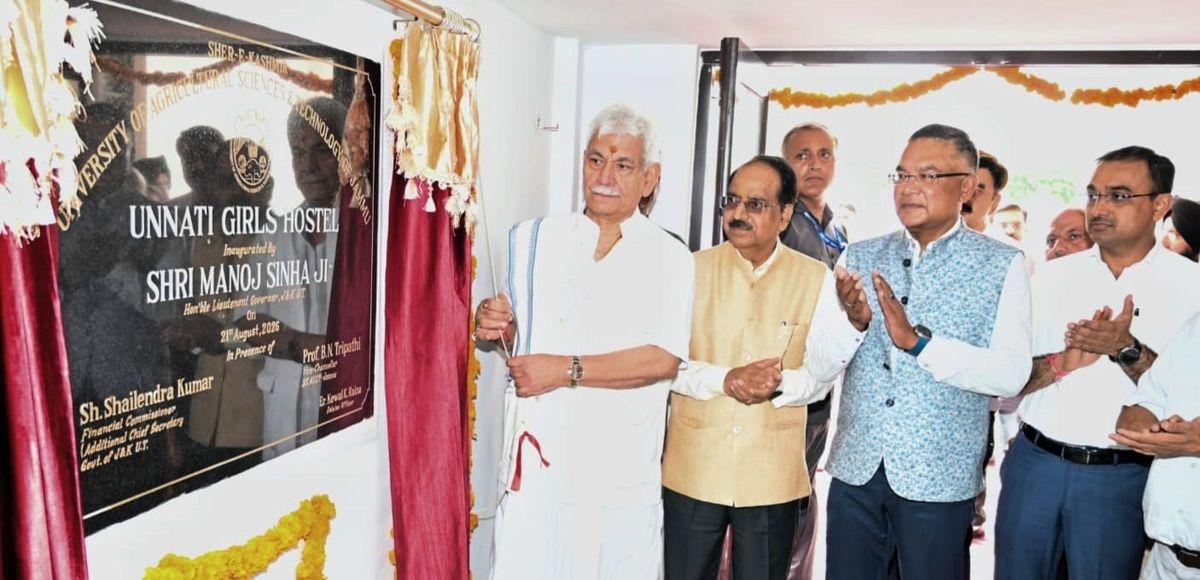
Five facilities opened at once on the SKUAST-Jammu campus at Chatha on Friday, and only one of them was a building in the ordinary sense. Alongside the Unnati Girls Hostel, Sher-e-Kashmir University of Agricultural Sciences and Technology, Jammu switched on a Centre for Artificial Intelligence and Machine Learning in Agriculture, a Centre for Mushroom Research and Innovation, an Advanced Sericulture Laboratory, and a Centre for Digital Media and Publication. Lieutenant Governor Manoj Sinha inaugurated all five, and launched a Startup Outreach Programme aimed at farmers and rural youth in the Jammu division on the same visit.
Strip away the ceremony and there are three things here that change what a young person in Jammu can actually do: a machine-learning lab sitting on an agriculture campus, a hostel that changes who can physically attend, and an incubation pipeline that has already put money and mentoring behind 56 startups.
What opened, and why each one matters
The Centre for AI and ML in Agriculture is the headline. Agriculture is one of the few fields where machine learning has obvious, unglamorous uses — yield prediction, disease detection from leaf images, irrigation scheduling, price forecasting — and until now a Jammu student wanting to work on that had to choose between a computer science department with no farms and an agriculture department with no compute. This is the first time both sit on one campus here.
The Centre for Mushroom Research and Innovation matters for a different reason. Mushroom cultivation is one of the lowest-capital agri-businesses available in the Jammu belt — it needs a room, not a field — which makes it a realistic first enterprise for someone with a small plot or none at all. A dedicated research centre is where spawn quality, yield and shelf-life problems get solved.
The Advanced Sericulture Laboratory plugs into a trade J&K has practised for generations, and the Centre for Digital Media and Publication is the university's own communication arm. The Unnati Girls Hostel is the quietest entry on the list and possibly the most consequential: for students from Kathua, Samba, Udhampur or further out, whether a hostel bed exists is frequently the difference between enrolling and not.
The startup route: 150 students in, 56 startups out
SKUAST-Jammu's incubation record was put on the record at the same event. More than 150 students have been selected for idea incubation, and 56 startups have been supported. Eight startups, farmer producer organisations and rural enterprises were felicitated on the day, and four publications were released, including policy documents on medicinal plants.
The new Startup Outreach Programme is explicitly aimed at people who have had no prior exposure to incubation, mentoring or venture capital — which, if you have ever tried to find out how any of this works from outside a university, is most people. Sinha's line to the students was that "your degree is not your destination; rather, it is like a runway for your flight of success."
It is worth being straight about what has not been announced. No funding amount attached to the outreach programme has been published, and no eligibility criteria or application window has been put out. If you want in, the route today is the university's own incubation cell at Chatha rather than a form on a website.
What JKCIP is, and why the name keeps appearing
The outreach programme runs under JKCIP — the Jammu and Kashmir Competitiveness Improvement in Agriculture and Allied Sectors Project. It is not a state scheme in the ordinary sense. It is a seven-year programme supported by the International Fund for Agricultural Development, with a total outlay reported at about US$217 million — roughly ₹1,800 crore — of which IFAD contributes US$100 million and the J&K government US$26.4 million. Around US$50.77 million is earmarked for climate action. It runs across 90 selected blocks and is meant to reach roughly 300,000 families.
Buried in JKCIP's design is a line that matters to this audience: one of its stated components is developing the agribusiness ecosystem by growing agri-enterprises and startups, with a particular focus on those led by young women entrepreneurs. That is the pipe the outreach programme is feeding, and it is worth reading alongside the fact that the same visit opened a girls' hostel.
This is also not JKCIP's first outing at SKUAST-Jammu. An earlier industry-startup outreach under the same project, inaugurated by Chief Secretary Atal Dulloo, reported that more than 120 agri startup ideas had been incubated and over 32 had received funding from the Ministry of Agriculture and Farmers' Welfare. Representatives from CSIR-IIIM Jammu, IIT Jammu, IIM Jammu, J&K Bank and the District Industries Centre Jammu were in the room — which tells you where the mentoring and the lending are meant to come from.
If you want to use any of this
Three practical notes. If you are an agriculture, biotechnology or data-science student, the AI/ML centre and the mushroom centre are new lab access points, and lab access is the thing that turns a project report into something publishable. If you have an idea rather than a degree, the incubation route at SKUAST-Jammu is the one with a track record attached — 56 startups is a real number, not a target. And if you are looking at money rather than mentoring, the university route pairs with J&K's own ₹20 lakh startup seed fund, which pays out in four instalments and does not require a degree.
SKUAST-Jammu also signed an agreement with Cluster University of Jammu earlier this month on shared student research and startup work, so the two institutions are increasingly one pipeline rather than two.
Sources: Rising Kashmir · Morning Kashmir · Greater Kashmir on the JKCIP outreach programme · IFAD project page for JKCIP

%2Fgreater-kashmir%2Fmedia%2Fmedia_files%2F2026%2F06%2F27%2Fgmc-jammu-2026-06-27-05-46-24.jpg&w=3840&q=75)