Most young founders in Jammu have heard some version of "there's government money for startups." Very few can tell you what it is called, what it pays, or the one box you have to tick before any of it becomes available to you.
It is called the Seed Fund Scheme. It runs under the J&K Startup Policy through JKEDI — the J&K Entrepreneurship Development Institute — and it pays up to ₹20 lakh per startup, released in four equal instalments of ₹5 lakh.
Here is what it actually asks of you.
Do I need a degree?
No. The scheme states plainly that there is no minimum education qualification required for founders.
That single line makes this one of the more genuinely open funding routes available here. It does not ask for an engineering degree, an MBA, or a college affiliation. It asks whether you have a startup that qualifies — which is a different question, and one you can influence.
What does it cost to apply?
Nothing. There is no application fee, and the process is entirely online with no physical submission of documents. You do not travel to an office, you do not pay an agent, and anyone asking you for money to "process" a Seed Fund application is running a scam.
What is the one thing I have to do first?
This is where most applications die before they start.
You cannot apply for the Seed Fund as a general member of the public with a good idea. Your startup must first be registered on the J&K Startup Portal and recognised by JKEDI. Recognition is the gate. Everything downstream — seed funding, and the other supports attached to the startup policy — runs through that recognition.
So the first action for a Jammu founder reading this is not to look for a Seed Fund form. It is to go to the J&K Startup Portal and get recognised. Do that now, whether or not a funding window is currently open, because when a window does open it runs for about a month and recognition is not something you want to be starting from scratch that week.
Who is ruled out?
Four conditions, and they are worth reading slowly because two of them catch people by surprise:
The startup must be registered on the J&K Startup Portal and recognised by JKEDI.
A startup can receive seed support from JKEDI only once. This is not a renewable annual grant.
An entity, or any partner holding more than a 49% stake, cannot have previously received seed funding from JKEDI. If your co-founder took JKEDI seed money for an earlier venture and holds a majority stake in this one, you are out — and people genuinely do not check this before applying.
You must not be a defaulter with JKEDI.
What can I actually spend it on?
The money arrives in two different forms, and they are not interchangeable.
The grant portion is for the early, unprovable stage: validating a proof of concept, developing a prototype, running product trials. This is the part that funds finding out whether the thing works at all.
The debt or convertible-debenture portion is for what comes after: market entry, commercialisation, scaling up. This is money against a business that has already shown something.
One hard restriction: the funds cannot be used for facility creation. This is not money to buy a building or fit out a workspace, and a proposal built around premises will not clear.
The four-instalment structure follows the same logic. You are not handed ₹20 lakh and wished well — you draw it down as you hit stages, which is also why a realistic, staged plan reads better than an ambitious flat one.
It is worth being clear-eyed about what the debt portion means, because "government funding" makes people assume the whole ₹20 lakh is a gift. It is not. The grant part you do not repay; the debt or convertible-debenture part is finance, and convertible instruments can become equity later depending on the terms you sign. Read that section of any sanction letter properly, and if you do not understand it, take it to someone who does before signing. That is ordinary diligence, not pessimism — founders who skip it are the ones who get surprised two years in.
Who decides?
Applications are screened by a Screening Committee and then approved by the Startup Task Force. JKEDI is the nodal agency throughout.
When can I apply?
This is the honest gap. The scheme does not run a permanent open window. Applications are invited through advertisement, for roughly one-month periods, and no standing annual deadline is published. An earlier cycle's window has already closed.
So there is no date to circle today, and anyone telling you there is has invented it. What you can do is get recognised on the portal now, keep an eye on JKEDI's announcements, and have your proof-of-concept documentation ready so that a one-month window is enough time rather than a scramble.
Is anyone actually getting this money?
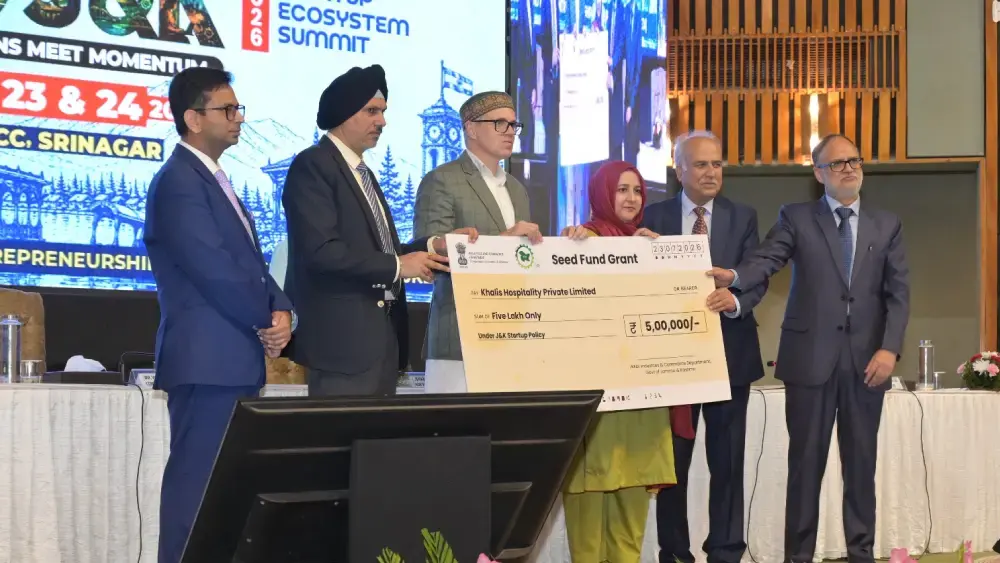
Yes, and at visible scale. At the ASCEND 2026 startup summit in July, seed fund cheques of ₹5 lakh each — the first instalment — were handed to seven startups. J&K now has somewhere in the region of 1,300 to 1,400 registered startups, up from a base that barely existed five years ago.
That number matters more than the ceremony. It means the recognition process is functioning at volume, and that the queue you would be joining is real rather than theoretical.
If you have been sitting on something — a prototype, a small trading business you want to formalise, a service you already sell informally — the cheapest possible next step is portal recognition. It costs nothing, it closes no doors, and it is the only thing standing between you and every other support the startup policy offers.
Sources: Seed Fund Scheme, J&K Startup Portal (startupjk.com); JKEDI.

%2Fgreater-kashmir%2Fmedia%2Fmedia_files%2F2026%2F06%2F27%2Fgmc-jammu-2026-06-27-05-46-24.jpg&w=3840&q=75)