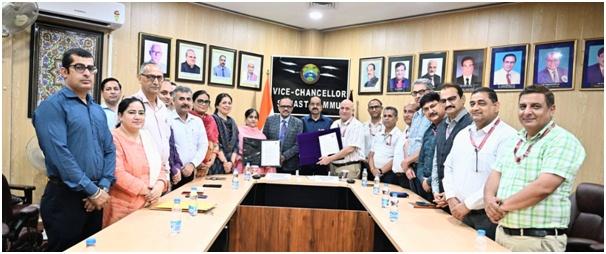
Two Jammu universities have signed an agreement that is easy to read as administrative news and harder to ignore if you are studying science, agriculture or trying to build something locally. SKUAST-Jammu and the Cluster University of Jammu (CLUJ) signed a Memorandum of Understanding at SKUAST’s Chatha campus on 20 July, setting out a framework for joint research, student and faculty exchange, capacity-building and startup support.
The agreement does not announce a new course, a funded fellowship or an application form just yet. But it joins institutions with different strengths: SKUAST-Jammu’s agriculture-led research and extension network, and CLUJ’s multidisciplinary colleges and programmes. For students, that combination could matter most when the broad promise turns into named projects, lectures, exchanges and incubator calls.
A bridge between subjects
The MoU covers Life Sciences, Biotechnology, Agricultural Engineering, Horticulture, Forestry, Veterinary Sciences, Dairy Technology, Vocational Education, Agri-Management and Entrepreneurship. That is a deliberately wide list. A biotech student, for example, could find a route into agricultural research; a management student could see more room around agri-enterprise; and vocational learners could benefit if the planned training programmes are opened beyond the two institutions’ usual silos.
SKUAST-Jammu and CLUJ have said the framework includes joint research projects, student and faculty exchange, training-of-trainers and faculty-development programmes, lectures and symposia. Those are commitments to collaborate, rather than a confirmed calendar. Students should therefore treat the announcement as a door being built, not as an admission notice.
Why the startup clause stands out
The agreement also names innovation and incubation support for startups. In Jammu, ideas around food processing, farm technology, horticulture, dairy, biotech and rural services often need both subject knowledge and a way to test or take the work beyond a classroom. The proposed collaboration could make that hand-off more practical—especially if student teams get access to mentors, research facilities or extension networks.
SKUAST-Jammu’s official release says the partnership also aims to transfer evolved technologies to farming communities through its Krishi Vigyan Kendras. That creates a useful test for any future student project: is it only a presentation, or can it solve a problem for people who would actually use it?
What to watch next
The agreement was signed by CLUJ Registrar Ankur Mahajan and SKUAST-Jammu Registrar Dr Anil Kumar. Neither institution has yet published a timetable for exchanges, joint calls or incubation opportunities. Students interested in the areas named in the MoU should watch department notices, university social channels and startup or incubation cells for the first concrete programme that follows.
Source: SKUAST-Jammu official press release.