There is a fencing hall at MA Stadium in Jammu where children turn up after school, borrow kit that has been repaired more than once, and learn to hold a sabre. It is not a glamorous room. It is, however, the room where Shreya Gupta started.
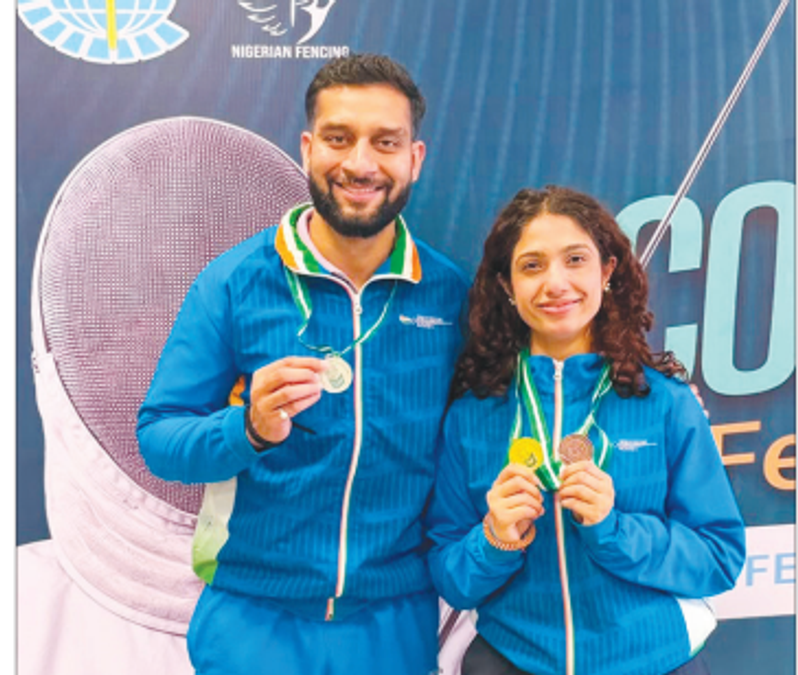
On Wednesday, in Lagos, she won a gold medal at the Senior Commonwealth Fencing Championship — the first J&K woman fencer to do so, according to reports of the result. Vishal Thapar, who came through the same Jammu setup, took silver in men's team sabre. The J&K Sports Council called the performances “a proud moment for the Union Territory.”
What actually happened in Lagos
Two Commonwealth fencing championships ran concurrently in Lagos, Nigeria, from 9 to 14 August 2026 — a Senior championship and an Under-23 championship. It is worth separating them, because Shreya medalled at both and the two results have been blurred together in some coverage.
Senior championship: Shreya Gupta won gold, with Daily Excelsior reporting she played “a key role in the Indian team's victory.” Vishal Thapar won silver in men's team sabre.
Under-23 championship: Shreya took bronze in women's individual sabre, behind Jeferlin (gold) and Aakhari (silver). India finished the U-23 event with 17 medals — four gold, four silver and nine bronze.
So: a team gold at senior level and an individual bronze at U-23, in the same week, in the same city.
The two-year climb
This is not a debut. In July 2024, at the Commonwealth Fencing Championship in Christchurch, New Zealand, Shreya won bronze in the sabre category — reported at the time as J&K's first individual international fencing medal. Two years on, the colour of the medal has changed.
Between those two results sits a domestic record most readers will not have seen: Senior and Junior National Champion titles, and 17 gold, 11 silver and seven bronze medals across national competition. She is on the Ministry of Youth Affairs and Sports' Target Olympic Podium Scheme and is a Khelo India athlete — the two funding routes that decide whether an Indian athlete in a minority sport can afford to keep going.
In July this year, we wrote about Shreya and Vishal making India's squad for the World Fencing Championships. Lagos is the next entry in the same story.
Why the MA Stadium detail matters
It would be easy to file this under “athlete does well abroad” and move on. The more useful fact for a reader in Jammu is where it began: the Sports Council Fencing Centre at MA Stadium, under coaches Shotu Lal Sharma and Ujwal Gupta.
That is a public facility in the middle of the city. It is not selective in the way an academy in Delhi or Pune is. A school student in Jammu who wants to try fencing can, in principle, walk in and find out what it involves — which is a very different proposition from reading about a medal won 7,000 kilometres away and assuming the pathway does not exist here.
Shreya now trains at the Vijay Bharat Sports Academy in Ahmedabad, which is its own honest part of the story. Jammu produced her; a bigger centre finished the job. That gap — strong grassroots coaching, thin high-performance infrastructure — is the recurring theme in almost every J&K sport story we cover, from wushu players asking for a training hall to soft tennis players commuting to nationals.
What we do not know yet
Two things are still unclear, and we would rather say so than fill them in.
First, the exact senior event Shreya's gold came in has not been specified in the reporting we have seen — the coverage refers to the Indian team's victory without naming the weapon and format, though she is a sabre fencer and Thapar's silver is explicitly men's team sabre. Second, the “first J&K woman to win Commonwealth gold” line comes from Daily Excelsior's report rather than from a federation record we have been able to check independently.
Neither changes the substance. A fencer who learned the sport at MA Stadium is a Commonwealth champion.
What sabre actually is
Fencing has three weapons, and they are not interchangeable. Foil and épée score with the point alone. Sabre scores with the edge as well as the point, and only above the waist — a legacy of cavalry swordsmanship. It is the fastest of the three: exchanges are often decided inside a second, and right-of-way rules mean the referee has to judge who attacked first as much as who landed.
Team sabre, which is where both Jammu medals came from, is fought as a relay. Three fencers a side, nine bouts, each running to a rising score target until one team reaches 45 hits. It rewards squad depth rather than one star — which is why “a key role in the Indian team's victory” is a meaningful description rather than a hedge.
What a medal like this is worth, concretely
Beyond the podium, J&K operates a cash-award scheme for medal-winning athletes — we explained how it works, and who actually gets paid, in ₹2.71 Crore to 580 Athletes. International medals sit at the top of that structure.
The more durable benefit is selection. TOPS and Khelo India funding is reviewed on results, and a Commonwealth gold in an Olympic weapon is the kind of line that keeps an athlete inside the system through the years when they are not winning anything. For a fencer from a union territory with one serious training centre, that continuity is most of the battle.
Sources
Daily Excelsior — Shreya wins Gold, Vishal silver at Commonwealth Fencing C'ship
Greater Kashmir — J&K Sports Council congratulates Shreya Gupta, Vishal Thapar
The Bridge — India wins 17 medals at U-23 Commonwealth Fencing Championships
Greater Kashmir — Shreya Gupta clinches J&K's 1st individual international fencing medal (2024)
%2Fgreater-kashmir%2Fmedia%2Fmedia_files%2F2026%2F06%2F27%2Fgmc-jammu-2026-06-27-05-46-24.jpg&w=3840&q=75)