₹2.71 crore. 580 sportspersons. Two award years cleared at once.
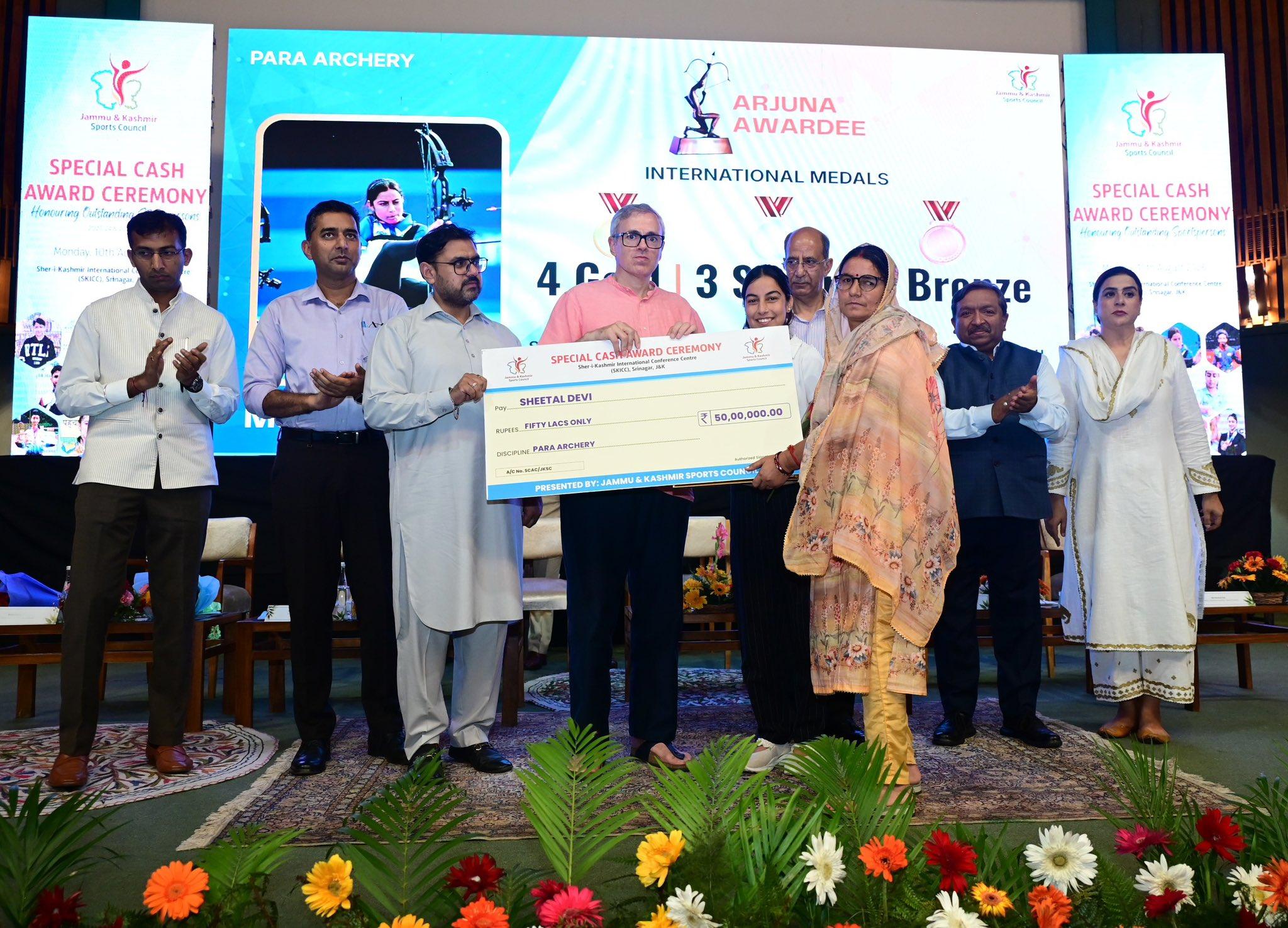
That was the arithmetic at the Special Cash Award ceremony held at the Sher-i-Kashmir International Convention Centre in Srinagar on 10 August 2026, covering performances from 2023-24 and 2024-25. Twenty-two athletes collected in person; the remaining awards went out by Direct Benefit Transfer into bank accounts.
The ceremony is the least interesting part of this. What matters to a young athlete training in Jammu is the machinery underneath it — because it is a standing scheme with a published scale and an application counter in this city, and it runs again.
What a medal is actually worth
The cash awards sit under the J&K Sports Policy 2022, which set out special cash awards in a band running from ₹1 lakh to ₹1 crore. At the top end that means ₹1 crore for an Olympic medal and ₹50 lakh for an Asian Games medal.
The competitions named in the policy are the Olympics, Asian Games, Commonwealth Games, Asian Championships (senior and junior), World Cups and World Championships, the Youth Olympic Games, the South Asian Games, and World University Games and Championships.
Below that tier, winners in recognised national competitions and the National School Games are covered by scholarships through the Directorate of Youth Services and Sports rather than by the same cash-award scale.
Who qualifies
Three conditions do most of the work:
You placed first, second or third in a national or international competition.
That competition was conducted by an authorised national or international sports body or federation — the sanctioning body is what counts, not the size of the event.
You are an eligible domicile of J&K.
Importantly, medals earned at sub-junior and junior level count, not only senior. A 16-year-old with a national junior podium is inside this scheme, which is not how most people assume government sports money works.
Where a Jammu athlete files
This is the detail that tends to be missing from the coverage. Applications go on a prescribed format available from the J&K Sports Council, and they are submitted to the Divisional Sports Officer — for this division, at the New Indoor Sports Complex, MA Stadium, Jammu. (The Kashmir division counter is at Bakshi Stadium, Srinagar.)
You submit the form with copies of the certificates or documentary proof of the medals you are claiming for. When the Sports Council last invited applications, it covered medals won between 1 April 2024 and 31 March 2025, and it stated plainly that applications received after the due date, or found incomplete, would not be entertained.
That last clause is the one that costs people money. These windows are announced, run for a few weeks, and close — and an incomplete file is treated the same as a late one.
What to do now
The window that produced this month's payout has already closed. There is no live application date announced for the next cycle at the time of writing, and we are not going to invent one. What a Jammu athlete can usefully do in the meantime is unglamorous and genuinely worth doing:
Collect your certificates now, while the organising federation still answers the phone. Reconstructing proof of a junior podium three years later is a real problem.
Check the sanctioning body. If the competition was not run by a recognised federation, no amount of paperwork fixes it.
Watch jksportscouncil.in for the next call, and the Divisional Sports Officer's office at MA Stadium for the form.
The gap the payout does not close
At the ceremony the Chief Minister flagged shortfalls in synthetic tracks, playing surfaces and indoor training facilities, particularly in mountainous and winter-affected areas, and argued for spreading support beyond cricket into disciplines including martial arts, cycling, gymnastics, skateboarding and roller sports.
That is the honest tension in a scheme like this. Prize money rewards a result that has already happened; it does not by itself produce the year-round training environment that makes the result likelier. Both things can be true, and for an athlete deciding whether to keep going, only one of them arrives after the fact.
Among those recognised were J&K's para-archers Sheetal Devi and Rakesh Kumar, both Paris Paralympics bronze medallists, and MMA fighter Owais Yaqoob, who beat an unbeaten two-time IMMAF world champion at BRAVE CF 107 in Bulgaria.
If you are earlier in that pipeline, the free coaching route is worth knowing about too — Jammu's Khel Gaon runs nine free Academies of Excellence open to anyone with the talent to get in.
Why the DBT detail matters
That 22-in-person, rest-by-transfer split is worth a second look, because it changes what an athlete has to do. Direct Benefit Transfer means the money lands in a bank account tied to your application, not handed over at an event you have to travel to. For a sub-junior from a district town whose family cannot fund a trip to Srinagar, that is the difference between an award being real and being theoretical.
It also means the bank details on your form are load-bearing. An award you qualify for can sit unpaid because of a mismatched account or an unlinked number, and that is a much more common failure than being judged ineligible.
One figure we are deliberately not printing: how many of the 580 recipients are from the Jammu division. It has not been published, and the divisional split is exactly the number that would tell readers here how well the scheme is reaching them. We will update this piece if the Sports Council releases it.
Sources
Rising Kashmir — ₹2.71 crore cash awards presented to 580 sportspersons (date, venue, totals, DBT split)
Greater Kashmir — J&K Sports Council invites applications for special cash awards (eligibility, submission counters, documentary requirements)
Greater Kashmir — Administrative Council approves J&K Sports Policy 2022 (award band and competition list)