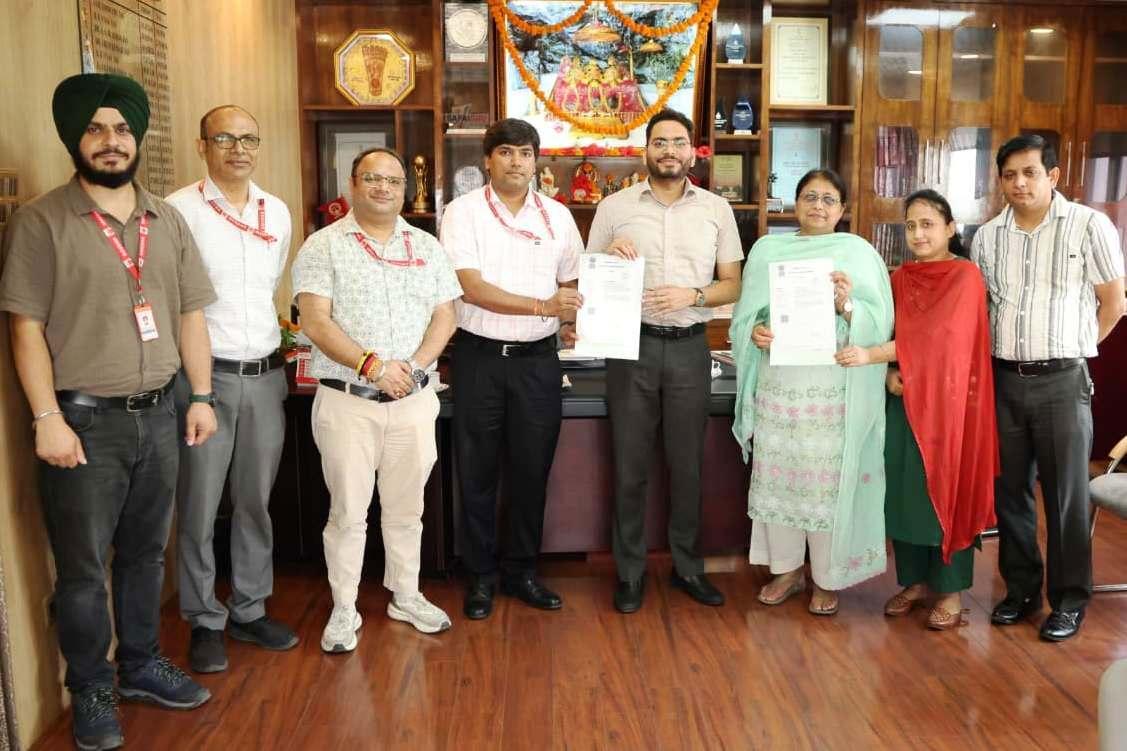
₹15 crore. That's the annual procurement the Shri Mata Vaishno Devi Shrine Board (SMVDSB) now expects to route through women's self-help groups (SHGs) once a new MoU with the Jammu & Kashmir Rural Livelihoods Mission (JKRLM) is fully rolled out — up from roughly ₹3.5 crore last financial year. The agreement was signed on August 13, 2026, and it turns one of J&K's biggest year-round buyers, the shrine that feeds Katra's pilgrim economy, into a guaranteed customer for rural women's enterprises.
What the MoU actually does
SMVDSB runs the daily business of the Vaishno Devi shrine — including buying the Puja Samagri and Prasad items sold and distributed to pilgrims. JKRLM (locally known as UMEED) is the state agency that organises rural women into SHGs under the Centre's Deendayal Antyodaya Yojana-National Rural Livelihoods Mission (DAY-NRLM). The MoU formalises a supply pipeline between the two: JKRLM identifies and recommends eligible SHGs and takes on their capacity-building, skill development, financial literacy and digital-payment training, while also exploring working-capital support so groups can fulfil larger shrine orders. SMVDSB, in turn, commits to sourcing more of its Puja Samagri and Prasad supply from these groups, with the product range explicitly open to expansion "as per requirements." Eco-friendly packaging, biodegradable materials and food-safety compliance are built into the deal as conditions on the SHG side.
Who's covered right now
Groups: around 13 SHGs already supply the shrine board
Women: an estimated 450–500 across those groups
Last year's business: about ₹3.5 crore in Puja Samagri and Prasad procurement
Projected after the MoU: around ₹15 crore a year
Region: the Katra-Reasi belt and adjoining districts
Why this matters beyond Katra
For young Jammu residents, the interesting part isn't the ceremony — it's the model. A predictable, high-volume buyer like the shrine board is exactly the kind of guaranteed market that most rural micro-enterprises never get, and the MoU explicitly frames this as pilgrim-economy demand being converted into household income for women running these groups, many of whom bring in daughters, daughters-in-law and other younger family members as their enterprises scale. It also sits inside a wider push in J&K to connect SHGs to real buyers rather than just training them: JKRLM's broader mandate covers roughly 96,637 women's SHGs across 125 blocks of the Union Territory under DAY-NRLM, and this is a rural counterpart to the kind of market-access work JammuBeat has already covered on the urban side — see Inside JK Karigari, the state's online marketplace for artisans, which runs under a separate urban livelihoods scheme. It also complements Mission YUVA's explicit emphasis on first-generation entrepreneurs and women linked to SHGs, detailed in JammuBeat's plain-English guide to Mission YUVA.
What's next
Neither side has published a rollout timeline or a list of which new SHGs will be onboarded first. The immediate next steps described in the agreement are administrative: JKRLM screening and recommending additional eligible groups, and the shrine board working those groups into its procurement cycle for Puja Samagri and Prasad. Given the product range is explicitly open-ended, further categories — beyond the current puja items — are plausible if this first phase goes well, though nothing beyond "as per requirements" has been announced.
Sources: ThePrint, Daily Excelsior, The Earth News.
%2Fgreater-kashmir%2Fmedia%2Fmedia_files%2F2026%2F06%2F27%2Fgmc-jammu-2026-06-27-05-46-24.jpg&w=3840&q=75)