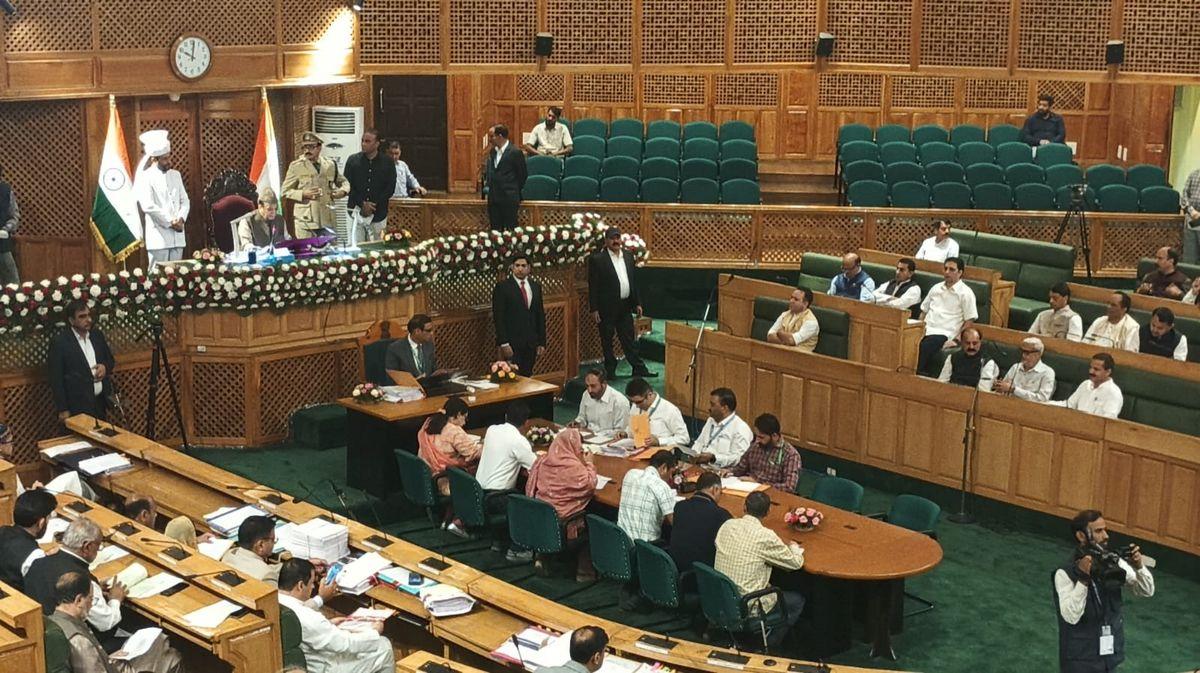
7,580. That is how many selections Jammu and Kashmir's two recruiting agencies have finalised since October 2024, according to a written reply the government placed before the Legislative Assembly on 21 September 2026 during the Autumn Session's Question Hour.
It is a more useful number than it first looks. A day earlier the same session had produced the figure that made headlines — 40,672 government posts lying vacant across departments. That told you where the gaps are. This one tells you something different and, if you are sitting an exam, more practical: how many of those gaps actually converted into a selection letter, and how the posts were split before anyone sat a paper.
Where the 7,580 came from
The reply, answering a question from Handwara MLA Sajad Gani Lone, splits the total between the two agencies:
J&K Services Selection Board (JKSSB) — 5,812 selections finalised
J&K Public Service Commission (JKPSC) — 1,768 selections finalised
JKSSB, which handles the non-gazetted and Class-IV end of the government, accounts for roughly three of every four selections. That matches the shape of the vacancy data: the bulk of J&K's unfilled posts are non-gazetted, and JKSSB is the body that fills them.
The number underneath it: 14,270 posts referred
Selections are only half the arithmetic. Over the same period, departments referred 14,270 vacancies to the two agencies:
To JKSSB — 12,418 posts
To JKPSC — 1,852 posts
Set the two figures side by side and you get the conversion rate that actually governs your odds: 14,270 posts went into the pipeline, 7,580 selections came out the other end as finalised. The gap is not lost posts — a referral becomes an advertisement, then an exam, then a result, and the stages take time, so a post referred in 2025 may still be mid-process. But it is a fair measure of how much of the pipeline has cleared and how much is still moving.
How the referrals break down by category
This is the part worth reading closely, because the reply gives the category-wise split of the posts referred — not of the selections made. For the 12,418 posts sent to JKSSB:
Open Merit — 5,173
Scheduled Tribe-1 — 1,248
Scheduled Tribe-2 — 1,212
Reserved Backward Area (RBA) — 1,174
Scheduled Caste — 1,104
Economically Weaker Section (EWS) — 1,079
Other Backward Classes — 933
Actual Line of Control / International Border (ALC/IB) — 495
And for the 1,852 posts sent to JKPSC: Open Merit 855, Scheduled Caste 198, ST-1 166, ST-2 156, RBA 149, EWS 139, OBC 114, ALC/IB 65, plus 4 under the Physically/Special-category quota and 6 ST backlog posts.
Open Merit is a little over 41% of the JKSSB referrals and about 46% of the JKPSC ones. If you have been preparing on the assumption that reserved categories take most of the board, the published split says otherwise — Open Merit is the single largest block at both agencies, and the reserved categories are each in the hundreds or low thousands rather than dominating.
899 genuinely new posts, and where they went
A referral moves an existing sanctioned post into a recruitment cycle. Creating a post is a separate act, and the government told the Assembly that 899 new posts have been created across departments since 16 October 2024:
Health and Medical Education — 485
Housing and Urban Development — 266
Law, Justice and Parliamentary Affairs — 82
Jal Shakti — 43
Disaster Management — 16
Cooperatives — 3
Food and Civil Supplies — 2
ARI and Trainings — 1
Transport — 1
Health takes more than half. That is consistent across every recruitment dataset J&K has published this year — Health and Medical Education also carried the largest share of the 40,672 vacant posts, and it was Health that accounted for 421 of the 518 posts in JKSSB's August advertisement.
How a post even gets to an exam
The reply also names the machinery, which is worth knowing because it explains the lag. Referrals are governed by SRO-166 of 2005 and Circular No. 01-JK(GAD) of 2024: a department identifies a vacant sanctioned post, then refers it to whichever agency is competent to fill it. Nothing can be advertised before that referral happens.
The measures the government listed for speeding this up are procedural rather than dramatic — timely identification and referral of posts, advance planning of recruitment cycles, monitoring of recruitment timelines, and closer coordination with the recruiting agencies. In other words, the bottleneck it is claiming to fix is the paperwork ahead of the advertisement, not the exam itself.
One related thread for anyone on a casual or contractual engagement: a committee constituted on 19 March 2025 is examining the regularisation of casual, seasonal, contractual and need-based workers. The reply does not say when it reports.
What to actually do with this
Three things, if a government job is the plan:
Follow the referral, not the rumour. A post has to be referred before it can be advertised. Departments with large referral counts are where the next adverts come from, and Health remains the biggest single source by a wide margin.
Read your own category honestly. The splits above are published per agency. Work out how many posts in your category were actually referred before deciding a cut-off is unreachable.
Keep the live windows in view. JKSSB's Advertisement 09 of 2026, with 2,863 Class-IV and sanitation posts, is the current large-volume opening, and JKPSC's Assistant Professor cycle is the graduate-and-above route.
One caution on reading these numbers elsewhere: several figures for J&K recruitment have circulated this week on different baselines and definitions — “selections finalised” is not the same as “posts filled,” and the periods do not always match. The figures above are all from the replies tabled on 21 September 2026 and are internally consistent with each other; we have not mixed them with counts drawn from a different question or a different start date.
Sources: Kashmir Dot Com — JKPSC/JKSSB finalise 7,580 selections; Greater Kashmir — 899 new posts created in J&K since Oct 2024; Rising Kashmir — JKPSC, JKSSB finalize 7,580 selections; Greater Kashmir — 40,672 posts vacant, department-wise table.