Here is a test you can run at your next family function. Listen to how your grandparents talk to each other. Then listen to how your parents talk to them. Then listen to how your parents talk to you.
In a lot of Jammu families, the language changes somewhere in that third step. Grandparents speak Dogri naturally. Their adult children understand it and use it with elders. But when those adults turn to their own children, they switch — often deliberately — to Hindi or English. The child understands Dogri, laughs at a joke in it, knows exactly what tone means trouble, and cannot hold a five-minute conversation, read a page, or write a sentence.
That break is the whole story. A language can stay loud as an identity and go quiet as an inheritance at the same time.
So the question is not whether Dogri disappears tomorrow. It won't. The 2011 Census of India counted roughly 2.6 million Dogri speakers nationally, and institutions still fund Dogri literature, teaching and broadcasting. The sharper question is whether Dogri is becoming a language Jammu celebrates more often than it uses — and whether any amount of official recognition can substitute for the ordinary business of one generation handing it to the next.
This piece is not a lament. It is an attempt to lay out what is actually happening, what the evidence does and does not show, and what would genuinely have to change.
First, the three words: Dogri, Dogra, Duggar
They overlap, and they get used interchangeably, and they are not the same thing.
Dogri is a language. Dogra describes a people and a regional-cultural identity. Duggar is the historical-cultural region attached to that identity — centred on the Jammu hills and plains, but spilling past any modern administrative line you can draw.
Even those definitions come with an argument attached. Nobody has settled where the word Duggar comes from. Different writers have traced it to Durgara, a name in an early medieval inscription; to durg, a fort; to dungar, a hill word; or to Dwigarta, read by some as the land between two lakes or depressions. Linguists and historians have not agreed on one.
That is not a hole in the history. It is what regional identities normally look like up close — assembled slowly out of geography, political rule, language, migration and shared memory, rather than founded on a single tidy date.
One of the earliest literary mentions people cite is Amir Khusrau's Nuh Sipihr of 1317, where Duger appears among the languages of the subcontinent. By the nineteenth century the colonial linguist George Grierson had documented Dogri in the Linguistic Survey of India — though where exactly Dogri ends and Punjabi or the Western Pahari languages begin was contested then and still needs care now.
Modern linguistics puts Dogri in the Indo-Aryan branch of the Indo-European family, usually within the Western Pahari group. Like every modern Indo-Aryan language, it did not "start" on a particular morning. It grew over centuries through older and Middle Indo-Aryan stages, with scholars often pointing to an affinity with Shauraseni Prakrit and its descendants, absorbing vocabulary along the way from Sanskrit, Persian, Punjabi, Urdu, Hindi and — lately — English.
Which is worth saying plainly, because the lazy version gets repeated a lot: Dogri is not Hindi with a Jammu accent, and it is not Punjabi with the edges filed off. It has its own grammar, its own literary history and its own sound system. Its most distinctive feature is tone — a change in pitch can change meaning, something it shares with Punjabi and some neighbouring Western Pahari languages. And it shifts as you move, plains to hills, the way living languages do.
One more thing worth getting right. Dogra identity is not one religion, one caste or one political story. Duggar has been shaped by Hindu, Muslim and Sikh communities and by several language groups at once. Dogri sits at the centre of Dogra cultural history, but Jammu's actual linguistic map is wider than that: Gojri, Punjabi, Pahari varieties, Kashmiri, Bhaderwahi, Sarazi, Pogli, Urdu and Hindi all live here too. Protecting Dogri should not mean flattening any of them.
Before it had books, Dogri lived by being performed
For most of its history, Dogri's richest archive was not a library. It was people.
Songs marked births, marriages, harvests, separation and going away to serve. Ballads carried folk figures like Bawa Jitto and Mian Dido. Proverbs compressed a whole district's experience into one line you could not argue with. Karkan, baaran, suhag, ghorian, devotional compositions, seasonal songs, oral narrative — all of it moved by performance, not print.
That matters, because a language's literary history is not measured from the date of its first printed book. Oral literature can be formally complex and culturally durable even while political power, literacy and printing all run in somebody else's language.
Dogri did build a written tradition too. A 2024 study on the history of translation in Dogri, published by the University of Jammu, traces an early printed milestone to Dharam Pustak, a Dogri translation of the New Testament brought out by the Serampore missionaries in 1818. Under Maharaja Ranbir Singh, translation and printing picked up state patronage — and a Dogri translation of Bhaskaracharya's mathematical treatise Lilavati was printed in Jammu in the early 1870s. That last one is the detail worth holding onto: Dogri was not only for folklore and devotion. It was used to carry maths.
So the arc is not "oral dialect becomes modern language." It is a mature spoken culture that kept gaining and losing access to the institutions of writing, administration and education.
The script Dogri lost, and the one it adopted
Nowhere is that push and pull clearer than in what happened to Dogri's script.
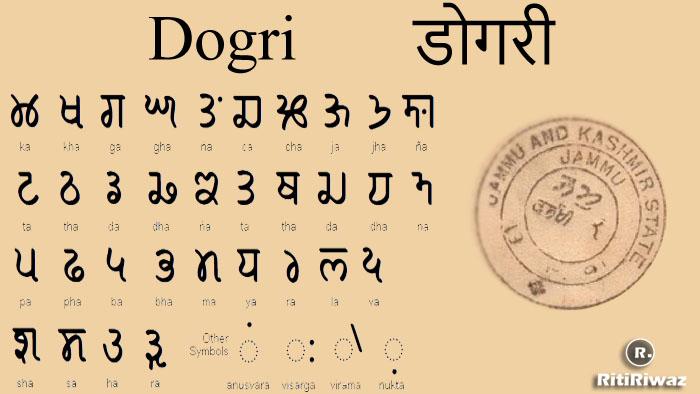
Variants of Takri were used across the western Himalayas. In Jammu, a standardised form tied to the Dogra administration became known as Dogra Akkhar, or Name Dogra Akkhar. Under Maharaja Ranbir Singh it was used in administration and printing alongside other scripts and languages. What survives includes books, revenue and legal papers, postal and fiscal items, and multilingual state documents.
The most detailed technical account you can actually read is Anshuman Pandey's proposal to encode the Dogra script in Unicode, which reproduces historical specimens — pages of the Dogri Lilavati, stamps, official documents — and works through how the older and newer Dogra letterforms relate.
Then it receded, as Urdu took over the princely state's administration and education. In the modern literary movement, Devanagari became the main script for Dogri in India. Across parts of Pakistan and Pakistan-administered territory, related speech is more often written in Perso-Arabic.
Devanagari made printing and teaching far easier — the fonts, the presses and the readers already existed. It also opened a gap that has never closed: most Dogri speakers alive today cannot read the script that was once specifically theirs.
Reviving it is not a technology problem any more. Dogra Akkhar was added to the Unicode Standard in June 2018, in version 11.0, as a block of 60 characters — which is the foundation for fonts, keyboards, digital archives and searchable text. But Unicode inclusion is plumbing, not revival. A script lives when people have reasons and chances to use it.
That leaves a real choice, and it is worth making deliberately. Making Dogra Akkhar compulsory for basic Dogri literacy would hand new learners a second barrier at exactly the wrong moment. Treating it purely as decoration empties it out. The workable middle is Devanagari as the everyday literacy script, with Dogra Akkhar taught as a heritage script and used for archives, art and specialist work.
How a modern literary language got built, starting in 1944
The turning point has a date. In 1944, Ram Nath Shastri and a group of writers — Dinu Bhai Pant, Bhagwat Prasad Sathe, Sansar Chand Baru, D.C. Prashant, N.D. Misra — formed Dogri Sanstha.
They were up against two problems that fed each other. Dogri had very little modern published literature. And plenty of Dogras had absorbed the idea that their mother tongue was not fit for serious writing or formal life.
The answer was not slogans. It was output. Poetry, plays, short stories, novels, criticism, translations, dictionaries. Folk literature collected, performances organised, material prepared for formal language examinations. Dinu Bhai Pant's Guttalun proved a Dogri publication could find a mass audience. Ram Nath Shastri's work on folk heroes and theatre stitched modern literature to regional memory. The journal Nami Chetna gave new writing somewhere to land.
The Dogri writer Lalit Magotra has described how Dogri Sanstha treated publishing, education, performance and plain cultural self-respect as one movement rather than four. Academic surveys agree on the timing: the 1940s are when the modern Dogri canon expanded fast.
The national breakthrough came on 2 August 1969, when the Sahitya Akademi's General Council recognised Dogri as an independent modern literary language of India. That made Dogri eligible for the Akademi's awards and translation networks, and pulled writers like Narendra Khajuria, Ram Nath Shastri, Padma Sachdev, Ved Rahi and Jitendra Udhampuri into a wider Indian literary conversation.
Padma Sachdev mattered for a specific reason: her work showed Dogri could be intimate, modern and legible nationally without stopping being rooted in Jammu. The Sahitya Akademi describes her as the first modern woman poet of Dogri, and her poetry and translations carried the language outward while keeping women's experience at the centre of it.
By the end of the century, nobody could seriously ask whether Dogri had literature. The open question was whether literary achievement would convert into durable public use.
Three recognitions — and what recognition cannot do
Dogri's institutional climb has three markers.
1969: Sahitya Akademi recognition. Dogri established as an independent modern literary language, plugged into national publishing, translation and awards.
2003: the Eighth Schedule. The Constitution (Ninety-second Amendment) added Dogri, Bodo, Maithili and Santali to the Eighth Schedule, taking India's scheduled languages from 18 to 22. The Lok Sabha passed it on 22 December 2003 and the Rajya Sabha the next day; the President assented on 7 January 2004. Jammu marks 22 December as Dogri Manyata Diwas every year — you will have seen the programmes at SMVDU, Cluster University and GCW Udhampur.
2020: official language of Jammu and Kashmir. The Jammu and Kashmir Official Languages Act, 2020 named Dogri, Kashmiri, Urdu, Hindi and English as official languages of the Union Territory, and authorised steps to strengthen institutional support for regional languages.
Every one of those mattered. Recognition moves legitimacy, examinations, publishing, translation, state funding and public confidence. It killed off the old habit of dismissing Dogri as a household dialect and nothing more.
And not one of them decides which language a parent uses with a four-year-old.
That is the contradiction at the centre of this. Dogri won the legal argument and stayed weak in the places where a language actually lives. Parliament can put a language in a Schedule. It cannot put it into a child's vocabulary unless homes, schools, media and public life are all pulling the same way.
What the numbers say, and what they can't
The last full official count is still the 2011 Census. Its national tables recorded 2,596,767 speakers under Dogri — about 0.21 per cent of India's population. Within the erstwhile State of Jammu and Kashmir, roughly 2.5 million people returned Dogri as their mother tongue.
The absolute number had risen across earlier censuses. Its share of the former State's population had not: down from roughly 24 per cent in 1971 and 1981 to about 22 per cent in 2001 and 20 per cent in 2011.
Those percentages are worth looking at, and they are not proof of abandonment. Census categories and the grouping of mother tongues changed between rounds. Migration changed the population. Plenty of people write "Hindi" on a form while speaking Dogri at home. A census answer captures identity and classification at least as much as it captures competence.
The opposite mistake is just as easy. A big speaker count does not mean a healthy language. You can be counted as a Dogri speaker and still never read it, never write it, and never pass it on.
A widely discussed 2025 report in The Hindu put numbers to what a lot of families already sense. Drawing on a survey of 130 respondents across 20 locations, it described a sharp generational and rural–urban split: respondents over 60 fully fluent in speech with moderate reading and writing; the 21–40 group at close to zero Dogri literacy; under-20s with effectively no reading or writing at all. On writing, 15 per cent of rural respondents versus about 4 per cent of urban ones. Some 43 per cent saw little career or economic relevance in the language, and 48 per cent thought government support had fallen short.
Read that carefully, because the sample is small. One hundred and thirty respondents cannot stand in for the whole Jammu region, and no honest reading treats those percentages as a regional estimate. What the survey is genuinely good for is pointing: it identifies exactly the questions a proper, representative language-use survey should now test across districts, ages, school types, gender, and rural and urban populations.
The honest conclusion is narrower than "Dogri is dying" — and more uncomfortable than "Dogri is fine." Dogri remains widely spoken and institutionally well-developed. There is also credible evidence of domain loss: falling use among children and young adults, low literacy, thin presence in education and administration, and a steady drift to Hindi and English wherever ambition is involved.
Why families stop speaking a language they say they love
Almost nobody drops a language out of dislike. Mostly, parents make a choice they believe will help their child.
Hindi and English read as investments
English is attached to higher education, private-sector work and getting out. Hindi runs mass entertainment and most interregional conversation. So parents speak those at home to give the child a head start at school and, later, at work.
Individually, that is a rational call. Collectively, it pushes Dogri into a corner: elders, jokes, affection, anger, songs, ceremonies. And once children stop using it with siblings and friends, the language loses the places where new vocabulary, slang and jokes are actually made.
It does not have to be a trade. A child can pick up Dogri at home and still learn Hindi and English properly at school. The damage comes from treating multilingualism as replacement rather than addition.
Schooling arrives before Dogri literacy does
For decades Dogri had a thin and uneven place in school education — available as a subject sometimes, usually late, and not built in consistently from the primary years across government and private schools in Dogri-speaking areas.
The mismatch does real damage. A child hears Dogri at home but learns to read and write only in Hindi or English. Dogri then registers as a spoken code with no serious written world behind it. By the time it turns up as an elective, it already looks academically marginal.
This is the part that is genuinely moving right now, and it is worth knowing if you have a younger sibling in school. CBSE's circular Acad-49/2026, issued on 10 July 2026, sets out guidelines for implementing the three-language scheme from the 2026-27 session. Every Class IX student in 2026-27 studies three languages, and at least two must be Bhartiya Bhashas. The third language (R3) is assessed internally by the school — there is no CBSE board exam for it — but it does have to be cleared in the school-based assessment in Class X to get the Secondary School Examination Pass Certificate. Students already in Class X in 2026-27 are unaffected and continue on two languages. In a March 2026 answer in Parliament, the Ministry of Education had already confirmed that CBSE schools are free to offer Dogri in Classes I–VIII, with Dogri offered in Class IX from 2026-27 and extended upward in later years.
On paper, that is the biggest structural opening Dogri has had in school education in decades — Dogri as the obvious third language for the Jammu province, in the school system a large share of the city's middle class actually uses.
On the ground it is patchier. Reporting from Jammu this year describes textbooks for Class VI still under development, some schools yet to start a third language at all, and parents saying their children were told Dogri was not on offer in Class IX. "Available" is not "chosen," and "chosen" is not "well taught." Schools need teachers, timetable slots, books and parents asking for it. Without those four, Dogri stays an option that exists in a circular.
Official language, unofficial reality
The 2020 Act gives Dogri formal status. Walk into an office and you will still mostly meet Hindi, Urdu and English — on forms, on websites, in recruitment, on notices, in court-related work, in official correspondence.
That gap does its own damage. If a language is called official but almost never helps you get a service, apply for a job or understand a notice, young speakers draw the obvious conclusion about what the title is worth.
The city thins out the network
In a village or a tight neighbourhood, Dogri gets reinforced constantly — relatives, neighbours, shopkeepers, ritual life. Urban mobility mixes speech communities and rewards whatever language everyone shares. Move out of Jammu entirely and the daily network gets thinner still; a kid in Delhi, Bengaluru, Mumbai or abroad may only hear Dogri on video calls with grandparents.
The language does not vanish. It contracts — from the street to the house, from the house to conversations with elders, and finally from speech to recognising a few familiar phrases.
The prestige problem lives in the accent
Most young speakers have run into the idea that Dogri sounds rural, or rough, or less educated than standard Hindi or English. Those judgments are social, not linguistic. Every language has grammar. Every accent has a history. But stigma changes behaviour long before anyone notices it is doing so.
When a parent corrects a child's Dogri-inflected Hindi with a flicker of embarrassment, the lesson the child takes home is rarely better Hindi. It is that sounding local is something to manage.
The phone doesn't speak it well enough
You do not experience language mainly through textbooks. You experience it through search, memes, music, subtitles, games, keyboards, voice assistants and messaging.
Dogri is on the internet — the music and creator video scene is genuinely alive — but it lacks the scale of searchable text, good subtitling, audiobooks, reference material, standard digital terminology and language technology that bigger languages have. Dogra Akkhar has Unicode support and almost no everyday fonts or input tools. Dogri in Devanagari types easily enough, but the corpora, speech datasets and learning products are thin.
A language missing from a phone does not die of it. But for a generation whose social life, entertainment and information all route through that phone, the absence quietly decides what counts as contemporary.
Where Dogri is not merely surviving
None of which means the picture is uniformly bleak. It isn't.
Dogri stays strong in many rural and semi-urban households across Jammu, Samba, Kathua, Udhampur and parts of Reasi, though fluency and use vary a lot. It still carries humour, intimacy and turns of phrase that speakers find genuinely hard to reproduce in another language.
Music is its strongest bridge to anyone under 30. Folk repertoires now sit alongside studio-produced songs on YouTube, Spotify and short-video platforms. Quality varies, as it does in every music industry anywhere. The point is that Dogri is being used to make current popular culture, not just archived as heritage — something you can hear for yourself at the city's Dogri folk evenings, or at a Dogri mushaira at Abhinav Theatre.
Radio still gives it a daily public voice. All India Radio's Jammu service carries Dogri news and programming; the News on AIR archive shows multiple Dogri bulletins on an ordinary broadcast day. That continuity counts, especially for listeners that text-heavy digital media never reaches.
New writers keep arriving. The Sahitya Akademi's Yuva Puraskar list records recent Dogri winners in poetry, drama and short fiction. The University of Jammu's Department of Dogri runs postgraduate teaching and research in language, literature, culture and folklore — a real academic route, if you want one. Dogri Sanstha is still publishing.
The heritage script has a digital floor under it. With Dogra Akkhar in Unicode, historical material can in principle be transcribed, indexed, taught and exchanged as text rather than as photographs of pages.
And individual schools have shown demand can be manufactured. In May 2026, Dogri Sanstha felicitated Vivek Chauhan, principal of Oriental Academy, Jammu, for introducing Dogri as a subject at the primary level. Around 400 students in the school are now studying it, and the Sanstha announced annual awards for the highest scorers in Dogri in Classes I to V. One school is not a regional revival. It is a proof of concept, and a fairly loud one: young learners engage when a school gives the language time, a teacher and status.
These are small packets of life. The work is joining them up — so a song leads to literacy, literacy leads to reading, education leads to public use, and public use makes a parent confident enough to speak Dogri to a child.
What would a serious revival actually require?
Celebration days, cultural evenings and bilingual signboards create visibility. They are not a language policy. A revival that worked would need movement on several fronts at once.
1. Restart transmission at home
The single most important intervention costs nothing: adults who know Dogri speaking it consistently with children.
That does not mean banning Hindi or English. It means giving Dogri a stable domain and holding it — conversation with parents and grandparents, bedtime stories, meals, calls with relatives — while the child picks up everything else elsewhere.
Parents also deserve reassurance that early multilingualism is not an academic handicap. UNESCO's 2025 State of the Education Report for India, titled Bhasha Matters and launched in December 2025, makes an evidence-based case for mother-tongue-based multilingual education and for learning rooted in languages children actually understand. Dogri is an additional cognitive and cultural resource. It is not competing with English for a fixed slot.
2. Start in primary school, not as a late elective
Dogri should be available — and genuinely taught — from the early grades in Dogri-speaking areas, across government, private and CBSE schools. Nobody needs every school converted to Dogri-medium. A realistic model looks like:
oral Dogri and local stories in the first years;
graded reading and writing in Devanagari;
songs, theatre, games and projects, not only rote grammar;
an introduction to Dogra Akkhar as heritage literacy;
locally relevant science, environment and history material in Dogri;
explicit bridges between Dogri, Hindi and English vocabulary;
trained teachers and credible assessment — without turning the subject into one more source of exam anxiety.
The new CBSE space for Dogri only matters if Jammu's schools opt in and parents ask for it. That second part is not somebody else's job.
3. Turn "official" into a measurable service standard
The administration should publish an annual Dogri implementation report, tracking:
the proportion of essential citizen forms available in Dogri;
Dogri pages and services on government websites;
public notices issued in Dogri-speaking districts;
interpretation and translation capacity;
staff trained to take basic applications or grievances in Dogri;
budgets and outputs of language institutions;
use of Dogri in the Legislative Assembly and local bodies.
The aim is not to displace the other official languages. It is to give Dogri visible, functional value in the places where the law already says it has standing.
4. Fund culture that people under 30 actually consume
A language does not survive on commemorative poetry recitals attended by the people who already care. Public and philanthropic money should back competitive grants for Dogri podcasts, animation, documentary, comedy, children's programming, web series, audiobooks, comics, games and music.
And it should be tied to distribution and audience, not just production. Every funded video carries Dogri and English or Hindi subtitles. Every song publishes accurate lyrics. Schools and libraries get legal access to the results.
5. Build an open digital language commons
Universities, CIIL, broadcasters, publishers and technology companies could jointly build:
a large, copyright-cleared Dogri text corpus;
transcribed, annotated speech from different districts and age groups;
open dictionaries and terminology banks;
good Devanagari and Dogra Akkhar fonts and keyboards;
optical character recognition for older printed works;
speech-to-text and text-to-speech datasets;
spell-check, transliteration and subtitling tools;
digitised, searchable runs of the major Dogri journals and out-of-print books.
That is preservation infrastructure. It is also economic infrastructure. Without datasets, Dogri stays badly represented in the AI systems, voice interfaces and translation products that increasingly stand between people and information.
6. Give Dogri some economic value
No language should have to justify itself with a salary slip. But language choices do respond to incentives, and pretending otherwise has not worked.
Dogri competence should count where it improves the service: primary teaching, local broadcasting, tourism, museums, cultural institutions, translation, community health, rural outreach, archives, district-level citizen services. Fellowships for young translators, editors, lexicographers, subtitlers and digital creators would turn language skill into professional experience.
It would also answer the thing young people in Jammu say most often about Dogri — that it offers affection and identity, and no pathway.
7. Measure language use properly
Jammu needs a representative language-vitality survey, repeated at intervals, measuring more than self-declared mother tongue:
what language adults use with parents, partners and children;
speaking, comprehension, reading and writing, counted separately;
use at school, at work, in markets, at worship and online;
attitudes to accent and status;
differences by district, class, gender, age and rural or urban location;
what young people would genuinely watch, read or listen to in Dogri.
UNESCO's language-vitality framework is clear that no single measure — speaker numbers included — is enough on its own. Intergenerational transmission, use across domains, educational materials, response to new media and institutional policy have to be read together.
Without a baseline, every argument about Dogri will keep swinging between unsupported panic and unsupported reassurance.
So — can it survive?
Yes. Not through recognition alone.
Dogri is not a relic. A language with millions of speakers, a university department, daily radio, new authors and young artists making current music has serious resources to work with. Its position is far stronger than that of many smaller languages that have already lost their child speakers and their institutional cover.
But numbers and awards can hide a break in transmission. If one generation understands Dogri and does not speak it to its children, the next inherits the symbols without the fluency: a few songs, some wedding phrases, an accent, a signboard, and the knowledge that this used to be the language of the house.
The real choice was never Dogri versus English, or roots versus ambition. It is whether Jammu can build the additive kind of multilingualism where a 22-year-old can speak Dogri without flinching, study Hindi and English without fear, read the region's literature, use a public service in it, and make something new in it.
Dogri's last revival started in 1944, when a small group of writers refused to accept that their language was unfit for modern literature. The next one starts when families, schools, creators and institutions refuse to accept that it is unfit for modern life.
Dogri at a glance
Language family: Indo-European → Indo-Iranian → Indo-Aryan; usually classified within Western Pahari
Core region: Jammu, Samba, Kathua, Udhampur and parts of Reasi, with speakers elsewhere in J&K, Himachal Pradesh, Punjab and across the border
Distinctive feature: a tonal language — pitch contributes to meaning
Main present-day script in India: Devanagari
Historical regional script: Dogra Akkhar, from the Takri tradition; encoded in Unicode 11.0 in June 2018
Speakers recorded in Census 2011: 2,596,767 nationally under Dogri
Sahitya Akademi recognition: 2 August 1969
Eighth Schedule inclusion: 2003 (Constitution 92nd Amendment; marked in Jammu on 22 December)
Official language of J&K: since 2020, alongside Kashmiri, Urdu, Hindi and English
What this piece is still waiting on
A few things we could not pin down, and are saying so rather than papering over:
The census fine print. The 2011 C-16 tables distinguish the national "Dogri" language total from the "Dogri" mother-tongue subtotal used for J&K. The figures above follow the published national tables; the underlying spreadsheet is worth reading before anyone quotes them in a policy argument.
The 2025 survey's method. Its questionnaire, age bands, raw tables and sampling details have not been published. Until they are, its percentages should be read as a signal, not a measurement.
How many schools actually teach Dogri. There is no public count of government, private and CBSE schools teaching it, as opposed to being permitted to offer it. That number would settle a lot of this argument on its own.
Implementation of the 2020 Act. Forms, websites, translation staff and district-level use have never been reported publicly.
If you teach Dogri, study it, write in it or are trying to raise a child in it, we would like to hear how it is actually going. That is the reporting this piece could not do on its own.
For more on how the last seven years reshaped the institutions in this story, see our explainer on what actually changed for young Jammu after Article 370.
Sources: Census of India 2011, language tables; Jammu and Kashmir Official Languages Act, 2020 (India Code); CBSE Circular Acad-49/2026, "Guidelines for Implementation of Three-Language Scheme from academic Session 2026-27 onwards", 10 July 2026; Ministry of Education, Lok Sabha answer on Dogri in CBSE schools (March 2026); Anshuman Pandey, "Proposal to Encode the Dogra Script in Unicode" (L2/15-234); University of Jammu, "History of Translation in Dogri Literature" (2024); Lalit Magotra on Ram Nath Shastri, Dogri Sanstha and the Dogri movement; Sahitya Akademi, Padma Sachdev fellowship profile; Sahitya Akademi, Yuva Puraskar awardees; George Grierson, Linguistic Survey of India (Digital South Asia Library); University of Jammu, Department of Dogri; News on AIR, Jammu bulletins archive; Dogri Sanstha, "Dogri Introduced at Primary Level in Oriental Academy School, Jammu" (11 May 2026); "Is the Dogri language losing resonance in India?", The Hindu (2025); UNESCO, Bhasha Matters — State of the Education Report for India 2025; UNESCO, "Language Vitality and Endangerment" framework.
%2Fgreater-kashmir%2Fmedia%2Fmedia_files%2F2026%2F06%2F27%2Fgmc-jammu-2026-06-27-05-46-24.jpg&w=3840&q=75)