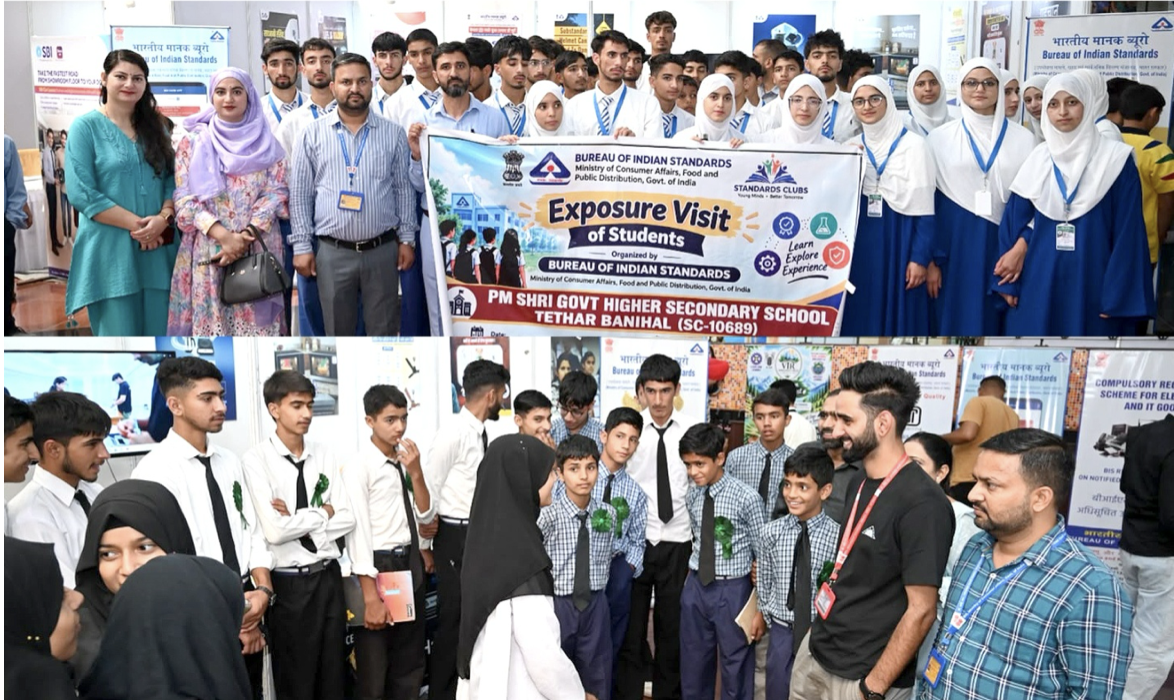
635 students. 25 Standards Clubs. One exhibition. That is the scale of the exposure visits the Bureau of Indian Standards (BIS) sponsored at Gatisheel Jammu & Kashmir 2.0 in Jammu, which concluded on 30 September, according to Greater Kashmir. If your school or college has never heard of a Standards Club, here is what happened, what these clubs are, and why the lab visit in particular is worth a young shopper's attention.
What happened at the exhibition?
Greater Kashmir reports that the 635 students came from 25 BIS Standards Clubs, with schools from across the Jammu region represented, including remote and hilly areas. The visits were meant to add practical exposure to classroom learning and build an understanding of standards, quality and safety. Students were taken around government departments, public sector undertakings and other participating organisations.
On the final day, 254 students from nine clubs toured the BIS Jammu & Kashmir Branch Laboratory. The report says the demonstrations covered gold testing, XRF, assaying, parting and hallmarking. Saaqib Raahi, Scientist-C and Deputy Director at the BIS J&K Branch Office, briefed the students on the Bureau's work in standardisation, conformity assessment, consumer awareness and Standards Club activities. The report also names Ashish Dwivedi (Standard Promotion Officer) and Sumit Kashyap (Consultant), and mentions the presence of Member of Parliament Jugal Kishore Sharma. The report as we read it does not detail the exhibition's venue or organiser beyond saying it was held in Jammu, so we are not stating either here.
What is a BIS Standards Club?
BIS is the National Standards Body of India. In a September 2023 Press Information Bureau release, BIS said the clubs exist to sensitise young people to the importance of standards in improving quality of life. The initiative began in 2021; by that release BIS counted 6,467 clubs (5,562 in schools and 905 in colleges, 384 of them in engineering colleges) with over 1.7 lakh student members from a science background, guided by science-teacher mentors who receive training from BIS.
Typical club activities listed by BIS include standards-writing competitions, debates, essay writing and poster making, and exposure visits to laboratories and industrial units. A BIS programme note from 2024 describes the clubs as covering students from grades 9 to 12 and aiming to produce future quality ambassadors and informed consumers.
BIS also said that eligible government high and higher secondary schools with a club can receive a one-time laboratory grant of up to Rs 50,000 in the form of lab equipment, and that up to Rs 1,00,000 is available to set up a 'Manak Kaksha' (a renovated room with basic amenities such as smart TVs and audio-visual systems) in government institutions with a club.
How does a school or college start one?
This is the part we could not confirm from an official page. The BIS pages we could read describe the purpose, the activities and the grants, but not a step-by-step application procedure or form, so we are not going to guess at one. The practical route is to ask your teacher or principal to contact BIS directly through bis.gov.in or the BIS Jammu & Kashmir Branch Office, the office named in the exhibition report, and ask what the current enrolment process is.
Why the hallmarking demo matters to you
If you have ever bought, or been gifted, a piece of gold jewellery, the lab tour has a direct link to your wallet. BIS's own brief on the hallmarking scheme explains that gold is alloyed for jewellery, which makes buyers vulnerable to adulteration that is hard to detect without technical tests, and that hallmarking is the accurate determination and official recording of the precious-metal content.
- The jeweller registers with BIS and sends pieces to a BIS-recognised Assaying and Hallmarking centre.
- The centre tests the item (the BIS brief lists XRF, sampling and fire assay among the steps) and, if it meets the standard, laser-marks it.
- The mark for gold jewellery now has three parts: the BIS logo, the purity in carat and fineness (for example 22K916, 18K750 or 14K585) and a six-digit alphanumeric code, the HUID, generated from BIS's server for each article.
- Mandatory hallmarking under an order of 23 June 2021 applies to 14, 18 and 22 carat gold jewellery in districts with an assaying and hallmarking centre. The brief notes later additions of 20, 23 and 24 carat grades to the standard.
For a buyer, BIS says its official mobile app, BIS Care, has a "Verify HUID" feature that lets consumers check the authenticity of hallmarked gold jewellery before buying. BIS's consumer-protection page also says you can have a piece tested at any BIS-recognised hallmarking centre, and that if hallmarked jewellery turns out to be less pure than marked, the buyer is entitled to compensation. The page sets that at the shortfall amount for the weight sold, plus twice the testing fee.
The takeaway
The exhibition visit is a reminder that standards are not abstract. The same system behind a hallmark on a ring sits behind many everyday products. If you are in a school science stream, ask whether your institution has a Standards Club; if not, ask who at BIS you can write to. And before your next gold purchase, look for the BIS logo, the purity mark and the six-digit HUID, then check it in the app.