44.8. That is the Gross Enrolment Ratio for higher-secondary education in Jammu and Kashmir — Classes 11 and 12 — according to NITI Aayog's report on India's school education system. The same report puts J&K's primary-level ratio at 113.7.
Put those two numbers side by side and you have the single most important fact about education in this Union Territory: the system is close to universal at the bottom and less than half-full at the top. Everything else — exam results, college cut-offs, who turns up to a JKSSB recruitment drive — sits downstream of that gap.
First, what a Gross Enrolment Ratio is not
It is worth being precise, because this statistic gets misread constantly.
A Gross Enrolment Ratio compares the number of students enrolled at a level of schooling with the size of the population that is officially the right age for that level. It is not a headcount of dropouts, and it is not a percentage of one cohort followed over time.
That is why a GER can exceed 100. J&K's primary figure of 113.7 does not mean 113 children out of 100 exist; it means enrolment at primary includes a good number of pupils who are older or younger than the official primary age band — children who started late, or repeated a year.
So the honest way to read 44.8 is this: for every 100 young people in J&K who are of Class 11 and 12 age, fewer than 45 are enrolled in Class 11 or 12. The rest are somewhere else — in work, at home, in a different kind of training, or out of the system altogether.
The slide, level by level
The report tracks the ratio down the school ladder, and the decline is steady rather than sudden:
Primary: 113.7
Upper primary: 77.3
Secondary: 66.1
Higher secondary: 44.8
The steepest single drop is between secondary and higher secondary — the point at which school stops being compulsory in practice and starts costing families money, time and travel. J&K's secondary-level dropout rate is 12.9%, against a national average of 11.5%.
A percentage point and a half sounds small. Across a UT-wide cohort it is thousands of individual students who were in a classroom in Class 9 and were not in one by Class 11.
1,371 schools with one teacher — and 146 with no students
Two findings in the report describe a system whose resources and its students have drifted apart.
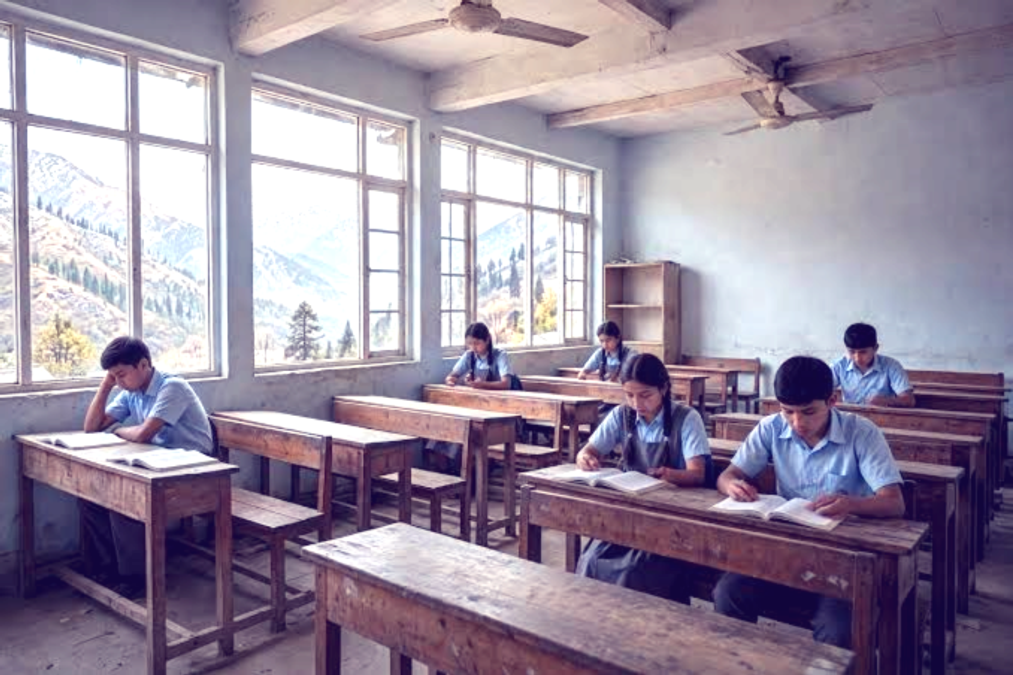
The first: J&K has 1,371 single-teacher schools, between them serving 32,303 students. One adult, every subject, every grade in the building. Whatever else that arrangement is, it is not a setting in which a student is likely to be prepared for a competitive Class 12 board result.
The second, and stranger: 146 schools in J&K have zero students enrolled — and 61 teachers posted to them. Those teachers are on the rolls, drawing salaries, in buildings nobody attends, while 1,371 other schools run on one teacher each.
Neither number is an accusation of anybody in particular. Both are the arithmetic of a school map drawn for a population distribution that has since moved.
The infrastructure line you can check yourself
Two more figures from the report are worth holding onto, because unlike enrolment ratios you can verify them against a building you have actually been inside:
16.5% of J&K's schools have a functional smart classroom.
45.4% have a ramp for children with special needs.
The second number means that more than half of the schools in this UT are, in a straightforward physical sense, not enterable by a child who uses a wheelchair. That is not a technology gap or a funding debate. It is a slope of concrete.
Where these numbers come from, and what they don't say
The report is titled School Education System in India: Temporal Analysis and Policy Roadmap for Quality Enhancement. It was released on 6 May 2026 by NITI Aayog, and draws on UDISE+ 2024-25, the PARAKH Rashtriya Sarvekshan 2024, National Achievement Survey rounds from 2017 and 2021, and ASER 2024.
Nationally it counts 14.71 lakh schools and 24.69 crore students, and records government schools' share of enrolment falling to 49.24% in 2024-25 from around 71% in 2005.
One important limit: every J&K figure above is Union Territory-wide. The report does not break the data down to Jammu district, and neither should anyone reading it. Jammu city, with its density of schools and colleges, almost certainly looks different from a single-teacher school in a hill block — but the report does not tell us by how much, and inventing a Jammu-specific number from a UT-wide one would be guesswork.
It is also, in news terms, not new. The report came out in May; what is fresh is the J&K-specific reading of it now circulating. Treat it as a diagnosis, not a bulletin.
Why a 22-year-old in Jammu should care
Because this is the pipeline that decides who you are competing with, and who you are not.
When a JKSSB advertisement draws tens of thousands of applications for a few hundred posts, the intuitive conclusion is that there are too many qualified young people in J&K. These numbers suggest something more uncomfortable: the applicant pool is large and the pool that never reached the starting line is larger still. Fewer than half of an age cohort is even enrolled at Class 11 and 12, which is the minimum ticket to most of what follows — a degree, a diploma, a government exam, a bank clerk's job.
If you finished Class 12, you cleared a bar that most of your age group in this UT did not. That is worth knowing, and it is also worth knowing why: not because they were less capable, but because in a lot of J&K the school thinned out before they got there.
The practical version, if you are still in the system: the transition from Class 10 to Class 11 is statistically the most dangerous point in a J&K student's education. If you know someone wobbling there, that is the moment where an intervention actually counts — a scholarship application, a stream conversation, a bus fare.
%2Fgreater-kashmir%2Fmedia%2Fmedia_files%2F2026%2F06%2F27%2Fgmc-jammu-2026-06-27-05-46-24.jpg&w=3840&q=75)