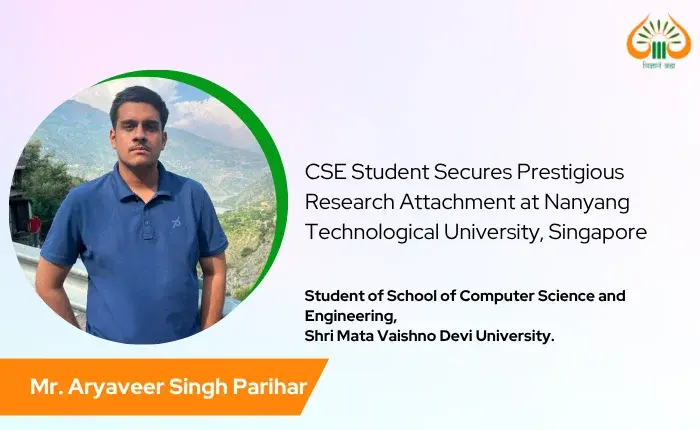
A second-year computer science student from Shri Mata Vaishno Devi University is taking a Jammu classroom into one of Singapore’s most ambitious research environments. Aryaveer Singh Parihar has been invited to join the Cognitive Interface Lab at Nanyang Technological University for a one-year research attachment from January 2027 to January 2028.
SMVDU’s announcement says the work will focus on Edge AI, extreme model quantization and resource-constrained, bare-metal hardware. In plain English, that means making useful artificial-intelligence systems run on small devices with tight limits on memory, power and computing capacity — the kind of engineering behind faster, cheaper tools that do not need to send every task to a cloud server.
Why a Jammu student should care
Research attachments are often treated as something that happens after a PhD. Parihar’s opportunity shows a different route: a strong undergraduate project, a specific technical interest and a host lab willing to take the student seriously. It also gives local students a concrete example of how subjects such as embedded systems, computer architecture and machine learning can connect to international research.
The attachment is not a degree transfer or a promise of a job. It is a defined research placement, and the final work will depend on the lab’s programme and the student’s project. That distinction matters: the useful takeaway is the pathway, not a headline about guaranteed outcomes.
The skills behind the opportunity
Build for constraints: learn to optimise models instead of assuming unlimited cloud hardware.
Show working evidence: projects, code and experiments give a research application something stronger than marks alone.
Find the right mentor: the best-fit lab is usually more valuable than a generic ‘AI’ label.
For students in Jammu who want a similar route, SMVDU’s School of Computer Science and Engineering is the sensible first stop for project guidance and research references. Start early, keep a record of experiments and ask faculty which international labs work in your area.
Source: SMVDU official announcement.