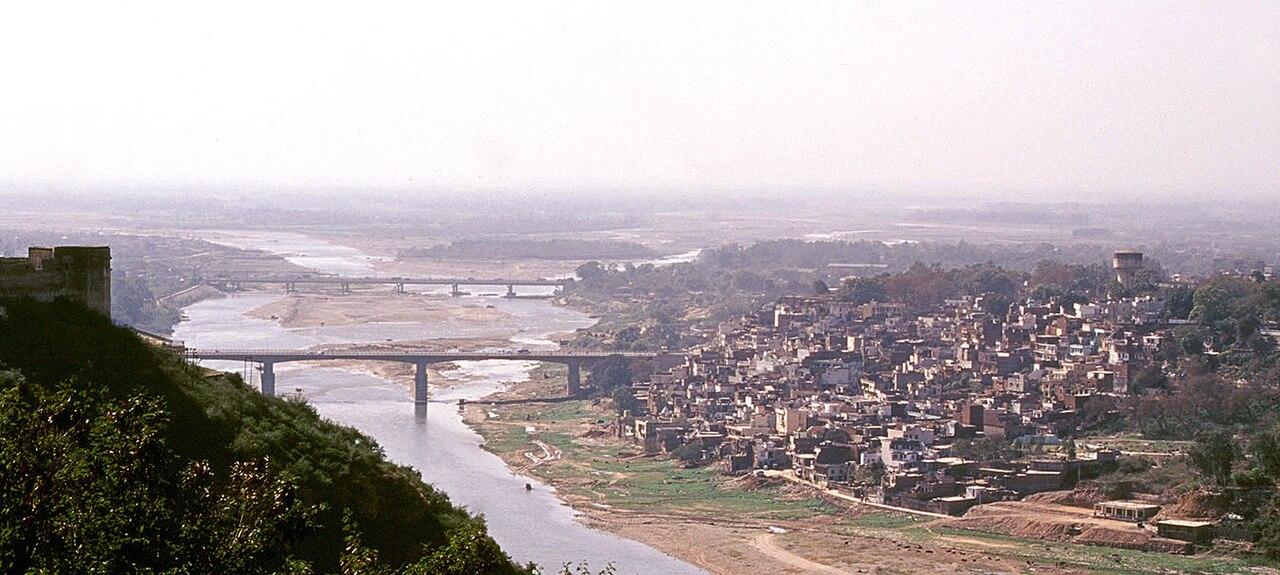
Ask anyone who grew up in Jammu and they will describe a Tawi that no longer exists — a river clean enough to swim in, fish from, drink at the edges of. The river that runs through the city today is a harder thing to love: shrunken in stretches, clogged with plastic, carrying the runoff of a growing city. But this spring, between civic festivals, campus campaigns and a few stubborn volunteers, the Tawi is getting more attention than it has in years. The question is whether attention turns into a river anyone can swim in again.
A festival to make the river visible
Around Baisakhi, the city tried something different: instead of only celebrating the harvest, it celebrated the river. The Jammu Municipal Corporation and the Smart City effort organised a Swachh Tawi Mahotsav at the 4th Tawi Bridge — a multi-day event built around cleanliness drives, awareness activities and cultural programming, timed to draw families to the riverbank during the festival season. The idea is simple and smart: you cannot make people care about a river they never look at, so bring the city to the water and let it remember what it is missing.
Events like this are easy to be cynical about — a clean-up that coincides with photo opportunities. But the honest counterpoint is that visibility matters. A river that disappears from the public imagination gets treated like a drain. A river that hosts a festival, however briefly, gets seen again — and seeing is the first step to protecting.
The campus that adopted a river
The more sustained pressure has come from the University of Jammu. Its environmental sciences department and green-campus volunteers, working with the municipal corporation, have run a Save Tawi campaign along the banks — clean-up drives, water-quality awareness, and a particular focus on the religious immersions that load the river with plastic and non-biodegradable waste during festival seasons. That last point is delicate and important: a lot of the Tawi’s pollution is not industrial villainy but the cumulative residue of ordinary devotion, and addressing it means persuasion, not policing.
Researchers have been blunt about the numbers. Water testing along polluted stretches has repeatedly found pollution parameters well beyond safe limits. That is the unglamorous backdrop to every clean-up photo — a river under real chemical and biological strain, not just a littered bank.
The volunteers who never left
Long before any festival, small groups of Jammu residents were wading into the Tawi on weekends to pull out what others threw in, often with little official support. Their work is the least photogenic and the most honest part of this story: no stage, no banner, just gloves, sacks and the grim arithmetic of a river that refills with trash faster than a handful of people can empty it. They will tell you the same thing every time — clean-ups treat the symptom; the cure is upstream, in how the city handles its sewage, its solid waste and its habits. What keeps them going is not optimism so much as stubbornness, the refusal to accept that a river their parents swam in is simply gone.
What a revived Tawi could be
It is worth being concrete about the prize, because abstract appeals to ‘save the river’ rarely move anyone. A genuinely cleaner Tawi is not a fantasy; it is a riverfront the city could actually use. Picture an evening walk along a bank that does not smell, a stretch of water clean enough that the migratory birds come back in number, ghats where people gather without wading through plastic. Cities that have turned filthy urban rivers around — and several in India are trying — did not perform a miracle; they fixed the sewage, managed the solid waste, and then, crucially, gave residents a reason to keep showing up. The Tawi has the geography for all of it. What it has lacked is sustained will.
What actually changes the river
Here is the part that involves you. A river’s health is decided less by grand projects than by a million small choices on its banks. Do not immerse plastic, thermocol or synthetic material in the water during festivals — use the designated collection points that drives now set up. Carry your mela and picnic waste back instead of leaving it for the next flood to wash downstream. And treat the Tawi as a place worth visiting rather than a backdrop to ignore; the rivers that recover are the ones a city decides to look at.
The Tawi will not be restored by a single festival or a single campaign, and nobody serious pretends otherwise. But the combination this spring — a city event, a university campaign and a core of volunteers who never quit — is more momentum than the river has had in a while. Momentum is not a clean river. It is, however, the only thing that has ever produced one.
%2Fgreater-kashmir%2Fmedia%2Fmedia_files%2Fwp-content%2Fuploads%2F2025%2F08%2FAssembly-J-K-e1755833571261.jpg&w=3840&q=75)