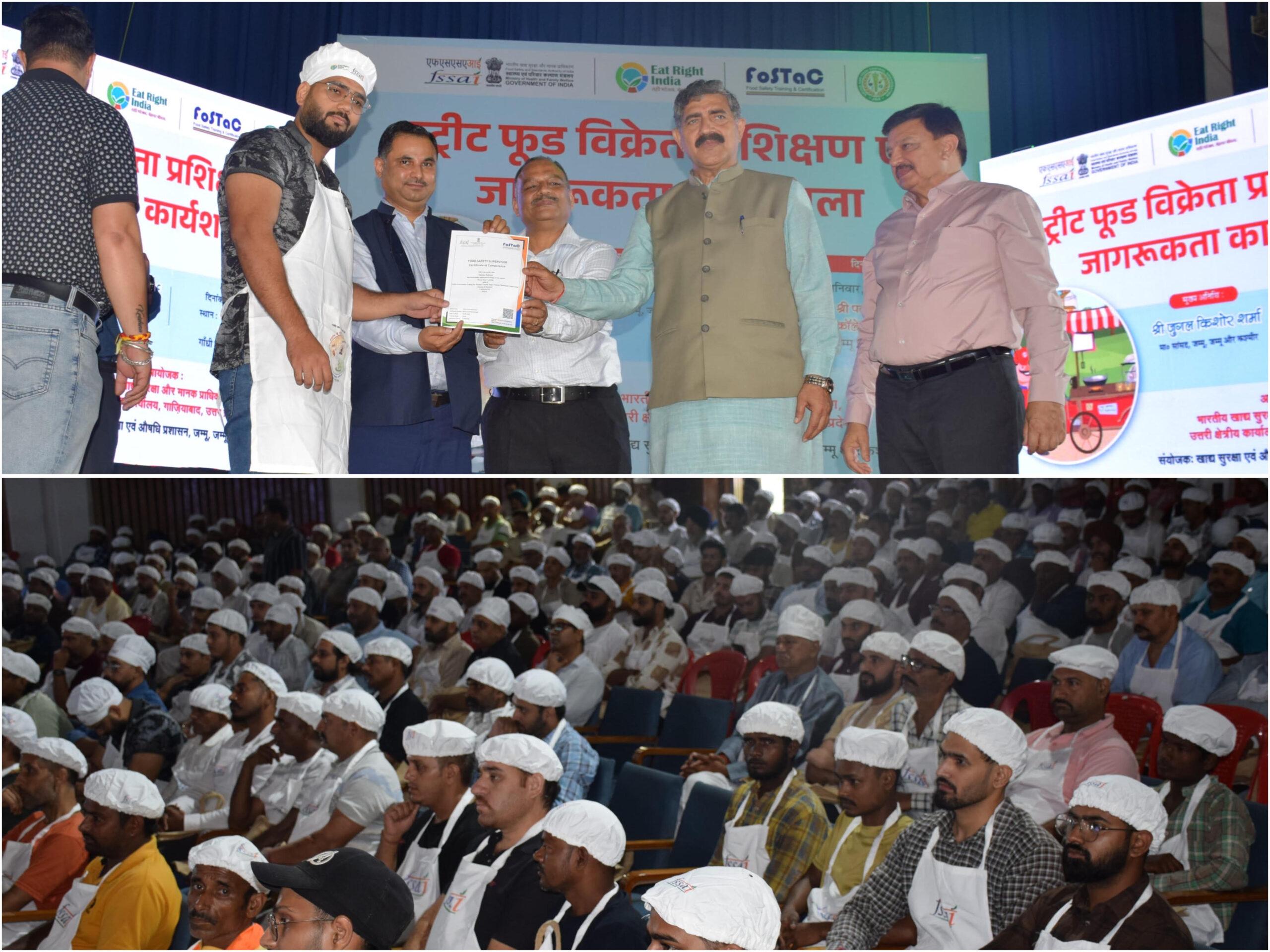
A hall full of Jammu's street-food vendors in white chef caps and aprons is not a sight the city has had before. On Saturday 19 September, at Padma Shri Padma Sachdev Government College for Women in Gandhi Nagar, the UT ran its first Street Food Vendor Training Programme — and sent the participants home with a certificate.
For a readership that eats a meaningful share of its meals off a cart, this is not a bureaucratic footnote. It is the first time the people cooking that food have been put through formal hygiene training in an organised way.
Who ran it, and under what
The programme was organised by the Northern Regional Office of the Food Safety and Standards Authority of India (FSSAI) together with the Food and Drug Administration, Jammu & Kashmir. It sits under two existing national frameworks rather than being a one-off local scheme:
FoSTaC — Food Safety Training and Certification, FSSAI's standard training programme for food handlers.
Eat Right India — the broader FSSAI campaign on safe and healthy food that FoSTaC feeds into.
That matters because it means the certificate handed over in Gandhi Nagar is a nationally recognised one, not a locally invented badge.
What the vendors were actually taught
The curriculum, as described identically in both outlets that covered the session, covered personal and stall hygiene, waste disposal, procurement and storage of raw material, and safe handling and storage of cooked food.
Read that list again with a customer's eye. Procurement and storage of raw material is where most of what can go wrong on a cart actually goes wrong — not in the cooking, which is usually fierce enough to be forgiving, but in what was sitting in a bucket before it went into the pan, and at what temperature, and for how long. Waste disposal is the other one: a cart's bin is six feet from its tawa.
What the certificate is supposed to do
MP Jugal Kishore Sharma, the chief guest, framed the certificate as a commercial asset rather than a compliance burden — saying vendors carrying it "will enjoy an edge over their peers in the marketplace."
Whether that plays out depends on something the training cannot supply on its own: customers actually looking. A hygiene certificate only becomes a competitive advantage in a market where people check. If you eat regularly at one cart, the useful thing you can do with this story is ask the person behind it whether they have been through the training.
Also present were Sanjeev Kumar, Joint Commissioner Food Safety, J&K; Ankeshwar Mishra, Joint Director, FSSAI; Nimanshi, Manager at the FSSAI Northern Regional Office; and Arun Gupta, President of the Chamber of Commerce and Industries Jammu.
Eight more sessions, district by district
Gandhi Nagar was the first, not the only one. Eight further sessions are planned, district-wise across J&K.
Here is what we could not establish, and would rather say than fudge: no source gives the number of vendors trained on the day, no dates have been published for the eight follow-on sessions, and nothing states whether vendors pay a fee to attend. If you run a cart and want to be in the next one, the Food and Drug Administration J&K is the office to ask — we could not find a published registration route.
Why Gandhi Nagar, and why now
The venue is not incidental. Gandhi Nagar's rehri strip is one of the densest concentrations of street food in the city, and it is already mid-transformation: the row is being rebuilt into a 120-cart food zone, with 22 carts already up. Training the vendors who will occupy a purpose-built food zone, in the year that zone is being built, is a sensible piece of sequencing.
It also follows a tightening on the formal side of the trade. J&K eateries were recently required to name the meat on their menus and display their FSSAI licence. Taken together, the direction is consistent: the regulator is working on what the customer can see and verify, at both ends of the price range.
What FoSTaC certification is, in plain terms
FoSTaC is not an inspection and it is not a licence. It is a structured training course with a test at the end, run through FSSAI-approved trainers, and a food business is expected to have trained supervisors in proportion to its size. For a single-cart operation, the vendor and the trained supervisor are the same person — which is precisely why a session aimed at street vendors, rather than at restaurant kitchens, is the gap this fills.
The short version
One training session does not clean up a city's street food. But it establishes a mechanism where there was none, attaches a recognised certificate to it, and commits to nine sessions rather than one. For a city where the cart is a primary food source for students and young workers, that is a real thing to have started — and the part worth following is whether the other eight actually happen, and on what dates.
Sources: Srinagar Observer — J&K's first Street Food Vendor Training Programme held at Jammu; Kashmir Thunder.
%2Fgreater-kashmir%2Fmedia%2Fmedia_files%2Fwp-content%2Fuploads%2F2025%2F10%2Fclassroom-pic.jpg&w=3840&q=75)