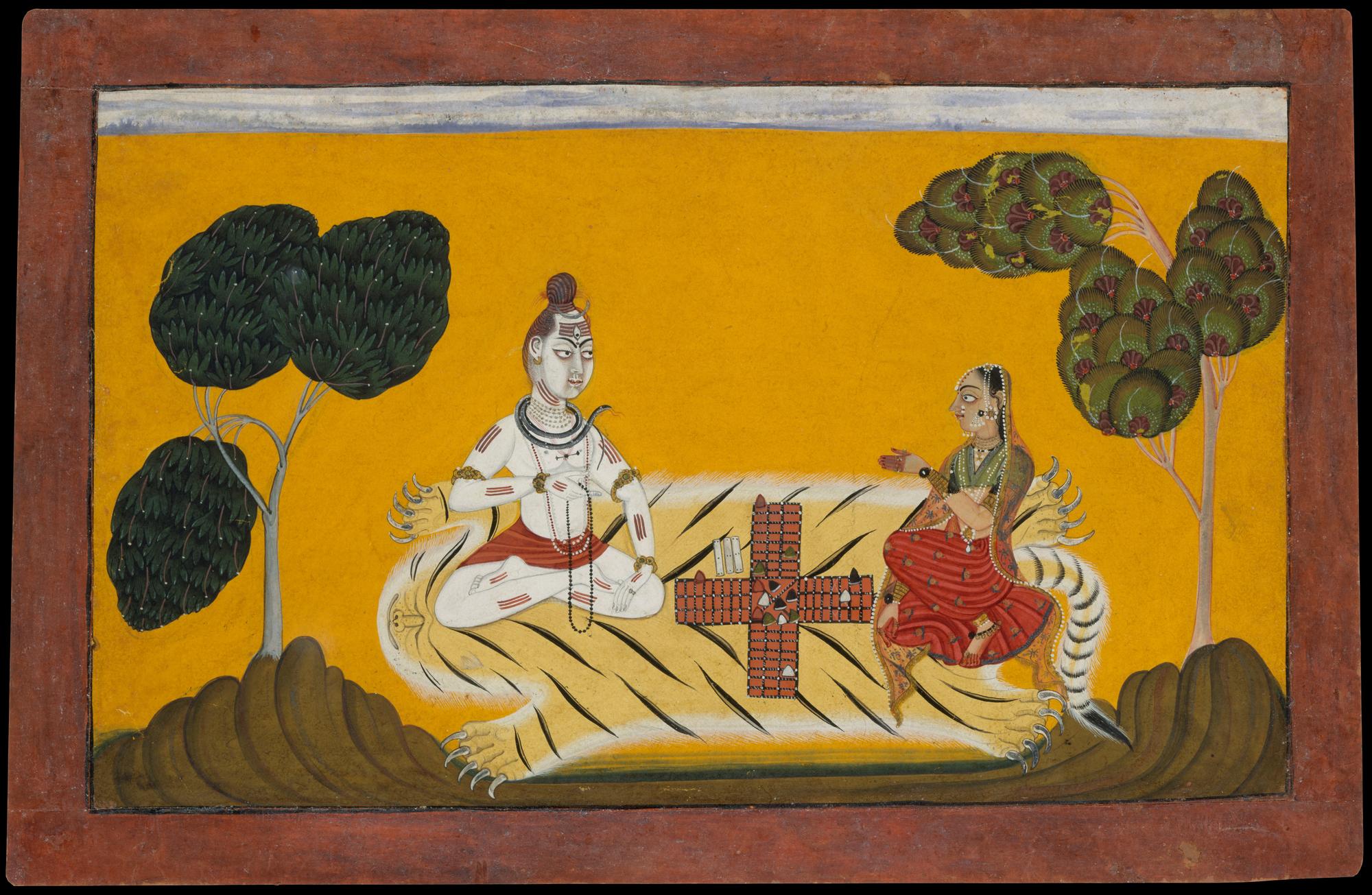
Walk into a museum three thousand kilometres from Jammu and you may meet Basohli before you ever meet Basohli.
At New York’s Metropolitan Museum of Art, a small page shows Shiva and Parvati seated across a chaupar board. Shiva has cheated his wife of a necklace; Parvati wants it back. The background is an almost confrontational yellow. Trees lean inward as though they too are listening. There is no perspective trick, no shading, no attempt at realism — only gesture, colour and compressed space carrying a domestic quarrel between two gods. The museum dates it to 1694–95, names its painter as Devidasa of Nurpur, and records where it was made: Basohli, Jammu.
Look harder at other works from the same hill court and the painted jewellery starts to misbehave. What reads as an emerald can be an actual fragment of a jewel beetle’s wing case — cut, thinned and set into raised gold, so it shifts colour as you move. In 2025, Met conservators put some of these under a microscope and found pieces reduced from roughly 400 microns, the thickness of an intact wing case, to less than a quarter of that, then laid in after the surface had been burnished — the very last thing the artist did (“Painted with Beetles”).
That is the first thing to hold on to about Basohli painting. The objects are tiny. The ambition is not. And a young person in Jammu today is far more likely to have encountered the tradition as a line in a textbook, a framed reproduction in a government office or a stall at a festival than as the thing itself.
Basohli town, three hours up the Kathua road, has a GI tag, a training pipeline, five cooperatives and a growing tourism pitch. What it does not yet have is a working answer to a harder question: what does it take to turn a celebrated name into a living income?
A court above the Ravi
Basohli sits on the right bank of the Ravi in Kathua district. The kingdom was small; small did not mean cut off. Hill courts were stitched together by marriage, warfare, pilgrimage, trade and service at bigger imperial courts, and Basohli sat on routes linking the Punjab plains to Jammu, Kashmir and the neighbouring hill states.
M. S. Randhawa’s government-published survey Basohli Painting describes the town’s seventeenth- and eighteenth-century prosperity and the role of the Pal rulers — Raja Bhupat Pal, who established the capital at the present site and built the palace, and above all Raja Kirpal Pal, ruling from 1678 into the early 1690s, under whose scholarly patronage the court’s painting matured. His successor Dhiraj Pal carried it on.
The palace was the architectural half of that confidence: towers, balconies, a commanding position over the river. Its murals are gone and most of the structure is ruin. That matters, because these paintings were not produced by an abstract “school”. They came out of a courtly world of manuscripts, music, poetry, ritual and patronage. The vanished palace was part of the visual environment that made them possible. (The fort is now on a restoration list — one of two Jammu day trips getting ₹13.4 crore of conservation work.)
The origin story usually gets told too neatly: Mughal artists, supposedly pushed out or neglected under Aurangzeb, drift into the hills and invent the Basohli style. Migration from imperial and regional workshops is entirely plausible, and Mughal technique is visible in the costume, the portraiture, the finish. But “artists fled Delhi” is not proven in the form it is usually repeated.
Randhawa argued for something more interesting — a meeting. Flat, forceful colour, indigenous facial types and emotional directness on one side; refinements picked up in wider courtly networks on the other. Earlier scholars proposed links to Mewar, to western Indian manuscript traditions, to Nepal, to a pre-Mughal hill style. Several of those were conjecture even when first advanced. The secure evidence starts not with a tidy myth but with surviving objects, inscriptions and a fully-formed visual language.
Which is the point worth taking away: Basohli painting is not important because it was pure or untouched. It is important because mobile artists, local convention, ambitious patrons and a literary culture were fused into something nobody could mistake for anything else.
The style had to be rediscovered — and renamed
For a tradition now bound up with a town’s identity, its modern classification arrived surprisingly late.
When paintings with deep red borders and blazing colour surfaced in the Amritsar art market in the early twentieth century, dealers often called them “Tibeti”. Ananda Coomaraswamy initially filed much of the material under a broad Dogra or Jammu heading. The Archaeological Survey of India’s 1918–19 annual report, published in 1921, recorded acquisitions for the Central Museum at Lahore and used the term “Basohli School”. Fieldwork by Ajit Ghose in the 1920s helped prise Basohli loose from the loose labels then in circulation.
That sequence tells you how art-historical names actually get made. A painting is created at one court, kept by another family, sold through a third city, described by a dealer using a label that is simply wrong, and reclassified by scholars decades later. Even “Basohli school” does not settle much: it can mean place, style, patronage or later attribution, and those four do not always point at the same object.
Modern scholarship has complicated the map further. B. N. Goswamy and Eberhard Fischer showed how much depends on artist families — above all that of Pandit Seu and his sons Manaku and Nainsukh, whose members worked across Guler, Jasrota, Basohli and elsewhere. Nainsukh painted for Raja Balwant Singh of Jasrota and later for Raja Amrit Pal of Basohli; his descendants kept going. Styles, it turns out, did not stop at political borders.
So Basohli should neither be dissolved into a vague “Pahari” nor sold as the single parent from which every hill style mechanically descends. It was a decisive early centre inside a network. Its vocabulary travelled; other courts reworked it; artists carried knowledge in their hands; and later Guler-influenced naturalism came back into Basohli itself.
The Rasamanjari: painting feeling, not illustrating text
The work most securely tied to Basohli’s international reputation is an illustrated Rasamanjari completed in Vikram Samvat 1752 — 1694–95 — by Devidasa. W. G. Archer’s survey records the colophon as stating it was executed at Basohli for, or dedicated to, Raja Kirpal Pal.
The chronology needs a little care. Older sources disagree about the final year of Kirpal Pal’s reign and his death, while the series itself is firmly dated. It is safer to say the manuscript was commissioned for or dedicated to Kirpal Pal and finished at the end of his patronage era than to reconstruct a precise court biography from inconsistent regnal lists.
The Rasamanjari, written in Sanskrit by Bhanudatta, is a classification of lovers — the states, behaviours and temperaments of the nayaka and nayika. In Basohli hands this stopped being taxonomy. Desire, anticipation, jealousy, deceit, estrangement and reconciliation became spatial and chromatic events. A wall separates lovers. A tree echoes a bowed body. Empty space becomes emotional distance. A red field runs hot; a yellow one leaves a figure exposed. The couples appear as courtiers, or as Radha and Krishna, Shiva and Parvati, Rama and Sita. The result sits somewhere between literature, theatre, devotion and psychology.
Mulk Raj Anand called these paintings of “laughing colours” — ochre, red, orange, yellow, brown, lapis blue, dark green, black, gold and silver working as an almost orchestral field of feeling. The phrase has survived fifty-odd years because it catches what formal description keeps missing. These colours do not politely fill outlines. They act.
One correction worth making, since it turns up constantly: the dated Devidasa series is often called the earliest Basohli painting. Not quite. Earlier groups — the so-called Early Rasamanjari and the Tantric Devi series, usually dated around 1660–70 — belong to the broader Basohli–Nurpur world, though their exact place and authorship remain debated. The 1694–95 manuscript is better described as the earliest securely dated major Basohli series.
That may sound like pedantry. It is actually the difference between cultural history and a slogan.
How to look at one
The standard checklist runs: brilliant primary colours, red borders, receding foreheads, high aquiline noses, huge lotus-petal eyes, rounded chins, patterned textiles, stylised architecture, and jewellery built up from gold, silver, raised white pigment and beetle-wing fragments. The Government of India’s Indian Culture portal and Kathua district’s ODOP documentation both list most of these.
A checklist, though, makes the art sound formulaic. The real achievement is controlled intensity.
Basohli painters largely refused the idea that a picture is a window onto ordinary space. Floors tilt forward. Architecture becomes a stage set. Figures are wrong by anatomical standards and exact as carriers of emotion — an eye can dominate a face because psychological attention, not proportion, is the subject. Flat fields of saturated colour strip out distraction. Ornament does not decorate the event; it raises the temperature of it.
The making was equally exacting. Sheets were pasted and burnished into wasli. Drawings were transferred or worked up in fine line. Mineral and vegetal pigments were prepared and laid in layers, then re-outlined after burnishing. Gold and silver were polished with small agate tools. Raised white dots became strings of pearls. Slivers of beetle wing became emeralds.
The Met’s microscopy matters because it converts a much-repeated craft anecdote into evidence of material intelligence. The artist had to know how a biological surface would behave under thinning, moisture, adhesive, the colour beneath it and raking light. This was not “traditional art” in the soft sense. It was a technology of seeing.
Not one straight family tree
School labels help you get oriented. They also hide a great deal of movement.
Basohli — saturated colour, compressed space, hard contours, intensely stylised faces, jewelled surfaces.
Mankot, a neighbouring Jammu hill state — vigorous portraits and court scenes. Works once broadly filed as Basohli or Jammu are now reassigned to Mankot on portrait evidence.
Jammu and Jasrota — the ground for Nainsukh’s extraordinary mid-eighteenth-century work, especially his close observations of Raja Balwant Singh reading, worshipping, being shaved, sitting alone. Heraldic distance replaced by ordinary time.
Guler — the workshop of Pandit Seu and his sons, pushing towards a suppler, more naturalistic treatment of body, face and landscape while staying deeply connected to the other courts.
Kangra — the later eighteenth-century fame: lyrical landscape, softened colour, idealised Radha–Krishna. So dominant a name that “Kangra” got applied to Pahari painting made nowhere near it.
The transition was never a clean replacement of harsh Basohli by gentle Kangra. Styles coexisted and travelled. A Basohli ruler could be painted by a Guler-born artist. A Mankot portrait could depict a Basohli prince. A manuscript could be broken up and its pages attributed separately decades later. LACMA’s portrait of Raja Amrit Pal was painted by Ranjha, Nainsukh’s son, and passed through the collections of Pahda Kunj Lal and later Maharaja Karan Singh before reaching Los Angeles.
That fluidity makes Basohli’s achievement bigger, not smaller. The town was part of a regional laboratory continuously revising how divinity, desire, power and personhood could be pictured.
How the paintings left home
Royal workshops were not museums. Manuscripts and albums moved through dynastic change, political absorption, inheritance and gift. Basohli came under Sikh authority in the nineteenth century and later sat within the Dogra state. Court patronage weakened. Paintings passed to royal physicians, priests, officials, descendants, dealers and collectors.
By the twentieth century, scholars and administrators were combing hill towns and family collections for works already moving through the market. Partition then split the collections and institutional histories of north India down the middle. Lahore’s Central Museum kept important works; museums in Delhi, Jammu, Chandigarh, Varanasi and Chamba built their own. Randhawa’s collecting programme for the Government Museum and Art Gallery, Chandigarh, alone acquired more than 2,000 miniatures from royal and other collections, according to recent provenance research in Ars Orientalis.
Today, Basohli and related Pahari works sit in:
the Dogra Art Museum at Mubarak Mandi, whose official page puts its painting gallery at more than 700 miniatures and includes the celebrated Rasamanjari group — the closest most Jammu residents will get, and worth an afternoon;
the National Museum, New Delhi; Bharat Kala Bhavan, Varanasi; the Government Museum and Art Gallery, Chandigarh; and the Bhuri Singh Museum, Chamba;
the Lahore Museum, carrying the pre-Partition collecting history of the Punjab;
the Metropolitan Museum of Art, New York; the Museum of Fine Arts, Boston; the British Museum and the Victoria and Albert Museum, London; LACMA and the San Diego Museum of Art; the Museum Rietberg, Zurich; and a long tail of public and private collections.
That list is not a census. Cataloguing practice differs, attributions shift, and “Basohli”, “Basohli style”, “Punjab Hills”, “Pahari” and “Basohli or Nurpur” are not interchangeable. Some objects are not on display. Others are private and surface only when exhibited or sold.
The dispersal is legible in individual records, though. The Met’s Devidasa folio came in as a 1957 gift. LACMA’s Battling Elephants, circa 1700, with real beetle carapace, arrived as a private donation. The British Museum holds Rasamanjari pages bought on the London market, including one circa-1725 work whose Basohli attribution the museum itself marks with a question. The Rietberg documents Basohli rulers and Pahari artist networks through pieces such as its portrait of Raja Medini Pal.
None of this should be flattened into a single story of theft. The routes include purchase, gift, inheritance, institutional acquisition, Partition allocation and the page-by-page break-up of manuscripts. But “they’re safe in museums” should not end the inquiry either. For every major group, the public deserves an object-level provenance history: who owned it first, when it left the court or the family, through which dealer, what documentation survives, and whether any transaction happened under pressure. And digitally reconnecting scattered folios is possible even where physical reunification is not.
The strange condition of being famous elsewhere
Basohli’s problem is not that the world ignored its art. It is that global recognition has not produced local infrastructure.
The Dogra Art Museum holds a major collection — more than 100 km from Basohli. In the town itself, the Vishwasthali organisation has kept a gallery and training centre going, assembled replicas and contemporary work, run workshops and helped train artists. Local reporting has repeatedly described improvised space, thin resources and dependence on individual commitment rather than a staffed research, conservation and visitor institution.
Government activity has grown, and it is real. Basohli Painting and Basohli Pashmina were picked under Kathua’s One District One Product programme. The Handicrafts Department reports a training centre at Nagrota Preta, artisan registration, Karkhandar units and five active painting cooperatives. Government Polytechnic Jammu runs a one-year heritage-craft course with 21 seats and a monthly stipend — a genuine, low-barrier route in for a student in the region. IGNCA workshops, Basohli Utsav and Lalit Kala Akademi camps have put students alongside established miniature artists, and in December 2025 IIM Jammu placed students directly with GI-certified women artists.
These are signs of continuity. They also raise the next question: continuity into what?
Training numbers do not tell you how many people are still painting a year later. Cooperative membership does not tell you annual income, sales volume or bargaining power. A festival does not tell you year-round footfall. An exhibition does not tell you what share of the sale price reached the artist. “Export potential” is not recorded exports.
Basohli does not mainly need more trainees. It needs viable careers.
What the GI actually changed — and what it didn’t
Basohli Painting was filed as GI Application No. 755 on 26 April 2021 by the Basohli Vishwasthali Art and Painting Handicrafts Industrial Cooperative Limited. The GI Registry lists it as registered in Class 16 for handicrafts, Certificate No. 470 dated 31 March 2023, valid to 25 April 2031 (IP India record).
That is a genuine legal milestone. It fixes the registered indication, names the registered proprietor, records a specification of the craft, and lets authorised users act against misuse under GI law.
Three distinctions matter, though, and they are the ones most often collapsed.
A GI is not copyright in the old paintings. It does not bring historic Rasamanjari pages back to Basohli and it does not stop any museum displaying them. It protects a geographical indication as used on qualifying goods.
A GI does not enforce itself. Producers have to become authorised users, origin and quality have to be credibly verified, misuse has to be spotted, and somebody has to carry the cost of acting. Kathua district’s official page says a list of 120 potential authorised users stands submitted to the Registry. That is not the same as 120 registered users, and it should not be repeated as though it were.
A GI does not create demand. It can underwrite authenticity and a premium price — but only bolted to traceability, storytelling, distribution and buyer trust.
The most useful official local numbers are modest enough to be credible: 164 artisan registrations accumulated through 2023–24, five active cooperative societies listing 58 artisans, and several Karkhandar training units. The same district page is internally inconsistent in places — its prose says four units while its table lists five, and it describes the active painting centre as training people in “Basohli Pashmina Craft”. Probably drafting errors. Also a good illustration of why a promotional page is not programme data.
On the sources reviewed for this piece, there is no published official time series for Basohli painting sales, artisan income, export value, repeat buyers, authorised-user approvals, infringement actions or any post-GI change in price. Until that exists, “the GI has transformed livelihoods” is an aspiration, not a finding.
Revival should not mean freezing the art in 1695
There is a second danger beyond neglect, and it is quieter: preservation becoming imitation.
Recreating historic pages is a legitimate discipline. It teaches drawing, colour preparation, iconography and material control, and it lets local audiences see compositions whose originals are on another continent. But if every trained artist is expected only to reproduce Krishna, Radha or a familiar Rasamanjari folio, Basohli becomes a souvenir grammar rather than an artistic language.
The historical workshops were never static. They absorbed and rejected influences, moved between courts, revised facial types, experimented with portraiture and landscape, and used expensive materials inventively. Being faithful to that spirit probably requires new work — contemporary stories told with Basohli’s spatial compression, new pigments tested for conservation safety, animation and graphic narrative built on its visual syntax, collaborations in publishing, theatre, fashion and digital design, with artists keeping attribution and economic rights.
Authenticity should therefore have layers, clearly labelled. A museum-grade traditional work follows the registered material and process specification closely. A contemporary Basohli-derived work innovates but discloses its materials and authorship. A machine-printed decorative product is never sold as a hand-painted original. Clear categories protect the buyer and the artist at the same time.
What recovery could actually look like
Basohli does not need another announcement without an operating model. It needs a linked system. Seven pieces of one:
1. A Basohli Centre for Painting, not a display room
A permanent institution in the town: galleries, visible storage, a reference library, conservation facilities, classrooms, an artist residency, a sales space and professional staff. It should show high-quality facsimiles of dispersed masterpieces alongside original contemporary work, say plainly which is which, and connect visitors digitally to collections worldwide.
2. A digital catalogue raisonné
J&K institutions could lead a consortium with the National Museum, Bharat Kala Bhavan, Chandigarh, Chamba, Lahore and international museums. Each entry with image rights, inscriptions, translations, dimensions, condition, attribution history and provenance. Folios scattered across continents could be virtually reunited in their original textual order — the one form of repatriation nobody has to negotiate for.
3. Publish the economics, not just the symbolism
Annually, from the Handicrafts Department and the registered proprietor: active authorised users, trainees completing and still practising, cooperative and individual sales, median artisan earnings, buyer geography, institutional orders, enforcement actions. Without a baseline and annual measures, the GI’s livelihood impact simply cannot be evaluated — by anyone, including the people running it.
4. Give every new painting a trustworthy identity
A numbered certificate, physical and digital, naming the artist, the cooperative or studio, authorised-user status, materials, date, size, hours of work, and whether the composition is a historic reproduction or an original design. A QR-linked registry would make provenance an asset for living artists instead of something reconstructed a century later.
5. Use public procurement intelligently
Airports, railway stations, universities, government guest houses, hotels and cultural institutions can commission original work at transparent minimum rates. Procurement should not ask for free “exposure”, printed décor should be labelled as such, and large commissions can be split across cooperatives while preserving individual credit.
6. Connect art, town and river
A visitor should be able to fill a day in Basohli: the painting centre, a live demonstration, the fort remains and temples, the old settlement, lunch, certified work to buy, and the Ravi landscape that connected this court to everywhere else. Heritage tourism works when the community captures the value — guides, workshops, food, transport, stays — not when people turn up for one annual stage event and drive home. The weekend trip already exists; the art is the part still not properly plugged into it.
7. Let artists make new history
Scholarships, residencies and commissions that reward mastery and experimentation. Young painters need access to art history, conservation science, photography, design software, contracts, pricing and digital commerce. The aim is not more copies. It is that a Basohli artist in 2030 makes work a museum wants to acquire as contemporary art.
The real test
Basohli painting already has what most revival campaigns spend years trying to manufacture: a distinctive name, extraordinary objects, international recognition, a compelling material technique, serious scholarship and living practitioners.
What is missing is the bridge between them.
The historical paintings are treated as masterpieces. The living practice is treated as a scheme. The town is promoted as a destination while its visitor infrastructure stays fragmented. The GI is celebrated as an achievement while its economic effect goes unmeasured. Institutions teach production, and no transparent market architecture guarantees that value comes back to the artist.
Three centuries ago, painters in a small hill town made a sheet of paper feel larger than a stage. They turned colour into emotion, ornament into material experiment, and a minor court into a centre whose influence outran its territory.
Basohli does not have to prove it once mattered. The paintings did that.
The open question is whether Jammu and Kashmir can now build the scholarship, the institutions and the market that let Basohli matter where it began — and let the next generation there produce something more than a memory of the last one.
Basohli painting: the short version
Place: Basohli, right bank of the Ravi, Kathua district.
Peak production: principally the late seventeenth and eighteenth centuries; earlier attributions and later continuities are debated.
Earliest securely dated major manuscript: Devidasa’s Rasamanjari, Vikram Samvat 1752 / 1694–95.
Chief patrons: Raja Kirpal Pal above all, then Dhiraj Pal and later rulers as the style changed.
Subjects: Rasamanjari, Gita Govinda, Bhagavata Purana, Devi imagery, Ragamala, Ramayana, portraits and court life.
Visual signatures: saturated colour fields, strong borders, stylised profiles and large eyes, compressed or tilted space, elaborate textiles, charged gesture.
Material signatures: opaque pigment on prepared paper, gold and silver, raised white for pearls, and — on celebrated historical works — cut jewel-beetle wing cases as emerald-like inlay.
GI: Application No. 755, filed 26 April 2021; Certificate No. 470 dated 31 March 2023; valid to 25 April 2031.
Reported ecosystem (Kathua district): 164 accumulated artisan registrations through 2023–24; five cooperative societies listing 58 artisans; training and Karkhandar units. These count registrations and programme participation — not full-time livelihoods.
Where to see it, from Jammu
The Dogra Art Museum, Mubarak Mandi, is the practical answer: a painting gallery of more than 700 miniatures including the celebrated Rasamanjari group, roughly twenty minutes from most of the city, and free or near-free depending on the day. Basohli town itself is about three hours by road via Kathua, and the Vishwasthali gallery and training centre there is where you can watch the work being made rather than only hung.
Sources
Metropolitan Museum of Art — Shiva and Parvati Playing Chaupar, Devidasa, 1694–95 and “Painted with Beetles”, 2025
Intellectual Property India — Basohli Painting, GI Application No. 755
District Kathua — ODOP: Basohli Paintings & Pashmina
J&K Department of Culture — Paintings (Dogra Art Museum holdings)
M. S. Randhawa, Basohli Painting, Publications Division, Government of India
Vrinda Agrawal, “From Private to Public: The Movement of Pahari Paintings…”, Ars Orientalis, 2024
Mulk Raj Anand, “The Laughing Colours”, 1969, republished by Dogri Sanstha
Government Polytechnic Jammu — Basohli Painting heritage-craft course
The Tribune — “IIM-Jammu begins workshop on 300-yr-old Basohli art form”, 9 December 2025
Object records: LACMA, Battling Elephants · LACMA, Raja Amrit Pal of Basohli · British Museum, Rasamanjari page · Museum Rietberg, Raja Medini Pal
