5.53 lakh. That is the number of adults in Jammu and Kashmir who sat and cleared a foundational reading, writing and numeracy test between 2023 and 2026 — and it is the number doing the real work behind the headline that landed on Teachers' Day.
On 5 September, at an event at SKICC in Srinagar, Education Minister Sakina Masood Itoo announced that J&K has been declared a Fully Literate Union Territory under ULLAS — Nav Bharat Saaksharta Karyakram, the Centre's adult literacy programme. The recorded literacy rate under the scheme is 98.43%, placing J&K 10th in the country on this measure.
It is a genuine milestone. It is also a specific, technical one, and it is worth understanding exactly what was counted — because "fully literate union territory" sounds like a claim about everybody, and it is not.
What ULLAS is
ULLAS stands for Understanding of Lifelong Learning for All in Society. It is the operating name of the Nav Bharat Saaksharta Karyakram, a central scheme aimed at adults aged 15 and above who never became literate — people who missed school entirely, or left before reading and writing stuck.
It is not a school programme. It does not measure how many children are enrolled, how many finish Class 10, or how well anyone reads at the end of it. It measures one thing: how many previously non-literate adults have since acquired foundational literacy and numeracy.
The numbers behind the number
The School Education Department's own account of the three-year push runs like this:
7.58 lakh non-literate people identified across J&K through door-to-door surveys between 2023 and 2026.
5.53 lakh of them subsequently qualified the Foundational Literacy and Numeracy Assessment Test (FLNAT).
3,16,883 were certified in 2025-26 alone — well over half the total, in the final year.
FLNAT is the test that converts a learner into a statistic. It is a basic assessment of reading, writing and arithmetic, administered to people enrolled under the scheme, and passing it is what counts someone as literate for ULLAS purposes.
Why 98.43% becomes "fully literate"
Here is the part that trips people up. Under the Government of India's own norms for this programme, a state or union territory that crosses 95% on the ULLAS measure is treated as having achieved full literacy — 95 is rounded, administratively, to 100. J&K's recorded 98.43% clears that bar comfortably.
So "fully literate" is a defined threshold being met, not a census finding that every single resident can read. Both things can be true at once: the threshold is real and the work behind it was substantial, and there are still people in Jammu district who cannot read a bus timetable.
The minister put the human framing on it herself: "This achievement is not merely a number or a statistic; it represents thousands of lives…", adding that it marks a beginning rather than an end — "This is not the end of our journey. It is the beginning of a new chapter."
Why the last year did so much of the work
Look again at the year-wise split: of the 5.53 lakh who cleared FLNAT across three years, 3,16,883 were certified in 2025-26 alone. Roughly 57% of the whole total landed in the final year.
That pattern is normal for this kind of scheme and worth understanding rather than being suspicious of. The first years of an adult literacy drive go into the survey — physically identifying who is non-literate, household by household — and into recruiting and training volunteers. Learners only reach the assessment stage after that groundwork is done, so certifications bunch at the end. The 7.58 lakh figure is the denominator that took two years to build; the 5.53 lakh is what came out of it.
It also explains the gap between the two numbers. Around 2 lakh people who were identified as non-literate did not clear FLNAT in this cycle — through non-enrolment, dropping out of the classes, or not passing. That gap is not hidden in the announcement; it is simply what sits between the two figures once you put them side by side.
Where young people come into this
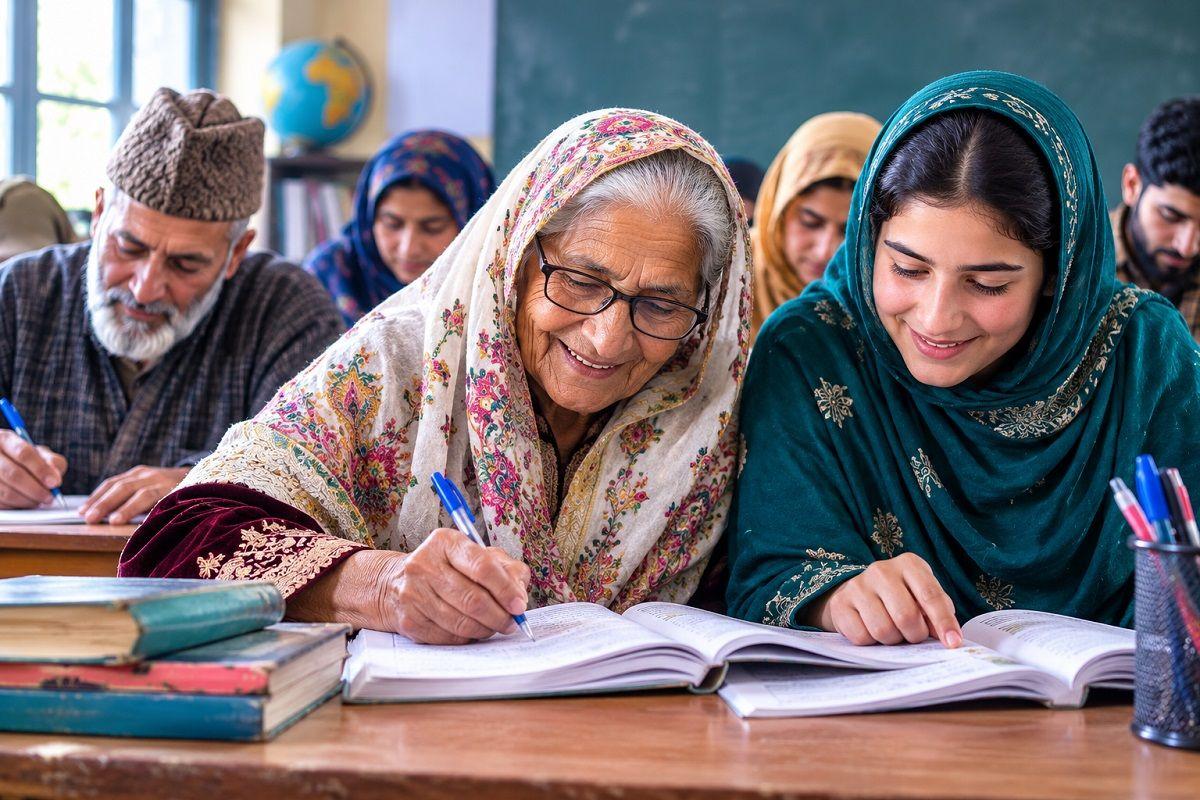
ULLAS is unusual among government schemes in that it runs substantially on volunteer teaching. The model is deliberately low-infrastructure: volunteers, many of them school and college students, teach non-literate adults in their own neighbourhoods, often in the learner's home or a nearby school building outside hours.
For a college student in Jammu, that is one of the few government programmes where the participation route is genuinely open rather than nominal — and it is the kind of thing that reads properly on an application for a fellowship or a teaching course, because it is real contact hours with a real learner.
If you want in, the route is the school education department's district and zonal offices, or your own institution's NSS unit, which is usually where ULLAS volunteer drives are routed.
What else was announced the same day
The literacy declaration came alongside several other school-education items, which are worth recording because they affect classrooms rather than statistics:
460 civil works projects worth ₹38 crore for school infrastructure.
2,403 vocational labs in high and higher secondary schools.
A Vidya Samiksha Kendra at Srinagar, set up to monitor learning outcomes.
The number this one does not replace
An adult literacy milestone and a school system in good health are different claims, and it is worth holding both in view. Last month we reported that J&K's secondary dropout rate rose to 12.6% — losses concentrated at exactly the stage that is hardest to reverse, and a separate problem from the one ULLAS was built to solve.
Read together, the two numbers say something more useful than either alone: J&K has got very good at bringing adults who were never schooled to a foundational level, and still loses a meaningful share of teenagers who were.
