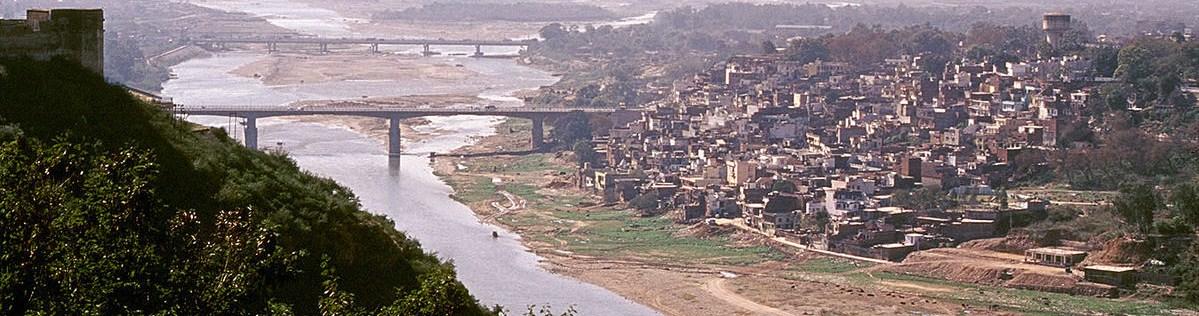
On a clear March morning the Tawi can fool you. The water runs high and bright with the first hill melt, the Bahu Fort ramparts catch the light on the far bank, and from the bridges the river looks the way Jammu likes to remember it. Walk down to the edge, though, and the other story is still there in the silt: plastic snagged in the reeds, plates and wrappers from a hundred picnics, the grey scarf of a drain meeting the current. The river that gives the city its older name, Suryaputri, has been fighting for its health for years. This spring, as the blossoms open, it is worth asking honestly how that fight is going.
A river under pressure
The Tawi's troubles are not a mystery; they are a matter of arithmetic. For years the city has discharged tens of millions of litres of untreated sewage into the river every day, and more than a dozen drains open directly into its course, carrying everything from household waste to industrial runoff. Studies of the polluted stretch have tracked the damage in the language of biological oxygen demand, the measure of how much life the water can still support. The encouraging part of that same data is that the trend has bent the right way: stretches that were once unfit even for bathing have seen their readings improve, the result of awareness drives, institutional pressure and slow infrastructure work. The Tawi is not healed. But it is, by the numbers, less sick than it was.
What makes the river hard to fix is that it is not one problem but several wearing the same coat. There is the engineering problem of sewage and drains, which only treatment plants and interception can solve. There is the behavioural problem of a population that has long treated the banks as a place to leave things behind, picnic plates, idol-immersion debris, construction rubble. And there is the upstream problem of what flows down from beyond the city, which no Jammu cleanup can reach. Untangling them needs the slow, unglamorous work of infrastructure married to the fast, visible work of citizens, and the river only recovers when both move at once.
The people who keep showing up
Much of that progress traces back to citizens who simply refused to wait. For several years now, volunteer groups and student collectives, often led by young people in their twenties, have made the riverbank a regular weekend address, pulling out sacks of waste, planting along the banks, and using each drive as a small act of public theatre to shame the carelessness out of the rest of us. Schools, colleges and the university have folded cleanups into their calendars. The effort has always run ahead of the official support behind it, and the volunteers will tell you so plainly; their work is proof of what a city can do for itself, and a polite, persistent reminder of what the city's systems still owe the river.
Talk to the regulars and a pattern emerges. The hardest part, they say, is not the lifting but the loneliness of it, the Monday when the same stretch is dirty again and the temptation to ask what the point was. What keeps them coming back is partly stubbornness and partly the slow accumulation of small wins: a bank that stays cleaner for longer, a school group that turns up unprompted, a neighbour who once shrugged and now carries his waste home. They have learned to measure success not in a single spotless morning but in the gradual shifting of a city's habits, which is the only kind of victory a river like the Tawi will ever offer.
Spring is the season to join in
If you have only watched from the bridge, the warming weeks of March and April are the easiest time to step down to the bank yourself.
- Find a drive. Local environmental groups and college eco-clubs post weekend cleanups on social media; the riverfront stretches near the Tawi bridges are the usual gathering points.
- Come equipped. Gloves, sturdy shoes, sacks and a refillable water bottle are all you need. Segregate what you collect so it can actually be processed rather than dumped again.
- Make it count beyond the morning. The bigger win is behaviour: carry your picnic waste home from Bagh-e-Bahu and the riverside, and nudge the friends who do not.
- Push the slow levers too. Cleanups treat the symptom; sewage treatment and drain interception treat the cause. Backing those demands, loudly and locally, is part of the work.
What the river is owed
There is a version of Jammu, not far off, where the Tawi is the city's front garden rather than its back drain, where the spring walk along the water is something residents boast about. Getting there is not romantic; it is sewage lines, treatment capacity, enforcement, and a population that stops treating the river as a bin. But the volunteers wading in every spring have already settled the harder question, the one about whether anyone still cares. They do, and they keep coming back. As the blossoms open over the banks this March, the kindest thing the rest of Jammu can do is come down and join them.