Dogri has the paperwork. It sits in the Constitution's Eighth Schedule and, on paper, among the official languages of the Union territory. What it needs now is a writer under 25. This editorial argues that the next step for the language is not another declaration but a plain, practical one: more young people being able to read and write it.
What the law has already done
The Constitution (Ninety-second Amendment) Act, 2003 added Bodo, Dogri, Maithili and Santali to the Eighth Schedule, which lists the languages the Constitution recognises (the Schedule as published by the Ministry of External Affairs). In 2020 Parliament passed the Jammu and Kashmir Official Languages Act, 2020, which names Kashmiri, Dogri, Urdu, Hindi and English as official languages of the Union territory from a date the Administrator fixes by notification; PRS Legislative Research summarises the bill. We did not locate that notification while preparing this piece, so we are not saying when, or how fully, the provision applies in practice.
Recognition of that kind confers status. It does not confer readers.
The gap is in the writing
A small, unofficial survey reported this month points at where the thin spot is. Respondents in Jammu district who said they speak Dogri regularly came to 56%; in urban areas only about 4% could write it. The study is one student's effort, with no published sample size, so it is a pointer and not a census: our report has the details and the caveats. A language that is spoken at home but never written is hard to teach, hard to publish in and hard to use in an exam, an application or a start-up pitch.
What is already working
The encouraging evidence is local and small-scale. In Samba, a Ramleela club is staging the Ramayana in Dogri for the first time after a dramatist spent more than three years on a new script; we reported on it. In Jammu city another club that has run Dogri competitions and poetry sessions is preparing a Ram Leela, which we covered separately. Both put the language on a stage where it carries a whole story, which is the kind of long, living use that textbooks cannot supply.
Three modest asks
- Make the written form usable first. Anyone who wants to read Dogri should be able to find a short, free primer and a set of simple texts. Nothing in the sources we read says this does not already exist; we simply could not point a reader to one, and that is itself a gap.
- Give young writers a reason. Competitions, school magazines and campus events that accept Dogri entries cost little and create a reason to write.
- Treat stage and screen as classrooms. If a village Ramleela can bring Dogri to hundreds of listeners, a campus society or a local studio can too.
What this is not
This is not an argument against Hindi, English or French, which many young people in Jammu reasonably learn for work and study. The survey's own story notes the rise of French alongside the decline in Dogri writing, and the two are not in conflict. The case for Dogri is that a language used only in speech depends on the people who happen to remember it. A generation that can also write it can pass it on.
This is the view of JammuBeat's editorial desk. If you write or teach in Dogri, tell us what you wish existed at hello@jammubeat.com.
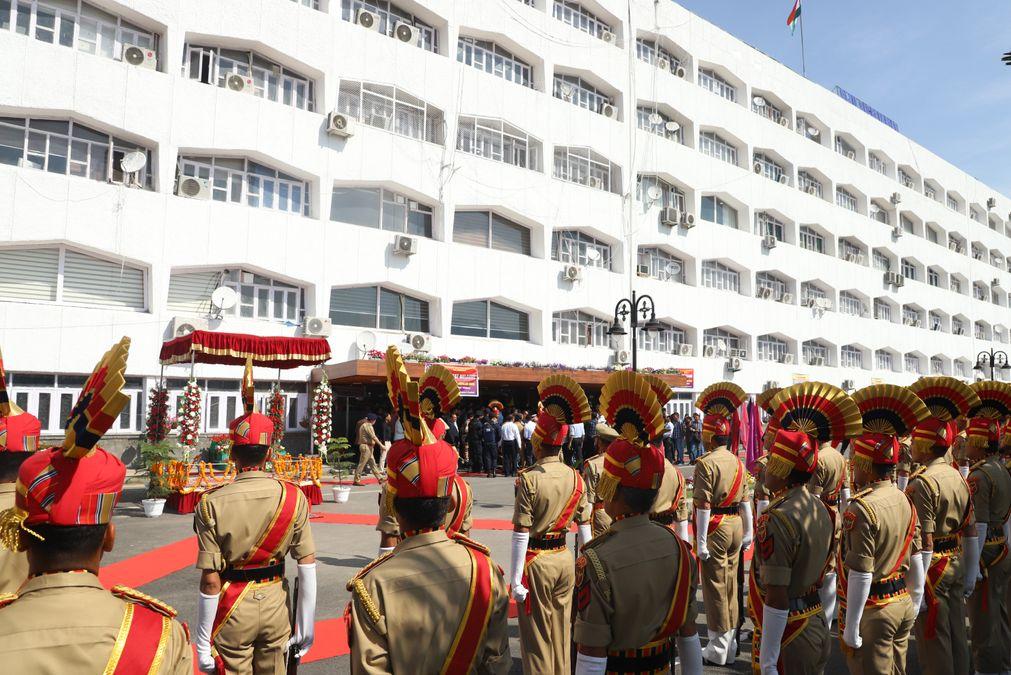
Sources: J&K Official Languages Act, 2020; PRS Legislative Research; Eighth Schedule to the Constitution. Photo: Pragyana Mehrotra / Wikimedia Commons (CC BY-SA 3.0), file photo of Mubarak Mandi.