On 28 May 2025, a door inside Mubarak Mandi opened for the first time in more than eighteen years.
Officers from the Hospitality and Protocol Department and the Directorate of Archives, Archaeology and Museums stood inside the palace Toshkhana — the old royal treasury. Police armourers examined weapons. Metallurgists looked at corrosion on metal objects. An older inventory was checked against what was actually in the room, and the whole thing was videographed.
It looked like the end of a long bureaucratic story. It was not. Within months the exercise had stopped, tangled in a dispute over method: experts objected that measuring every single artefact before handover was impractical given how many objects were waiting. Nothing moved for the better part of a year. On 19 May 2026, the Hospitality and Protocol Department issued a fresh circular restarting it — verification sessions every Monday, Wednesday and Thursday, the whole job to be finished within three months, with any laxity to be "viewed seriously."
Those three months are up this week.
That small, unglamorous saga is Mubarak Mandi in miniature. A room gets opened but its contents do not become a collection. A building gets repaired but not necessarily opened. A master plan gets approved but the money arrives through four different schemes. A deadline gets announced, missed, and replaced with a new one.
If you have grown up in Jammu, you have watched this from the outside — scaffolding you have never seen come down, gates you have never walked through, a skyline everyone calls the city's pride and almost nobody has been inside. So here is the whole story: how the palace was built, how it fell apart, where roughly ₹100 crore of public money has gone, what is actually locked in the treasury, and who has proposed turning parts of it into a hotel.
1710 or 1824? A palace built in layers
Mubarak Mandi does not have a birthday, and you should be suspicious of anyone who gives it one.
One tradition, drawn from the nineteenth-century Dogra chronicle Rajdarshani, traces the royal precinct to Raja Dhruv Dev, who is said to have moved his court from Purani Mandi up to the ridge above the Tawi around 1710. Government and tourism descriptions more often date the oldest surviving palace fabric to 1824. Both can be true: an earlier courtly site on the ridge, and a much larger nineteenth-century complex built over and around it. What you should not do is treat the two dates as interchangeable.
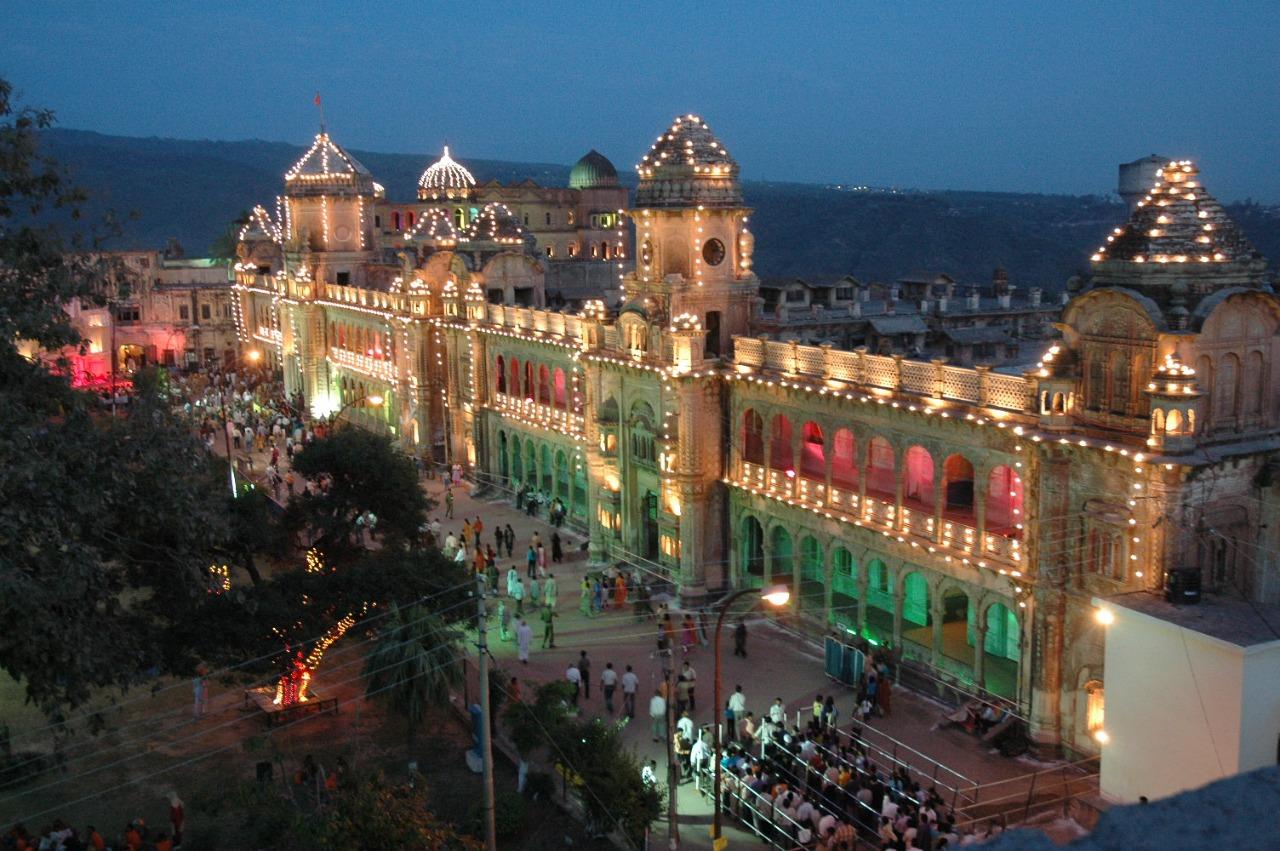
What is not in dispute is how it grew. Gulab Singh's rise — from Raja of Jammu under the Sikh empire to Maharaja of the new princely state created in 1846 — changed the scale of the court entirely. Under Ranbir Singh the palace stopped being a residence and became a machine of government: residences for different branches of the royal household sitting alongside courts, an army headquarters, a foreign office, stores, stables and ceremonial halls. Pratap Singh's period added more palaces and late-Victorian flourishes. By the time Hari Singh succeeded in 1925, this was a dense urban complex of roughly 25 buildings, not one architect's neat composition.
Which is why the architecture changes as you walk through it. Rajput and Rajasthani vocabulary in the projecting jharokhas, chhatris and carved brackets. Mughal and wider Indo-Islamic forms in the courtyards, cusped arches and domes. Europe in the classical columns, the long arcades, the Durbar Hall conventions and the theatrical rounded mass of Gol Ghar. The Government of India's own tourism listing runs through the names: Darbar Hall, Pink Palace, Royal Courts, Gol Ghar, Nawa Mahal, Rani Charak Palace, Hawa Mahal, Toshkhana, Sheesh Mahal.
That mixture is not confusion. It is a record of how a Himalayan court presented itself while moving through Rajput, Sikh, Dogra-princely and British-imperial worlds. And it makes conservation genuinely hard: you cannot recover a complex like this by fixing one façade, because its meaning came from the relationships between courts, offices, private palaces, ceremonial routes and the old city pressed up against it.
What happened after the Maharajas left
The decline did not start in 1947.
Hari Singh moved his principal Jammu residence to Hari Niwas in 1925, which ended direct royal maintenance while the palace stayed the seat of government. An 1898 fire is reported to have destroyed administrative records. You will often read that the complex has suffered "36 fires" — treat that as a repeated claim rather than an audited figure, because no incident-by-incident official register has been published. The fires that are firmly documented include 2006 and 2018.
After monarchy receded, the offices of the democratic state simply moved into rooms built for the princely one. Revenue courts, the High Court, the Public Service Commission, the Directorate of Information, archives and a long list of departments were fitted into palace halls. That kept the buildings occupied, but it was not conservation. Reception rooms were chopped up with brick and plywood partitions. Steel almirahs, coolers and open wiring were bolted into lime plaster. Tonnes of paper records piled onto floors designed for domestic use. Blocked drains and unmaintained roofs let water into lime-mortar masonry for decades.
Gol Ghar lost its floors and roof in the mid-1980s and has stood as a hollow shell ever since. The October 2005 earthquake pushed cracks through already weak walls. Engineering assessments found much of the complex unsafe, and the offices left — the High Court in 1994, the lower courts and remaining offices only by 2006.
Then came the part nobody plans for: a large, empty, unsupervised heritage site. Vegetation in the joints. Pigeons in the halls. No daily custodian, and no new public use ready to take over. As recently as 2024, heavy rain brought down another multi-storeyed portion of Gol Ghar. In June 2026, a slab beside the roughly 200-year-old Gadadhar temple next to the complex collapsed after rain, with residents linking it to excavation for the new multi-level parking nearby; officials said repairs had started.
This is the wider lesson about Jammu's built heritage, and it is not a comfortable one. Government occupation stops total abandonment, but decades of institutional use without a conservation regime eats the very fabric it accidentally protects — and when the offices finally leave, the buildings lose their last daily supervision before anything is ready to replace it.
The money: estimate, sanction, release, spend — four different things
Mubarak Mandi was declared a state-protected monument through SRO 126 on 26 April 2005. The Mubarak Mandi Jammu Heritage Society (MMJHS) was created in 2006 and the complex handed to it in 2008. INTACH prepared a conservation vision the same year.
Here is where reading the numbers carefully matters, because almost every public argument about this palace gets them wrong.
2010: a comprehensive project of about ₹296 crore was announced, with ₹50 crore approved by the Thirteenth Finance Commission for selected buildings. That was a plan estimate, not a cheque.
2017: an RTI-based report put actual money at ₹21.26 crore released and ₹13.51 crore used against a ₹298.86 crore estimate. In November that year the High Court recorded that only about 10 per cent of the complex had been restored and asked for clear timelines.
2019: a new master plan was approved dividing the complex into six adaptive-reuse zones — public zone and central courtyard, knowledge centre, interpretation and collection galleries, lifestyle spaces, experiential spaces, and a crafts centre. The first execution package was described at around ₹66 crore; the fuller master-plan envelope is now cited at ₹144.15 crore.
March 2023: the government's own completion deadline. During a site inspection the High Court found the ground reality contrary to that schedule; officials said five of 25 buildings were by then permanently lost.
March 2025: Assembly answers gave two snapshots — ₹59.69 crore sanctioned across seven projects with ₹17.70 crore of work complete; and separately, two sub-projects worth ₹12.34 crore finished (Army Headquarters, ₹3.96 crore, 2011; Royal Court–Gadvai Khana–Badi Deodi Phase I, ₹8.38 crore, 2022) with seven more "worth ₹33.85 crore" ongoing.
That last figure deserves a flag. The seven itemised project costs in the published answer add up to ₹21.81 crore, not ₹33.85 crore — a gap of ₹12.04 crore that only the official annexure can explain. It may be omitted components or revised estimates. It may be a reporting error. Either way, it is exactly the kind of thing a public dashboard would settle in ten seconds and currently takes an RTI.
Do not add these numbers together. Some are estimates, some are sanctions, some are completed-contract costs, some are the value of work in progress, and some cover visitor infrastructure rather than conservation. The absence of one public, building-by-building financial record is why every fresh announcement about Mubarak Mandi sounds like a beginning.
So why has it actually taken this long?
There is no single villain here. There is a chain.
The building is genuinely difficult. A multi-building complex on an eroding ridge, with lost roofs, fire damage, water in the masonry, frescoes, stucco and mirror work. Traditional lime mortar with surkhi and organic additives cures slowly and cannot be rushed. A contractor who can put up an office block is not automatically qualified to conserve a palace, and the pool of masons who can carve matching nineteenth-century stone is small.
Work started before there was one settled plan. Emergency repairs, individual building packages, the 2008 vision and the 2019 master plan all overlapped. Understandable on a collapsing site; it still produced piecemeal execution.
Money came in fragments. Finance Commission grants, state and UT capital budgets, J&K Infrastructure Development Finance Corporation support and Smart City funds, each with its own scope and procedure. Stop-start funding is uniquely damaging in conservation, because a half-opened building keeps weathering while it waits.
Responsibility was split. The Society coordinates but had no engineering establishment of its own; Tourism executed for years; ASI handles specific phases at ASI pace; R&B now runs a dedicated wing; Culture and the Archives directorate own heritage and collections; Smart City built the café and parking; Hospitality and Protocol still physically holds the treasury. Everyone has a defensible role. Nobody owns the whole thing.
And restored buildings did not always get used. In 2018, completed sections were reported locked, short of money for toilets and lighting. A repaired roof is not a management plan, and empty heritage starts deteriorating again immediately.
Chief Secretary Atal Dulloo, reviewing the site in June 2026, put the delay principally down to inadequate funding in earlier years, saying the pace picked up over the last four or five years as money became available. Work is now under way on 11 buildings, of which nine or ten are described as 80–90 per cent complete and due by March 2027. Five further projects are proposed, including a laser show and a light-and-sound show.
The Toshkhana is not a treasure story. It is a paperwork story.
Crowns, gold palanquins and jewelled talwars make for a good headline and a bad understanding of the problem.
After the December 2006 fire, most of the valuables were moved on 25 December to a strong room in the Civil Secretariat — reportedly leaving behind a palanquin and a chest too large to fit through the Toshkhana doors. What stayed in the palace sat in single-lock and double-lock enclosures: armoury and weapons in one, silver and precious metalwork in the other.
In 2016 a Joint House Committee was constituted after allegations that items had been misplaced. In 2018 that committee criticised contradictory official accounts of whether the Toshkhana keys were missing or held by a court. None of that proves the collection was stolen. What it proves is that custody and public confidence had weakened enough to require formal verification — which is precisely what has been limping along since 2022, when the Administrative Council decided to wind up the Toshkhana Organisation and move everything to the Culture Department.
Before any of this can be displayed, every object needs an accession number, a verified description, dimensions, material analysis, a condition report, a provenance and custody trail, a photograph and a conservation priority. Objects at Mubarak Mandi and in the Civil Secretariat have to be reconciled against the old registers. Only then can a curator decide what can safely go in a case, in what light, for how long.
Jammu does not need a rumour-fed glimpse of royal wealth. It needs a catalogue it can trust — and, eventually, a gallery where you can see this material in the building it was collected in, rather than in a Secretariat strong room.
What about the Taj hotel everyone has heard about?
This one needs saying plainly, because the claim has hardened into local fact.
The heritage-hotel idea is real. In 2021 the Heritage Society invited expressions of interest for a private operator to develop and run a hotel in the Zanana Mahal cluster overlooking the Tawi — six residential palace buildings including Rani Bandrali Mahal, Rani Guleri Mahal, Rani Charak Mahal and Nawa Mahal, covering roughly 9,419 square metres, on a public-private basis. The argument was financial: a hotel could generate revenue to maintain the rest of the complex.
The objections were also real. Critics — including heritage groups and sections of the bar — argued that inserting bathrooms, kitchens, plant rooms, fire escapes, lifts and commercial back-of-house into a declared protected monument risks irreversible change to exactly the fabric the protection exists for, and that handing the river-facing wings to a luxury operator alienates public space in the founding seat of the state.
But the Taj part is not established. Taj palace hotels such as Rambagh in Jaipur and Falaknuma in Hyderabad have been cited in local commentary as the model this could follow — and that comparison appears to be where the association came from. No government notice, EOI, tender or attributed official statement reviewed for this piece names Taj or IHCL as a selected or contracted operator at Mubarak Mandi. What the record actually shows is a hotel proposal that never reached a disclosed concession: a fresh transaction-adviser tender in 2024 after the 2021 exercise went quiet, and similar procurement resurfacing in 2025 and 2026. In other words, five years in, the government is still hiring someone to advise it on how to structure the deal.
Limited heritage hospitality is not automatically incompatible with conservation, and commercialisation is not automatically conservation either. The test is whether the use stays subordinate to the site. Before any concession, the things that should be public are obvious: a heritage-impact assessment, room and service layouts, structural and fire plans, water and sewage load, traffic, the terms of public access, the revenue-sharing formula, maintenance obligations and exit provisions. No operator should get exclusive control of the ceremonial spaces, the river view or the main public routes.
What is actually open right now
More than you might think, and less than the announcements suggest.
The Army Headquarters was restored years ago. Royal Court–Gadvai Khana–Badi Deodi Phase I finished in 2022. The heritage clock runs, the façades are lit, and restoration is well advanced on Darbar Hall, Raja Ram Singh Palace, Raja Amar Singh Palace and the Dogra Art Museum. A heritage cafeteria-cum-library opened to the public in May 2026 under a Smart City–MMJHS arrangement, with around 150 seats, and the 'Royal Legacy' hub has turned part of the complex into a genuine hangout with a café, library, 12D theatre and kids' zone. The Dogra Art Museum in the Pink Hall is open and holds more than 7,000 objects. The new heritage trail from Mubarak Mandi to Raghunath Bazar finally connects it on foot to the old city around it.
That is real progress and it deserves to be said clearly.
But a café is not a museum district, and illumination is not interpretation. Several restored or part-restored structures remain shut. Gol Ghar is still cordoned off. The Toshkhana collection has no display plan. And there is still no single public page telling you which gates, galleries and courtyards are open today, at what hours, at what cost, with what accessibility, and why the closed parts are closed.
What Mubarak Mandi should become
The false choice here is between sealing the palace as a monument and turning it into a themed attraction. The complex is big enough to be several compatible things at once, which is roughly what the six-zone master plan already gestures at: not one attraction, but a civic memory district.
An expanded Dogra Art Museum with rotating Basohli and Pahari displays. A properly curated Toshkhana gallery, opened only once the inventory and conservation are genuinely finished. A regional history museum that explains court, army, law, taxation and everyday life rather than only dynastic splendour. A public archive and research centre with digitised catalogues and supervised reading rooms — the thing a Jammu University student currently has no real equivalent of. Working space for Dogra and Pahari crafts, theatre, music and language, programmed year-round rather than for one festival. Courtyards for school programmes and evening performances with hard capacity limits. A café, a bookshop, and only where an impact assessment supports it, limited heritage accommodation.
That framing also fixes an imbalance. Mubarak Mandi was the seat of Dogra rulers, but the state governed from here was multilingual, multi-religious and regionally spread from the Punjab plains to Ladakh. Interpretation that explains power — patronage and taxation, reform and hierarchy, the rulers and the ruled — earns far more trust than interpretation that only celebrates it.
And none of it works without four unglamorous things: one conservation management plan covering every building, courtyard, temple, slope and view; one public dashboard showing sanction, contractor, deadline, extensions, physical progress and access status building by building; phased opening of safe completed sections on fixed dates instead of waiting for the whole complex; and a public-use covenant guaranteeing affordable entry, school access and accessible routes.
The real deadline is not March 2027
The current administration may well hit its target. Nine or ten projects at 80–90 per cent in mid-2026 could plausibly be finished by March 2027, and that would matter.
But this palace has had too many completion dates for one more date to count as recovery.
The test is what happens the morning after the scaffolding comes down. Are the doors open, and staffed, and maintained? Can a student read an archive there? Can a visitor work out why a Rajput jharokha, a Mughal arch and a European hall are standing in the same courtyard? Is there a published catalogue of the Toshkhana? Can craftspeople work there without being decor? Can private revenue fund conservation without privatising the place? Can any of us see where the money went?
In May 2025 officials opened a locked room and started counting what had survived. What Mubarak Mandi is really asking Jammu to do is a bigger inventory: of buildings saved and buildings lost, deadlines met and deadlines quietly replaced, and who the palace above the Tawi is actually for.
It will have recovered not when it looks like a postcard, but when you can walk in, ask questions of it, and trust the people looking after it.
Sources
Daily Excelsior — Govt revives stalled Toshkhana verification process (19 May 2026 circular)
Daily Excelsior — Toshkhana reopened after 18 years (May 2025)
Kashmir Observer — LG reviews Mubarak Mandi projects, June 2026
Daily Excelsior — March 2025 Assembly answer on completed and ongoing sub-projects
Business Standard / PTI — 2019 master plan approval and six zones
The Tribune — RTI figures on funds released and utilised (2017)
Daily Excelsior — High Court directives in the heritage PIL (2023)
Daily Excelsior — 2021 heritage-hotel expression of interest, Zanana Mahal cluster
Daily Excelsior — fresh transaction-adviser exercise for the hotel (2024)
%2Fgreater-kashmir%2Fmedia%2Fmedia_files%2F2026%2F06%2F27%2Fgmc-jammu-2026-06-27-05-46-24.jpg&w=3840&q=75)