Ask anyone in Jammu who has run a small business for more than a year what nearly killed it, and you will rarely hear "competition". You will hear about a payment that took eleven months to arrive.
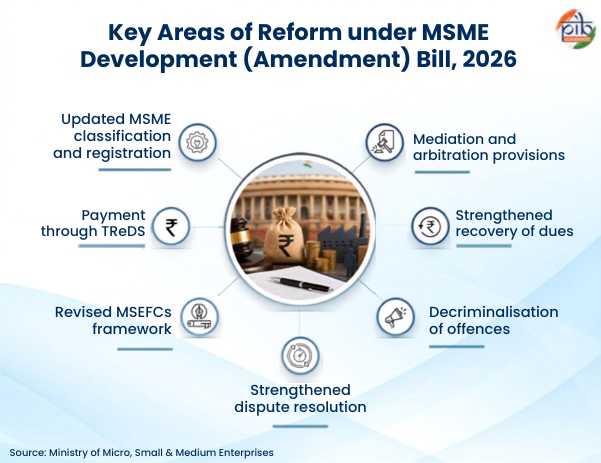
That is the problem Parliament has just legislated against. The Micro, Small and Medium Enterprises Development (Amendment) Bill, 2026 — introduced in the Rajya Sabha on 28 July, passed there on 3 August and in the Lok Sabha on 7 August — is the first substantial rewrite of the 2006 Act in twenty years. Most of the coverage framed it as a Delhi story. It is not: J&K now has around 6.16 lakh Udyam registrations, up from roughly 24,000 in 2021, and every one of them sits inside this law.
Here is what changes, in the order it is likely to matter to you.
If someone owes you money, there is now a clock
The old system had a delayed-payment mechanism that could drift indefinitely. The amendment puts fixed limits on each stage:
Mediation must be completed within 90 days of the first-appearance date.
If mediation fails, the case must be referred to arbitration within 30 days.
The arbitral award must come within 90 days of pleadings closing.
And the provision with real teeth: where a losing party challenges an award in court and the case runs past six months, the court may order payment of at least 50% of the award in the meantime. The old tactic — lose the arbitration, appeal, and let the small supplier run out of working capital — gets considerably more expensive.
States are also now permitted to set up multiple Micro and Small Enterprises Facilitation Councils rather than one. For a UT where a Jammu supplier previously queued behind the whole territory's caseload, that is a practical change.
Central public sector buyers must pay through TReDS
Every Central Public Sector Enterprise is now required to settle MSME invoices through the Trade Receivables Discounting System — an electronic platform where an unpaid invoice can be discounted with a financier instead of sitting on your books.
Why this matters here and now: on 22 August, the Chamber of Commerce and Industry Jammu wrote to the CEO of the J&K State Health Agency asking that Ayushman Bharat payments to empanelled hospitals be routed through TReDS too, along with a first-in-first-out rule for processing invoices. Whether or not that particular ask succeeds, it shows the mechanism the new Act mandates centrally is already being pushed at UT level.
Registration becomes voluntary — which is not the same as pointless
Filing the Udyam memorandum is now voluntary for all MSMEs, and the central digital registration platform is made permanent, with states allowed to run their own.
Read that carefully before you skip it. Registration is what makes you an MSME for the purposes of everything above — the delayed-payment machinery, the facilitation councils, the TReDS mandate. Voluntary means nobody will penalise you for not registering; it does not mean an unregistered business gets the protections.
How you are classified has moved out of the Act
The twin test stays: investment in plant and machinery and turnover. What has changed is that the actual thresholds are no longer written into the statute — they are now set by notification, so they can be revised without going back to Parliament.
One detail worth knowing if you are building anything technical: spending on research and development, pollution control and industrial safety is excluded from the investment calculation. You can invest in an R&D setup without it pushing you out of your category and out of the benefits attached to it.
Getting the paperwork wrong is no longer a criminal matter
Several compliance offences have been decriminalised and replaced with a graded penalty ladder:
False information at registration: a warning first, then a fine of ₹1,000 to ₹50,000.
Reporting violations: a warning, then ₹10,000 to ₹50,000, then ₹50,000 to ₹1 lakh for repeat instances.
Penalty amounts escalate by 10% every three years. For a first-time founder, the meaningful shift is that an administrative slip is now a fine rather than something that can turn into a prosecution.
So what should you actually do?
Register on Udyam if you have not. It is free, it is now optional, and it is the gate to every protection in this piece.
Check whether your buyers are CPSEs. If they are, ask when they are onboarding to TReDS.
Date your invoices properly and keep the acceptance record. Every clock in the new Act runs from a date someone has to prove.
If you are already stuck in a delayed-payment case, the new timelines and the 50%-on-appeal provision are worth raising with whoever is advising you.
None of this is a substitute for the funding side of the ecosystem — for that, our plain-English guide to Mission YUVA is the better starting point. But schemes hand you capital once. Getting paid on time is what keeps a business alive after the scheme money runs out.
Sources: PRS Legislative Research bill track for the provisions and passage dates; Press Information Bureau; and Greater Kashmir for the ICC Jammu representation of 22 August 2026.
%2Fgreater-kashmir%2Fmedia%2Fmedia_files%2F2026%2F06%2F27%2Fgmc-jammu-2026-06-27-05-46-24.jpg&w=3840&q=75)