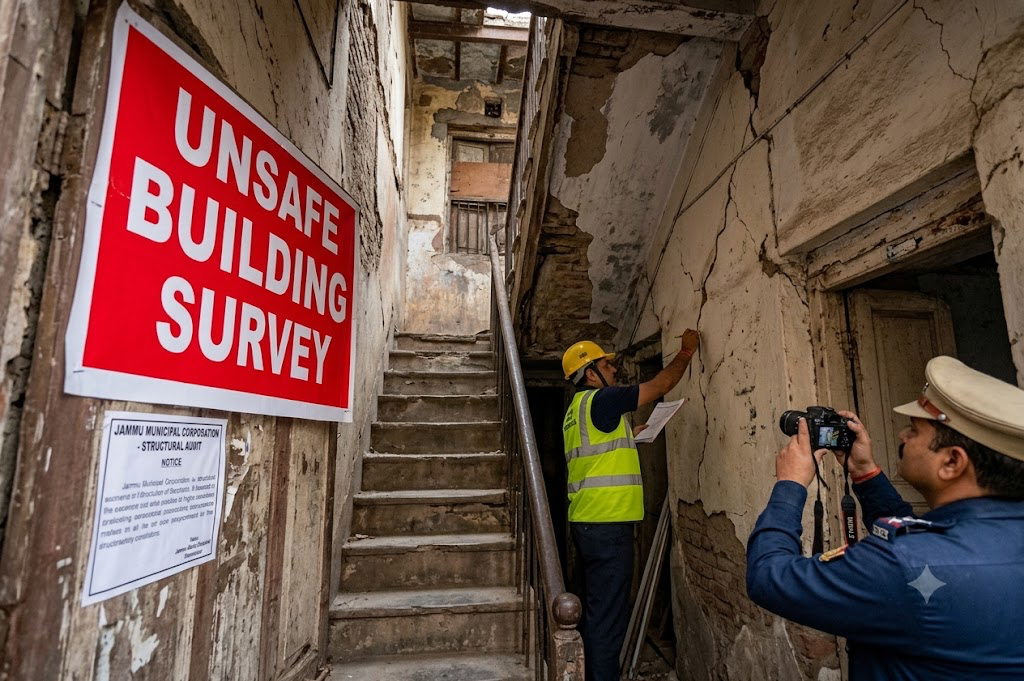
If you rent a room in the Old City, or sit in a coaching class on the first floor of an ageing building off one of the bazaar lanes, here is a question worth asking over the next fortnight: is your building on the list?
Jammu Municipal Corporation has ordered a city-wide drive to identify dilapidated and structurally unsafe buildings. Ward-level inspection teams have been given 15 days to finish their assessments and submit detailed reports. The order came from JMC Commissioner Devansh Yadav.
This is a survey, not a demolition drive — an important distinction, and one the corporation has itself drawn. But it is the step that decides which buildings get looked at seriously, and a large share of the stock in question is exactly the stock that young renters, students and coaching centres occupy.
What are the teams actually looking for?
The drive is focused on three things: the Old City; institutional buildings where large numbers of people live, work or gather; and residential structures 50 years old or more that are showing significant deterioration.
The assessment itself covers structural columns and foundations, water seepage, severe deterioration, and landslide risk. Each ward team's report has to record four things for every building it flags: location, ownership, a condition assessment, and recommendations.
That last field is the one that matters most, because it is where the fate of a building is actually decided.
Does unsafe mean it gets demolished?
Not automatically, and the corporation has been explicit about this. Structural engineers will assess whether a building can be made safe through retrofitting or structural strengthening before any decision to demolish is taken. Priority structures are then addressed under the provisions of the Municipal Corporation Act.
For scale: over the past year, JMC says it identified around 15 buildings as unsafe, had them officially declared so, and subsequently had them demolished. “Over the past year, we have identified around 15 buildings that were unsafe, got them officially declared unsafe, and subsequently had them demolished,” Yadav said.
Fifteen buildings in a year is the baseline against which to read this survey. Whether a 15-day city-wide sweep produces a comparable number or a much larger one is the thing to watch when the reports come in.
Why young renters have the most at stake
The honest case for this being a youth story rather than a municipal-file story is about where people actually live. A significant part of Jammu's rental market for students, paying guests and young workers sits in older building stock, much of it in and around the Old City, because that is where rent is lowest and where the coaching institutes, colleges and bazaar jobs are within walking distance. The same stock houses a good number of small first-floor coaching centres and hostels.
A survey that flags a building can cut two ways for the person renting in it. A recommendation to retrofit is, on balance, good news — it means the structure gets strengthened while people stay. A recommendation to demolish means finding somewhere else to live or study, possibly at short notice and almost certainly at higher rent. Either way, the tenant is rarely the person consulted, and is usually the last to hear.
This is also not the first time Jammu's building stock has come under this kind of scrutiny this year. In July, the High Court ordered a safety audit of the city's coaching hubs, hotels and banquet halls, with JMC directed to check fire clearances and building violations — a piece we covered in Fire Exits and Parking, Finally in the Spotlight. The two exercises look at overlapping buildings from different angles: one at fire and compliance, this one at whether the structure itself is sound.
What has not been announced
Three gaps are worth stating plainly, because they are the things a reader would most want and none of them has been published.
There is no public reporting channel named. The corporation has said it has been receiving complaints about unsafe structures, but no helpline, email or ward-office procedure has been specified for a resident who wants to flag a building. We are not going to print a number that has not been announced.
The specific section of the Municipal Corporation Act under which priority structures will be dealt with was not named.
There is no stated plan to publish the findings. Nothing announced so far says whether the ward reports, or a list of buildings declared unsafe, will be made public, or whether occupants will be notified directly and with how much notice.
What to do with this in the meantime
Nothing here requires a tenant to act. But if you are signing or renewing a rental agreement in the Old City over the next few weeks, it is a reasonable moment to ask a landlord directly whether the building has been inspected, and what the ward team said. The survey window closes in roughly a fortnight from the order; what follows it is an engineering assessment, not an immediate decision.