For years, the question every JEE topper from Jammu asked themselves was narrow and a little terrifying: which branch? Computer science or electronics, mechanical or civil — pick once, at seventeen, and live with it for four years. IIT Jammu has just decided that's the wrong question. Its newest undergraduate degree, a BTech in Unified Engineering, throws out the rigid branch silos altogether, and the timing matters for local students: it is on the table right now for anyone who cleared JEE Advanced 2026 and is filling choices in the ongoing JoSAA counselling.
So what actually is 'Unified Engineering'?
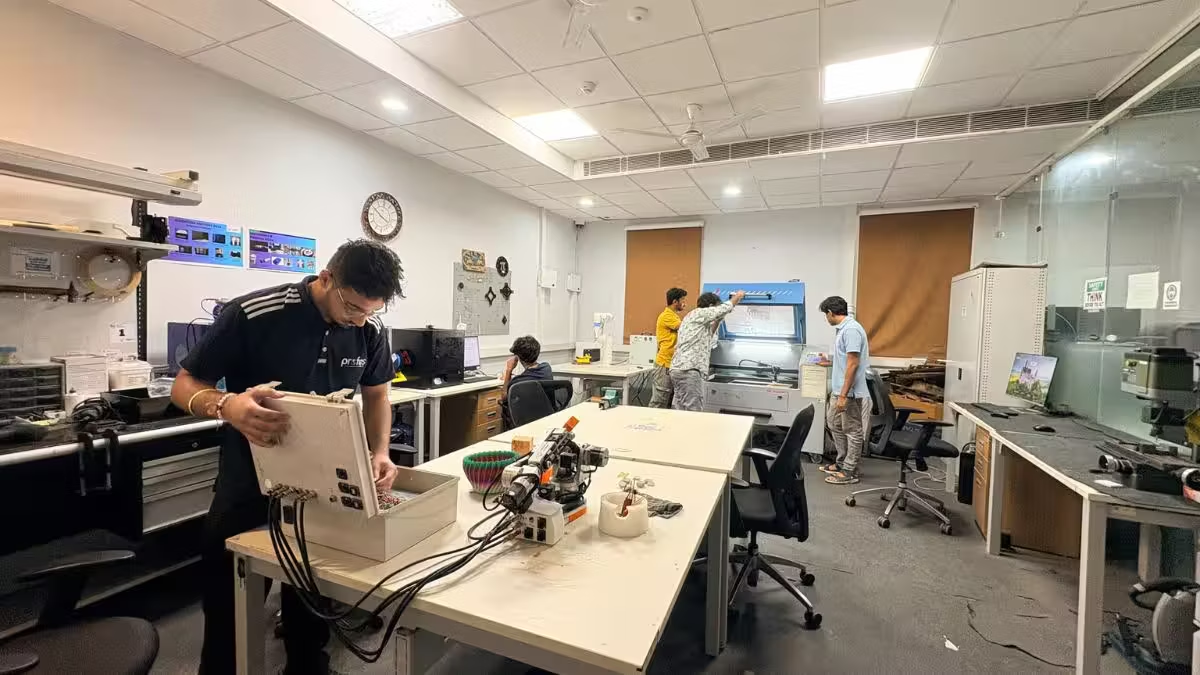
Instead of admitting you into a single department on day one, the programme starts students on a common, interdisciplinary foundation and lets specialisation emerge from the problems they choose to solve. The curriculum is built around what IIT Jammu calls a 'Grand Challenge' framework — challenge-driven, hands-on projects that pull from artificial intelligence, intelligent systems, robotics, smart mobility, electric vehicles and sustainable energy, rather than chapters in a single textbook.
Two features stand out for a generation that has grown up with chatbots. First, generative AI is baked into the learning environment — students are expected to work alongside cutting-edge AI tools as everyday companions, not banned distractions. Second, the emphasis is squarely on building. "We wanted to create a program where learning feels like an active engineering experience rather than a classroom chore," said Navneet Kumar, the programme chair for Unified Engineering at IIT Jammu — a line that doubles as a quiet critique of how engineering has often been taught in India.
Why this is a big deal for Jammu's students
For a young person in Jammu weighing whether to leave home for a 'bigger' IIT, a flagship, future-facing degree on their doorstep changes the maths. The programme is plugged into IIT Jammu's wider ecosystem — its placement network and a planned innovation park — which the institute says will give undergraduates direct exposure to startups, research and recruiters. IIT Jammu's published recruiter list already includes names like Amazon, Samsung, Intel, Siemens, ABB, Nokia, TCS, IBM, Dell Technologies, Flipkart, HP and Hitachi Energy.
The pitch is that graduates won't be boxed into one job title. The institute frames the degree as preparation for cross-functional roles — systems engineers, product developers, automation specialists and AI professionals — the kind of hybrid profiles that hiring managers increasingly ask for and that traditional single-branch degrees struggle to produce.
Is the 'no fixed branch' model right for you?
It's worth being honest with yourself, because this degree rewards a particular temperament. If you already know with total certainty that you want to be, say, a civil engineer designing bridges, a conventional branch programme may suit you better. But if you're the kind of student who tinkers across domains — who has built a small robot, dabbled in app code, taken apart a motor and wondered how an EV battery management system works — then a programme that lets you wander across AI, robotics, mobility and energy before committing is a genuine advantage rather than a compromise. The flip side of freedom is self-direction: in a challenge-driven curriculum, the students who thrive are the ones who chase problems on their own rather than waiting to be handed a fixed syllabus. For motivated young people in Jammu who have often felt that 'real' engineering exposure meant leaving the region, that trade-off is likely to feel like a feature, not a risk.
How to actually get a seat
Here is the part to act on. Admission runs through the Joint Seat Allocation Authority (JoSAA), the common counselling that allots seats across the IITs, NITs and other centrally funded institutes to candidates who qualified JEE (Advanced for IITs). JoSAA 2026 registration and choice-filling opened on 2 June, and the multi-round seat-allotment process is running through late July. If you cleared JEE Advanced 2026, Unified Engineering is simply another choice you can add to your preference list on josaa.nic.in — there is no separate form to chase.
A few practical reminders for first-timers:
Lock your choices in priority order. JoSAA allots strictly by the order you list programmes, so put what you genuinely want highest — even if last year's closing rank looks intimidating.
Understand float, freeze and slide. After each round you decide whether to accept and hold a seat (freeze), stay in the running for a better one (float), or move within the same institute (slide). Misreading this is the most common way students lose a seat they wanted.
Don't skip the reporting and document steps. A seat allotment is provisional until you complete online reporting, fee payment and verification within the round's deadline.
Read the official UE page. IIT Jammu has put programme details at iitjammu.ac.in/ue; treat that and josaa.nic.in as the only authoritative sources.
The bigger picture
Unified Engineering is part of a visible shift at IIT Jammu, which has spent the last couple of years pushing AI micro-credentials, an innovation push and an emerging tech-park ambition in the foothills. For Jammu's 17- and 18-year-olds staring at a JoSAA choice list this week, the message is simple: the most experimental engineering degree in the region is no longer something you have to board a train to access. It's a tick-box on a portal you're already logged into.
Sources: Careers360 — IIT Jammu launches new 'unified engineering' course for BTech aspirants; IIT Jammu official website; JoSAA 2026 counselling schedule.