Soft tennis rarely makes the front page. But a small result out of Srinagar in late June deserves the attention of anyone in Jammu who cares about where the city's young athletes are headed.
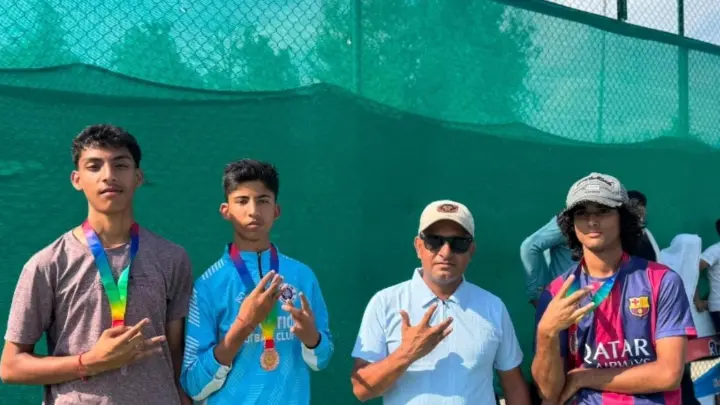
Four players from the Khelo India Soft Tennis Centre at MA Stadium, Jammu — Madhavendra Singh Sambyal, Harikesh Dutt Sharma, Aditya Dutt Sharma and Vihan Parihar — clinched the bronze medal at the 3rd North Zone National Soft Tennis Championship, held at Gindun Stadium, Srinagar, from June 26 to 28, 2026. They earned that podium against some of the strongest teams from across North India.
Why this is more than one medal
Soft tennis — played with a softer rubber ball and lighter rackets than the lawn game — is a discipline India has been quietly investing in, and it rewards exactly the qualities young players in Jammu can build without a lavish budget: footwork, anticipation and nerve. What makes this bronze notable is not just the result but the pipeline behind it.
These four did not train in isolation. They came up through a dedicated Khelo India centre based at MA Stadium, the beating heart of Jammu's sporting life, under the guidance of mentor and international soft tennis player Indu Bhushan Padha. That is what a functioning sports system looks like: a local facility, a coach who has competed at the top, and a clear route from practice court to national championship.
The numbers behind the momentum
The bronze sits inside a much larger surge. According to government data released earlier in 2026, Jammu and Kashmir has seen over 58 lakh youth engaged in sporting activity, with UT athletes bagging 2,556 national medals — 843 gold, 737 silver and 976 bronze — along with 84 international medals since 2021–22.
Those are not just statistics to recite; they describe a change in what is possible for a teenager in Jammu with talent and time. A decade ago, a promising player often had to leave the region to find serious coaching. Today, structures like the Khelo India centres, backed by the J&K Sports Council, the Youth Services & Sports (Y&SS) department and associations such as JKASTA, are trying to keep that talent home and competitive.
What it means if you're 16 and can play
The practical takeaway for young readers is simple. If you have ever been decent at a racket sport, or watched soft tennis and thought "I could do that," the on-ramp is closer than you think:
The facility exists. MA Stadium hosts a Khelo India soft tennis programme — not a distant academy in another state.
The coaching is credible. Being trained by someone who has represented the country at the discipline is rare, and it is available in your city.
The results are real. A national podium in 2026 is proof that players from here can compete with, and beat, the best of North India.
The bigger frame
Jammu's sporting identity has long leaned on cricket and football, and this year the city is adding its own super leagues and academies to that mix. Soft tennis is a reminder that the region's medal potential is broader than the marquee sports — that boxing rings, wrestling mats, tennis courts and chess halls are all quietly producing names worth knowing.
For now, four teenagers have a bronze medal and a story. The more useful thing they have handed the rest of Jammu's youth is a template: local centre, serious coach, national stage. It is repeatable — and that is the point.
Sources: Morning Kashmir — Jammu's young aces clinch bronze at North Zone Soft Tennis Championship; Kashmir Life — 58 lakh youth engage in sports; J&K athletes win 2,556 national medals.