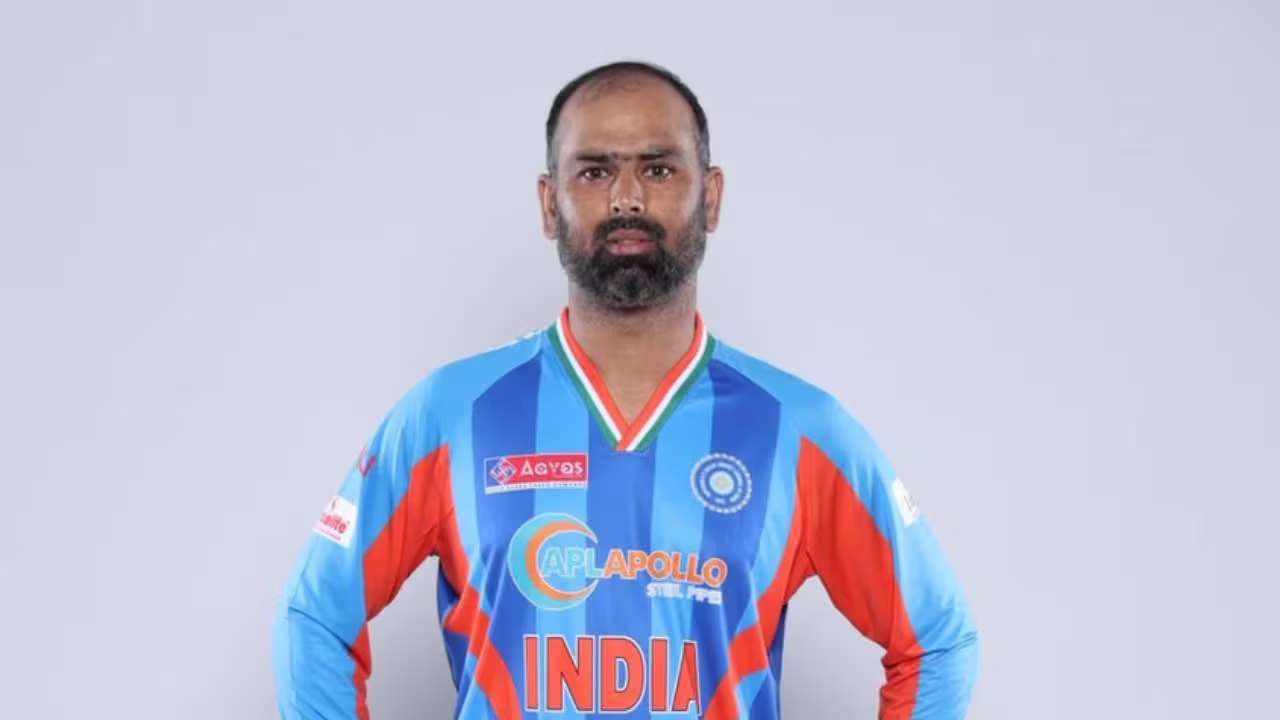
On August 19, when India's Mixed Disability Cricket team walks out at Lord's, the name against “captain” on the team sheet will belong to a player from Jammu and Kashmir. Majid Ah Magray has been named skipper of the 16-member Indian squad for a seven-match series in England — and he will not be the only face from home on the tour.
Two more J&K cricketers, Rizwan Altaf Bhat and Hilal Ahmad Wani, have made the travelling party, giving the Union Territory three players in a single national squad. For young sportspeople here who rarely see disability cricket covered at all, it is a rare and genuinely inspiring line to read: a J&K player, captaining India, on the tour of a lifetime.
What the tour actually is
The series is organised by the Differently Abled Cricket Council of India (DCCI) and runs from August 5 to 19, 2026 — seven Twenty20 internationals against England, each starting at 2:30 PM local time. The itinerary reads like a grand tour of English cricket:
August 5 & 7 — OurCoop County Ground, Derby
August 9 — Uptonsteel Grace Road, Leicester
August 12 — County Ground, Hove
August 15 & 16 — Arundel
August 19 — Lord's Cricket Ground, London
Finishing at Lord's, the sport's most storied venue, is the kind of stage most cricketers only dream about. To lead a side onto that turf — the ground they call the Home of Cricket — is a summit few Indian players of any description ever reach. That the captain leading them there is from Jammu makes it a first worth marking.
What “mixed disability” cricket means
If the format is new to you, it is worth understanding, because it is central to why this squad is special. Mixed disability cricket brings players from across a range of impairment categories — including physical disabilities, hearing impairment and others — into a single team, playing a full, competitive version of the T20 game. It is not a scaled-down or ceremonial format; it is international cricket, with selection trials, a national structure and a growing overseas calendar, of which this England series is among the most high-profile fixtures yet.
That structure is precisely what makes a captaincy meaningful. Magray hasn't been handed a token role — he leads a national side chosen on merit, one that will be measured over seven matches against a serious England outfit on its own soil.
Who leads and who coaches
Magray takes the armband, with Sai Akash Saivamani of Tamil Nadu named vice-captain. The squad is guided by head coach Rohit Jhalani, a former Rajasthan Ranji Trophy captain who brings top-level domestic experience to the dressing room.
“Majid Magray's appointment as captain is a proud moment not only for Jammu & Kashmir but for the entire differently abled cricket fraternity,” DCCI Secretary Ravi Kant Chauhan said of the selection — a line that reads as much like a statement of intent as a congratulation.
Why it matters for young Jammu
It is easy to file this under “feel-good” and scroll on. It is worth pausing on instead. Sport for players with disabilities in J&K has long run on grit more than infrastructure — short of accessible grounds, coaching pathways and, most of all, visibility. A homegrown captain and a three-player J&K contingent in an India squad is proof that the talent is here, and that it travels well beyond the Tawi.
For a teenager in Jammu who plays with a disability, or coaches or supports someone who does, the message is direct: there is a national team, there are selection routes, and people from this city are already in it — one of them wearing the armband. Representation like this does quiet, lasting work. It tells the next Magray that the path exists before anyone has to go looking for it, and it nudges the institutions that fund and organise sport here to take disability cricket as seriously as the players already do.
There is a wider point too. J&K has, over the past year, sent teams and athletes to national stages across hockey, shooting, wrestling and swimming. Add a cricket captain bound for Lord's, and the pattern is hard to miss: the region's young sporting talent is not waiting for permission.
A format finally getting its stage
Disability cricket in India has spent years fighting for the oxygen that the mainstream game takes for granted — grounds, sponsorship, television, a fixture list. A seven-match bilateral series in England, spread across grounds like Hove, Arundel and Lord's, is a marker of how far the format has travelled: this is a proper overseas tour, the kind that builds players and reputations. For the three J&K cricketers on it, the fortnight is both a contest and a shop window, in front of selectors and supporters who don't usually get to watch them play.
If you want to follow it, keep an eye on the DCCI's own updates through the series — seven matches in fifteen days is a genuine test of a squad's depth, and how India handles the back-to-back fixtures at Derby and Arundel will tell you a lot about the side Magray has been handed to lead.
The first ball is bowled at Derby on August 5. By the time the series closes at Lord's a fortnight later, a cricketer from Jammu will have led India in England — a sentence worth reading twice, and one a lot of young players here will be watching unfold.
Sources: Greater Kashmir · ANI · Cricket Country