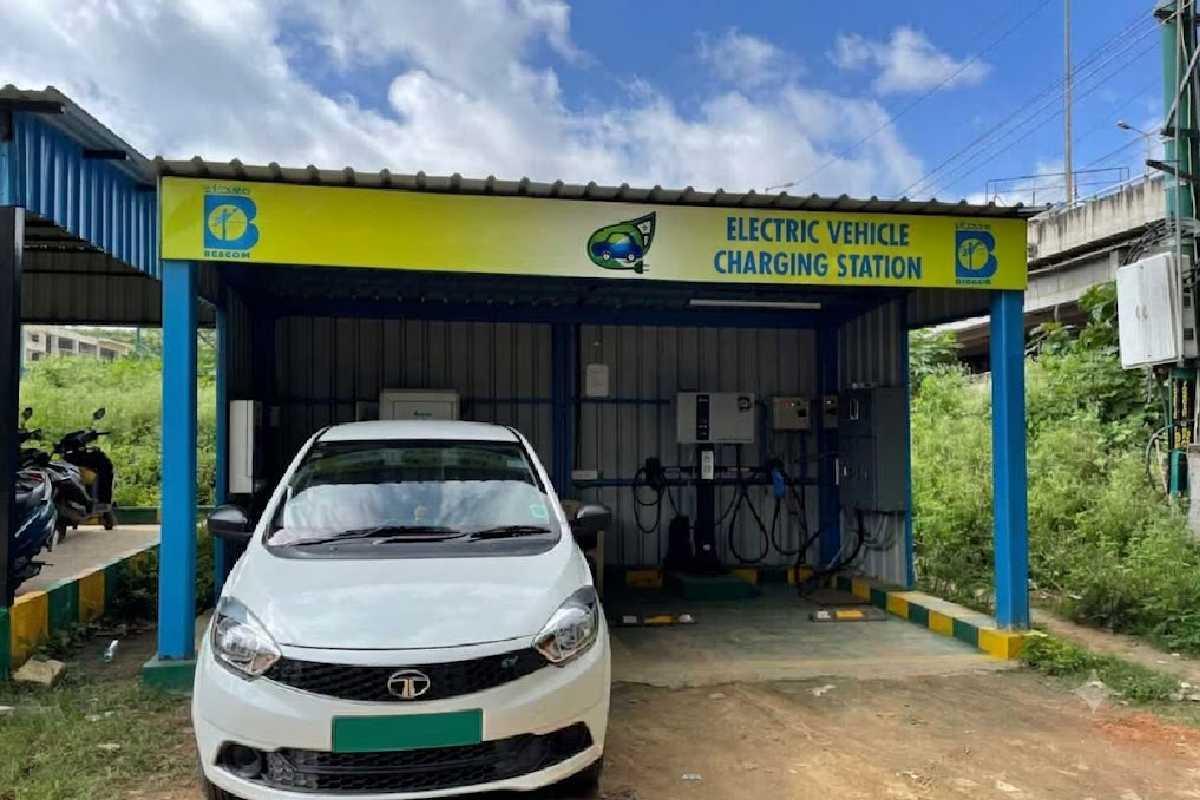
900. That is the number of public charging stations Jammu and Kashmir's draft Electric Vehicle Policy 2026 wants standing within six years. The Union Territory has roughly 180 today.
Start there, because it is the number that decides whether everything else in the document is real. An electric scooter is already the cheapest way for a student or a delivery rider in Jammu to get around. What stops people buying one is not the sticker price so much as the question of where you plug it in when you are not at home.
The targets, unpacked
The draft, prepared by the Transport Department, sets adoption targets to be hit over a six-year policy period. They are expressed as shares of new registrations, not of the vehicles already on the road:
40% of new personal four-wheelers
35% of new two-wheelers
30% of buses
25% of taxis and shared mobility
The two-wheeler figure is the one to watch in Jammu. Thirty-five per cent of new two-wheeler registrations going electric would visibly change what the Gandhi Nagar and Trikuta Nagar streets sound like.
From 180 to 450 to 900
The charging build-out is staged. About 180 public stations exist now; the draft targets 450 by year three and 900 by year six. Within that, 140 sites are designated priority fast-charging hubs, and these carry a service standard rather than just a construction target: at least 98 per cent monthly uptime.
That uptime clause is quietly the most important line in the draft. A charging point that exists but does not work is worse than no charging point, because you planned your trip around it. Writing a number into policy gives somebody something to be held to.
A winter test, which is the local bit
Most Indian EV policy is written for cities that never go near freezing. This draft is not. It provides for a Winter Validation Protocol — an assessment of battery thermal behaviour, how well vehicles accept a charge at low temperatures, and how much range is lost to running the cabin heater.
Anyone who has tried to start a vehicle in Patnitop in January, or watched a phone battery collapse on a winter morning in Jammu, understands the problem instinctively. Lithium cells lose usable capacity in the cold and charge more slowly. A range figure earned on a test track in a warm month tells a buyer in the Chenab Valley very little. Testing for it — and publishing the result — is the difference between a policy written for J&K and one copied into it.
What it would put in your pocket
On money, the draft offers two things. There is an interest subvention of up to 3 per cent a year on vehicle loans, or rolling top-up support — the two are alternatives, not a stack. And there is an annual scrappage exchange bonus, available for up to three years, for buyers who scrap an old vehicle through authorised channels.
A 3 per cent cut on the interest of a two-wheeler loan is not transformative on its own. On a multi-year loan for a first vehicle, it is not nothing either.
The arithmetic a rider actually does
Strip the policy language away and an EV decision in Jammu comes down to three sums.
The first is running cost. Electricity per kilometre is cheaper than petrol per kilometre almost everywhere in India, and as we reported after the September tariff revision, Jammu still pays less per unit than Delhi or Mumbai. On a two-wheeler doing 30 to 40 km a day — a college commute plus errands, or a part-time delivery shift — that gap is the single strongest argument for switching, and it needs no subsidy to work.
The second is the up-front price, which is where the interest subvention and the scrappage bonus are aimed. Neither closes the gap by itself; together they shave the monthly EMI rather than the sticker.
The third is the one policy has struggled with everywhere: confidence. Can you get home? A rider who lives in a flat with no dedicated parking cannot run a cable out of a third-floor window, which makes public charging not a convenience but the whole proposition. This is why the 900 figure and the 98 per cent uptime clause are the load-bearing parts of the draft, and the rest is detail.
What the draft does not settle
Two questions the published reporting does not answer, and that are worth asking of the final notified version whenever it appears.
Where the 900 go. A charging network concentrated on the Jammu-Srinagar national highway serves long-distance traffic and tourism. One distributed through Gandhi Nagar, Channi Himmat, Bakshi Nagar and Talab Tillo serves residents. Both are defensible; they are not the same policy, and the target number alone does not tell you which one J&K is buying.
Who pays for grid capacity. Fast chargers draw heavily, and the draft's 40 per cent renewable-integration target implies work at the distribution end, not just at the plug. A charging hub is only as reliable as the feeder behind it — which, in a UT where scheduled power cuts are a fact of life, is not a rhetorical point.
Eight pillars, and one caveat that matters more than all of them
The framework is organised into eight strategic pillars spanning vehicle adoption, charging infrastructure, workforce development, fiscal support, power-system integration and environmental outcomes, with a 40 per cent renewable-energy integration target across the policy period. It leans on the central PM E-DRIVE scheme for part of its funding.
Now the caveat. This is a draft. It has not been notified. Chief Secretary Atal Dulloo reviewed the framework in early September, with Transport Secretary Avny Lavasa among those present, and it is still with the Law Department for vetting. Until that finishes and a notification issues, none of the targets above binds anyone and none of the subsidies can be claimed.
So do not buy a scooter this month expecting a 3 per cent rebate. Do read the document as a statement of where the UT intends to go — and, if you are in the market for a two-wheeler in the next year or two, as a reason to ask a dealer what the winter range actually is before you sign.
The piece of this that is already real
One part of the electric transition in Jammu is past the drafting stage: the city's 100 sanctioned electric buses, and the ₹23-crore depot at Bhagwati Nagar they cannot run without, which we covered in Jammu's 100 Electric Buses Finally Have a Depot Coming. The draft policy's 30 per cent bus target is, in effect, a plan to do that several times over.
Sources: Greater Kashmir, 15 September 2026; The Northlines, 5 September 2026; Kashmir Life.