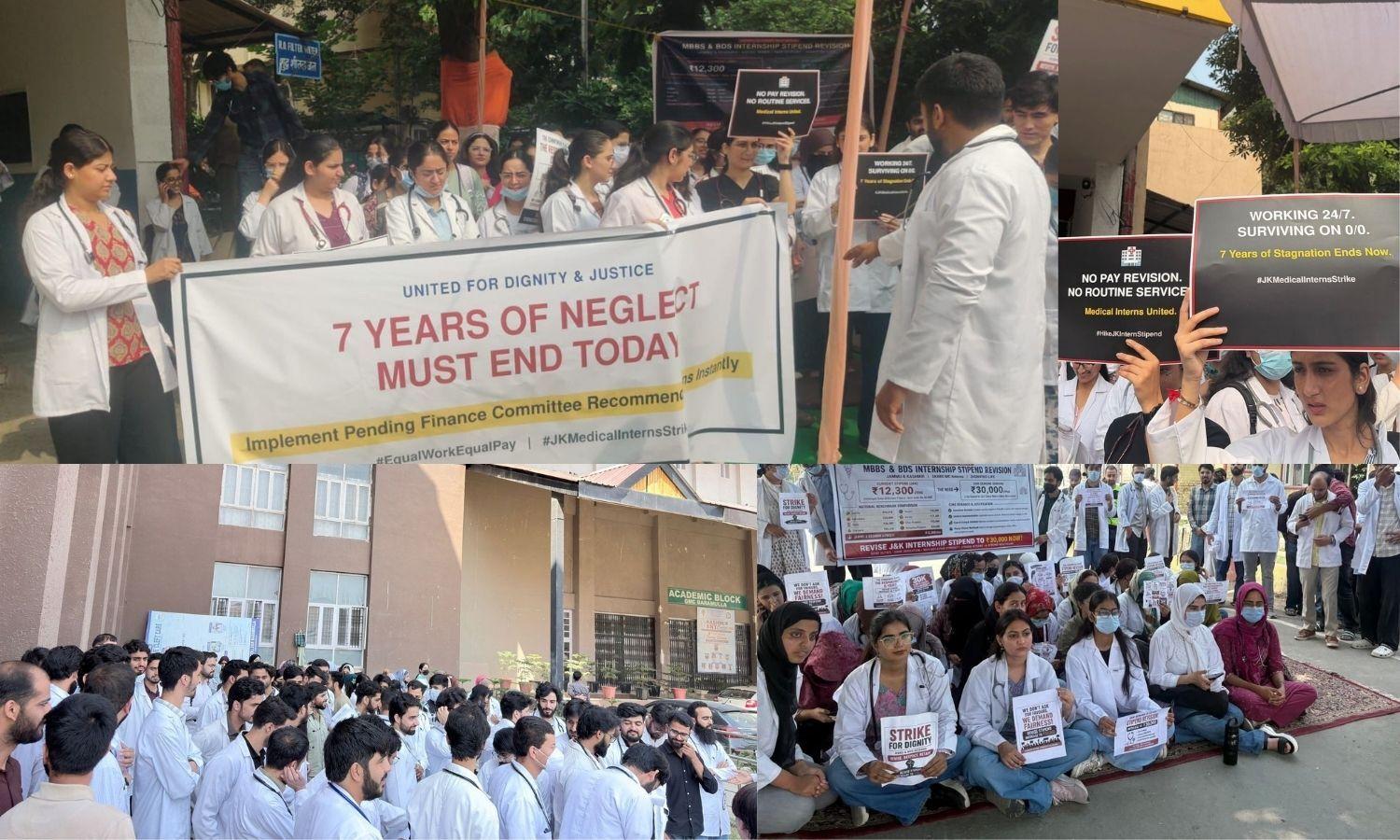
From 1 September, medical and dental interns across Jammu and Kashmir's government medical colleges stopped routine work. Interns at GMC Jammu, GMC Baramulla, GMC Anantnag, GMC Handwara, SKIMS and SKIMS Medical College Bemina are on an indefinite strike, with dharnas held at locations in Jammu alongside sit-ins outside SKIMS Bemina and GMC Srinagar.
The dispute is about one number that has not changed in close to seven years.
First, what an intern actually is
This matters, because "intern" in medicine does not mean what it means in an office. After completing the academic part of an MBBS or BDS degree, every graduate must do a compulsory rotatory residential internship — a year of supervised, full-time clinical work rotating through departments. You cannot register as a doctor without it. You cannot skip it, defer it indefinitely, or do it part-time while earning elsewhere.
During that year an intern does emergency duty, OPD, ward rounds, night shifts and 24-hour postings. They are, in practical terms, part of the workforce keeping a government hospital running. They are typically 23 to 25 years old, and most have families who have already spent heavily on getting them through medical school.
What the interns say
The stipend for that year in J&K is ₹12,300 a month — roughly ₹400 a day. It has been unchanged for nearly seven years. The interns are asking for ₹30,000 a month, and they have been explicit that they want a written government order rather than another assurance.
Their central argument is comparative, and they have made it with placards listing what interns are paid elsewhere in India:
Odisha — ₹44,319
West Bengal — ₹43,099
Assam — ₹35,000
Karnataka — ₹30,000
Kerala — ₹27,300
Delhi and Meghalaya — ₹26,300
Uttar Pradesh recently moved its interns from roughly ₹12,000 to ₹25,000. Speaking for the All India Medical Students Association, Dr Mohammad Momin Khan has pointed to the gap between what has been recommended in J&K and what has actually been ordered.
That gap is the second half of their case. A government-appointed committee recommended a revised stipend of roughly ₹26,300 a month — accounts of the exact figure vary slightly between ₹25,000 and ₹26,350 depending on the report, and a figure in that range was cited in the Assembly this year. No formal order has followed.
What the government says
Health and Medical Education Minister Sakina Itoo has not disputed the substance of the demand. She has called it genuine and said the proposal has been sent to the Finance Department.
Her position on the strike itself is that it is premature: "There was no need for them to go on strike as we are already working regarding the issue." She has urged the interns to reconsider, warning that "any disruption in services could impact patient care."
What is actually settled
Less is in dispute here than in most standoffs. Both sides agree the current stipend is low. Both agree a revision has been recommended. Neither disputes that J&K pays less than most states that have revised recently.
What is unresolved is where the file is and when it moves. The Health Department says it has sent a proposal to Finance. Finance has not issued an order. The interns say an assurance without an order is what they have been given before, which is why they are asking for the order first this time.
That distinction is the practical heart of the dispute, and it is worth understanding if you follow any government process here. A department recommending a revision and a department being able to pay for one are two different steps. A stipend revision is a recurring commitment on the health budget, so it needs the Finance Department's concurrence before an order can issue. Until that concurrence exists, the Health Minister's position and the interns' position can both be accurate at the same time — the proposal genuinely has moved, and no money has genuinely changed.
This has happened elsewhere, the same way
The comparison table the interns are holding up is not just a grievance. It is a prediction, based on a pattern that has repeated across several states.
Uttar Pradesh is the clearest recent example. Its interns were on roughly ₹12,000 — close to what J&K pays now — and moved to ₹25,000, covering around 3,928 interns. Madhya Pradesh went through a comparable revision. In state after state, the sequence has been the same: a stipend frozen for years, a committee recommendation that sits unimplemented, a strike, and then an order.
That is the context in which both sides here are operating. The interns are aware the recommendation alone has not historically been enough. The government is aware that the states which revised did so at numbers well above ₹12,300.
What it means if you are in Jammu
Two things, depending on who you are.
If you use a government hospital — GMC Jammu's emergency, OPD or wards — expect delays while this runs. Interns carry a meaningful share of routine load, and the interns themselves have framed the strike as withdrawal from routine services.
If you are a medical student, or someone weighing an MBBS seat after the NEET-UG results, this is a number to factor into a very long financial plan. The internship year is compulsory and it is the year you cannot earn elsewhere. ₹12,300 is what that year currently pays in this UT, and whether it changes depends on a file in the Finance Department.
There is no announced deadline, hearing date or next meeting. The thing to watch is a formal government order revising the stipend — until one is issued, nothing has actually changed.
