1,500. That is roughly how many people walk into the outpatient department at AIIMS Jammu on an average day — the institute's own figure, from a briefing by its director on 23 September. The daily range runs between 1,000 and 2,000.
Numbers like that are the clearest way to see what has happened at Vijaypur in under three years. The campus that admitted its first MBBS batch of 50 students now admits 125. Here is the rest of the ledger, and what each line changes for a young person in Jammu.
The teaching numbers
The MBBS intake has gone from 50 seats to 125 — a figure the institute's own website confirms, describing a 125-seat MBBS medical college in the academic block alongside a 60-seat nursing college. That is 75 additional MBBS seats inside the Jammu region at a central institute, which is the single biggest change in a local NEET aspirant's odds in years.
Beyond MBBS, the institute reports 50 super-speciality seats, including an MCh in Paediatric Surgery and a DM in Endocrinology. Those matter to a different cohort: MBBS graduates from GMC Jammu and elsewhere in J&K who have historically left the region entirely to do a DM or MCh. PhD programmes were described as planned.
The hospital numbers
The institute is authorised for 750 beds, of which 193 are ICU beds according to its own hospital page; the director's briefing described 650 as currently fixed. Clinical coverage stands at 30 broad specialities and 14 super-specialities, the latter including cardiology, neurosurgery and plastic surgery.
A nuclear medicine facility with PET-CT infrastructure was described as upcoming. No commissioning date was given.
The research and digital numbers
About 12 high-impact research projects worth ₹8-9 crore are active, alongside roughly 23 shorter ICMR-supported projects. The institute is also generating 15,000 to 24,000 ABHA IDs a month — the health account that sits under the national digital health stack.
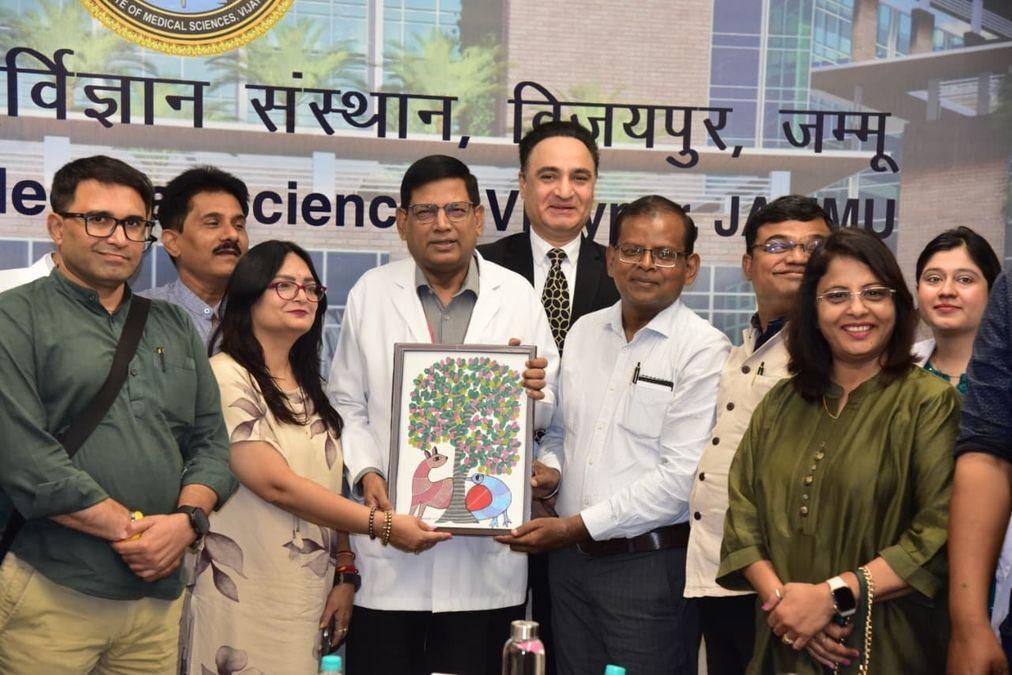
Present at the briefing were Prof (Dr) Sanjeev Sinha, Director and Chief Executive Officer; Prof (Dr) Shabab Lalit Angurana, Dean of Research and head of radiotherapy and oncology; and Dr Amit Chaudhary of hospital administration.
Why a central institute on the Samba road matters here
AIIMS Vijaypur came into existence as an Institute of National Importance through a central gazette notification dated 4 December 2019, under the Pradhan Mantri Swasthya Suraksha Yojana. It is about 20 kilometres out of Jammu city, which is close enough to be a realistic first stop rather than a referral of last resort.
For a reader in their twenties, the practical stake splits three ways. If you are sitting NEET-UG, there are 125 seats here rather than 50. If you already have an MBBS, there are 50 super-speciality seats that did not exist locally. And if someone in your family is on a specialist pathway — cardiology, neurosurgery, oncology — the number of things that no longer require a trip to Delhi or Chandigarh has grown considerably, as the institute's first leadless pacemaker implantation earlier this week showed.
What has not been said
Two gaps are worth naming honestly rather than guessing at.
First, cost. Nothing in the briefing addressed what a patient pays for the advanced procedures now available, or how much of it is covered under Ayushman Bharat. That is the question most families actually ask first, and it has not been answered publicly.
Second, the per-department seat and bed breakdown. The totals are on the record; the distribution across the 30 broad and 14 super-specialities is not.
There is also a reading-the-numbers caution. A 750-bed authorisation with 650 beds currently fixed is not the same as 750 functioning beds, and an OPD range of 1,000 to 2,000 is a range, not a capacity ceiling. The institute describes patients arriving from across north India, not only J&K, which means local demand and total footfall are different quantities.
The seats nobody mentions
One line in the institute's own description is easy to skip past and worth pulling out: alongside the 125-seat MBBS college, the academic block houses a 60-seat nursing college. Nursing and paramedical routes absorb far more Jammu school-leavers each year than MBBS does, and they are consistently under-covered next to the NEET scramble. Sixty seats a year at a central institute is a real door, and it does not require a top-percentile NEET rank to walk through.
The ABHA figure is worth a sentence too. An ABHA ID — Ayushman Bharat Health Account — is the digital health identity that lets records follow a patient between facilities instead of living in a folder at home. Generating 15,000 to 24,000 a month means a substantial share of everyone passing through is being enrolled, which mostly matters the second time you need care and someone can actually see what happened the first time.
The short version
An institute that opened to a 50-student batch is now teaching 125 MBBS students, running 50 super-speciality seats, operating 30 broad specialities, and seeing about 1,500 outpatients a day. For anyone in Jammu deciding whether medicine is a career they can pursue without leaving, that is a materially different answer than it was in 2024.
Sources: briefing by the Director, AIIMS Vijaypur, 23 September 2026, as reported by Greater Kashmir; bed, seat and institutional details from AIIMS Jammu's own hospital page. Related JammuBeat reading: AIIMS Jammu Set to Become India's First Hospital With Armed CISF Security Cover.