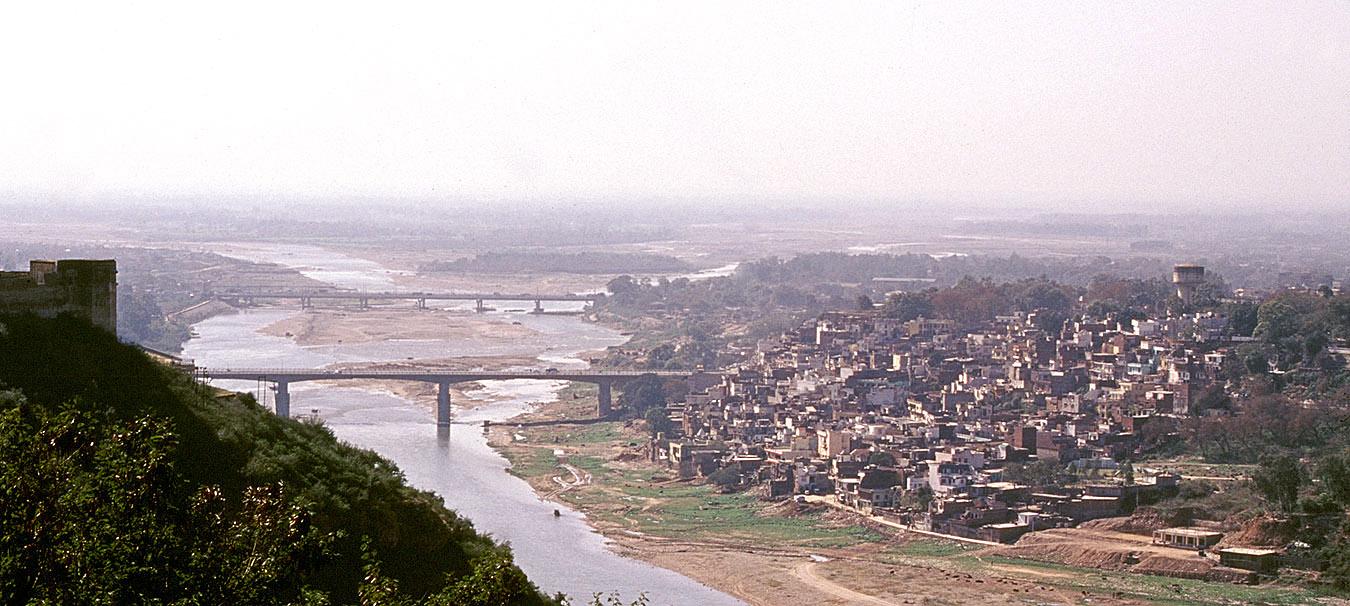
₹953.81 crore. That is the share of Jammu's new ₹1,567.91-crore Tawi riverfront project that no government has committed to pay — it is to be raised from the market and from public-private partnerships. Put another way: for every rupee of public money in the plan, roughly a rupee and a half has still to be found from private investors.
That number is the most important thing in the announcement, and it is worth understanding before anything else.
What was actually cleared
The Union Territory Level High Powered Steering Committee, chaired by Chief Secretary Atal Dulloo, approved three urban projects with a combined base cost of ₹2,692.58 crore under the Centre's Urban Challenge Fund. The Jammu one is TARANG — Tawi Area Regeneration and Green Growth, at ₹1,567.91 crore, the largest of the three.
Its funding splits three ways:
₹307.05 crore from the Government of India
₹307.05 crore from the Jammu and Kashmir government
₹953.81 crore to be mobilised through market-linked and PPP financing
The other two approvals were the Walled City and Nigeen Lakefront Revitalisation in Srinagar at ₹1,010.77 crore, and KRIPA — Katra Revitalisation through Integrated Pilgrimage Amenities in Reasi district at ₹113.90 crore.
KRIPA is the one Jammu readers will notice soonest, because Katra is an hour and a half away and most people here have made that trip more than once. It funds a multi-storey gateway centre carrying accommodation, retail space, dining and prayer facilities, plus a multi-level car park sized for 365 equivalent car spaces with electric-vehicle charging, and upgrades to the Municipal Committee's own offices. At ₹113.90 crore it is a fourteenth the size of TARANG — and much the most straightforwardly deliverable of the three.
The two halves of TARANG
TARANG is really two different kinds of project bundled into one number, and the distinction matters.
The first half is river engineering — a diaphragm wall, embankment filling, a retaining wall with anchor slabs, and interceptor drainage. This is the unglamorous part: stabilising the bank, and intercepting drains so that what flows into the Tawi is not raw sewage. It is also the part most clearly funded by the ₹614.10 crore of government money.
The second half is commercial. The PPP component covers a high-end group housing project, an upscale hotel, a modern retail mall and Left Bank road infrastructure. This is the part the ₹953.81 crore is meant to pay for, and it is the part that only happens if private developers decide Jammu's riverfront is worth building on.
What the Urban Challenge Fund is
The Urban Challenge Fund is a central scheme under which the Government of India contributes a share of a city's redevelopment cost, with the state or UT matching part of it and the balance raised commercially. The structure is deliberate: the central money is intended to make a site bankable enough that private capital follows, rather than to build the whole thing.
Which means TARANG's headline figure is a project ceiling, not a cheque that has been written. The ₹614.10 crore of public money is committed. The ₹953.81 crore is a plan to raise money. Those are different things, and Jammu will find out which one the riverfront gets over the next few years.
What it changes for a young resident
Three things, concretely.
Public space. Jammu has spent two years turning the Tawi's edge into somewhere people actually go — the aarti, the light shows, the boating deck. TARANG's drainage and bank work is what determines whether that stretch stays usable or goes back to being a drain with a promenade next to it. If you have spent an evening at the riverfront, this is the project that decides its next decade.
Jobs. A hotel, a mall and a housing project are, between them, one of the larger concentrations of hospitality, retail and construction employment proposed in Jammu city. Those are entry-level-heavy sectors — the kind of work a 22-year-old without a government job actually gets. But they arrive only with the private half of the financing, which is precisely the half that is not yet secured.
What the riverfront becomes. The same plan contains a public embankment and a private mall. How those two are balanced in execution — how much of the Left Bank ends up as open space and how much as leasable floor area — is a live question that the approval does not settle.
What has not been said
The committee stressed the need for timely execution, quality control and financial sustainability in implementation. It did not publish a construction timeline, a phasing plan, or a date by which the PPP component goes to tender. Nor has a detailed breakdown been released of how the ₹1,567.91 crore divides between the engineering works and the commercial bundle.
We were also unable to locate an official government release on the approvals; the figures above come from press reporting of the meeting, which is consistent across outlets — the three project costs sum exactly to the stated ₹2,692.58 crore total. We will update this piece if a departmental order is published.
