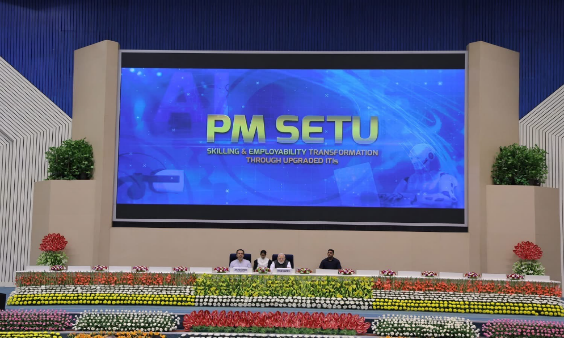
An ITI seat in Jammu has a reputation problem. It is widely treated as the thing you do when a degree did not work out — a certificate at the end, and then the same scramble for work as everyone else.
A scheme cleared on 10 September is aimed squarely at that reputation, and it arrives with a number that a prospective student can actually hold someone to: a 75% institutional placement target.
What was decided, and by whom
The first UT-level steering committee meeting on PM-SETU — the Prime Minister's Skilling and Employability Transformation through Upgraded ITIs scheme — was chaired by Chief Secretary Atal Dulloo on 10 September. Also in the room: the Additional Chief Secretary Finance, the Commissioner Secretary Education, the Secretary Skill Development, the Managing Director of the J&K Skill Development Mission, the Director Skill Development, the Labour Commissioner, and representatives of industry bodies.
The plan they reviewed commits an indicative ₹482 crore to Jammu and Kashmir over five years, to convert 10 government ITIs into what the scheme calls industry-oriented skill institutions.
How the money is split
The ten ITIs are organised into two hub-and-spoke clusters — one hub ITI per administrative division, each anchoring four spoke ITIs. That means one hub for the Jammu division and one for Kashmir.
Per cluster: ₹241 crore
Per hub ITI: roughly ₹81 crore on average
Per spoke ITI: roughly ₹40 crore on average
Where it comes from is the part worth pausing on:
Central government — 74.7%
UT government — 8.3%
Anchor industry partners — 17%
Why that 17% is the real story
Seventeen per cent does not sound like much next to the Centre's three-quarters. But it is not a donation. The scheme is delivered through Special Purpose Vehicles in which the anchor industry partners hold a seat in institutional governance.
In practice, that means the companies putting money in also have a say in which trades are taught, what technology the workshops carry, how training is run and how placement is organised. The syllabus stops being purely a departmental decision.
That is the mechanism behind the placement number. A firm that has paid into a cluster, sits on its governing body and helped choose its trades has an obvious interest in hiring out of it. Whether 75% is achieved is a separate question — but it is at least a target with someone's money behind it, which is not how ITI training in the UT has usually been funded.
Which trades
Five priority sectors are named:
advanced and smart manufacturing;
heavy engineering and automotive;
electricals, electronics and telecom;
process industries and food processing;
textiles, garments, construction and building interiors.
Read that list against the Jammu region's own industrial base — the Bari Brahmana and Samba belt, food processing, construction — and the overlap is not accidental. Several of these map onto sectors that already employ in this region rather than onto sectors a graduate would have to leave the UT to enter.
The plan also provides for incubation facilities at the upgraded institutes and for capacity-building of trainers, which addresses a quieter problem: new machines in a workshop are of limited use if nobody has been trained to teach on them.
The question nobody has answered
Here is what has not been published, and it is the single thing a Jammu reader most wants to know: which ten ITIs, and which one is the Jammu-division hub.
Neither the steering committee's proceedings nor any subsequent statement names them. We are not going to guess. If you are choosing an ITI now, or advising someone who is, that list is the thing to watch for, because the difference between a hub ITI at roughly ₹81 crore and a spoke at roughly ₹40 crore is substantial — and the difference between being in the ten and outside it is larger still.
Who this is genuinely for
PM-SETU is not a scheme you apply to. There is no form here and no deadline. It is a restructuring of institutions, and the way it reaches a student is through which ITI they enrol at and what that ITI can offer by the time they finish.
So it matters most to a specific group: someone aged 16 to 22 in the Jammu region, out of Class 10 or Class 12, weighing an ITI trade against a general degree that may not lead anywhere in particular. For that reader, the honest summary is this — the ITI route in J&K is being given real capital and an industry stake for the first time, the money is indicative and spread over five years, and none of it changes anything at all until the ten institutes are named and the clusters are actually stood up.
What to watch for next
The notification naming the ten ITIs and the two hubs.
Which companies sign on as anchor industry partners, and in which trades.
The first admission cycle that actually offers the upgraded trades.
Whether placement figures get published against that 75% target — a target nobody reports on is not a target.
Sources: The Kashmir Images — PM-SETU to transform J&K's ITIs into industry-ready skill hubs; Kashmir In Depth — ₹482 cr indicative investment in ITIs.
