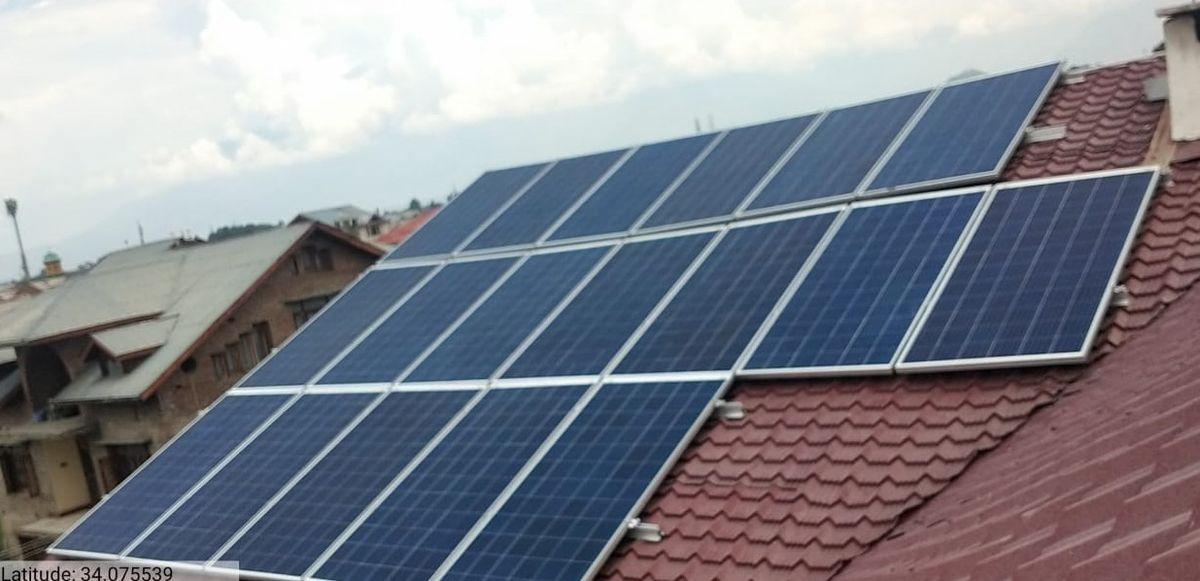
8,673. That is how many electricity consumers in Jammu and Kashmir are now on a zero electricity bill — 4,128 of them on the Jammu side, under JPDCL.
Not a reduced bill. Zero.
They got there through PM Surya Ghar: Muft Bijli Yojana, the central rooftop solar scheme, and the number is worth sitting with for a moment because the household electricity conversation in Jammu this month has been about the September tariff revision — a number families absorb and cannot argue with. Rooftop solar is the one lever on that bill a household actually controls. So it is worth knowing what it costs.
Start with the one number that matters
A 2 kW system — the size that suits a typical household load — benchmarks at roughly ₹1.10 lakh.
Against that:
₹66,000 central assistance
₹6,000 J&K top-up
Leaving roughly ₹38,000 to find yourself
That ₹38,000 is the real figure. It is not nothing — for most young households in Jammu it is a serious sum, and it is the number that decides whether this happens or does not. But it is also roughly a third of the sticker price, and it is the number that almost never appears in coverage of the scheme, which tends to stop at the subsidy percentage.
J&K is treated as a special-category Union Territory, which is why the rate here is ₹33,000 per kWp for the first 2 kWp, against ₹30,000 elsewhere. A household in Jammu gets a slightly better deal on the same panel than a household in most of the country.
How many people have actually done it
Two figures are in circulation, and they are two different cut-off dates rather than a contradiction — worth stating plainly, because they get blended:
40,076 households solarised as of 5 August 2026 (reported to the Rajya Sabha)
40,620 households, 133.40 MW, and ₹307.63 crore in central assistance released as of 12 August 2026
Roughly 500 households in a week, in other words, and the trajectory is upward. J&K's Power Development Department was ranked second nationally on PM Surya Ghar implementation in May 2026.
Where it is meant to go
The UT has sanctioned ₹53.53 crore to support 85,000 residential beneficiaries across 2024-25 to 2026-27. The two utilities are working to a target of 83,500 consumers — 39,500 on JPDCL (the Jammu side) and 44,000 on KPDCL.
Set that against demand: domestic connections in J&K are projected to rise from 23.11 lakh in 2026-27 to 28.10 lakh by 2028-29. Even if every one of those 83,500 targets is met, rooftop solar would sit on well under 4% of J&K's domestic connections. This is a meaningful option for the households that take it. It is not, on current numbers, a solution to the system's supply problem — and it is more honest to say so than to present it as one.
The version for households that cannot find ₹38,000
There is a separate track. Under the Antyodaya component, 2.22 lakh systems have been approved on the RESCO model — where a company owns and installs the system rather than the household buying it — delivering 200 free units a month for 20 years.
The distinction is the ownership. In the subsidy route you own the panels and the surplus is yours. In the RESCO route you own nothing and receive a fixed monthly entitlement. For a household without the upfront capital, the second is the door that is actually open, and it is the one least discussed.
What a young reader should take from this
If you are 22 and living with your family in Jammu, you are not usually the person who decides to spend ₹38,000 on the roof. You are, quite often, the person in the house who can work out whether it is worth it, read the portal, and get the application filed — which is where most of these decisions actually stall.
Three things to check before anyone commits:
Your actual consumption. The economics turn entirely on how many units you use. A household well under 200 units a month has a very different payback period from one running air conditioning through a Jammu summer.
Your roof. Shading, available area and structure decide what can physically be installed, and no subsidy fixes a roof that faces the wrong way or sits under a neighbour's wall.
The vendor. Use the registered vendor list on the national portal rather than a number off a poster. This is the stage where money goes missing.
The application route, the subsidy calculator and the registered-vendor list all sit on the national portal at solarrooftop.pmsuryaghar.gov.in.
Forty thousand households in J&K have already been through it. Whether the forty-thousand-and-first is yours comes down to one question the brochures do not lead with: can your family find ₹38,000, and how many units a month are you actually burning?
