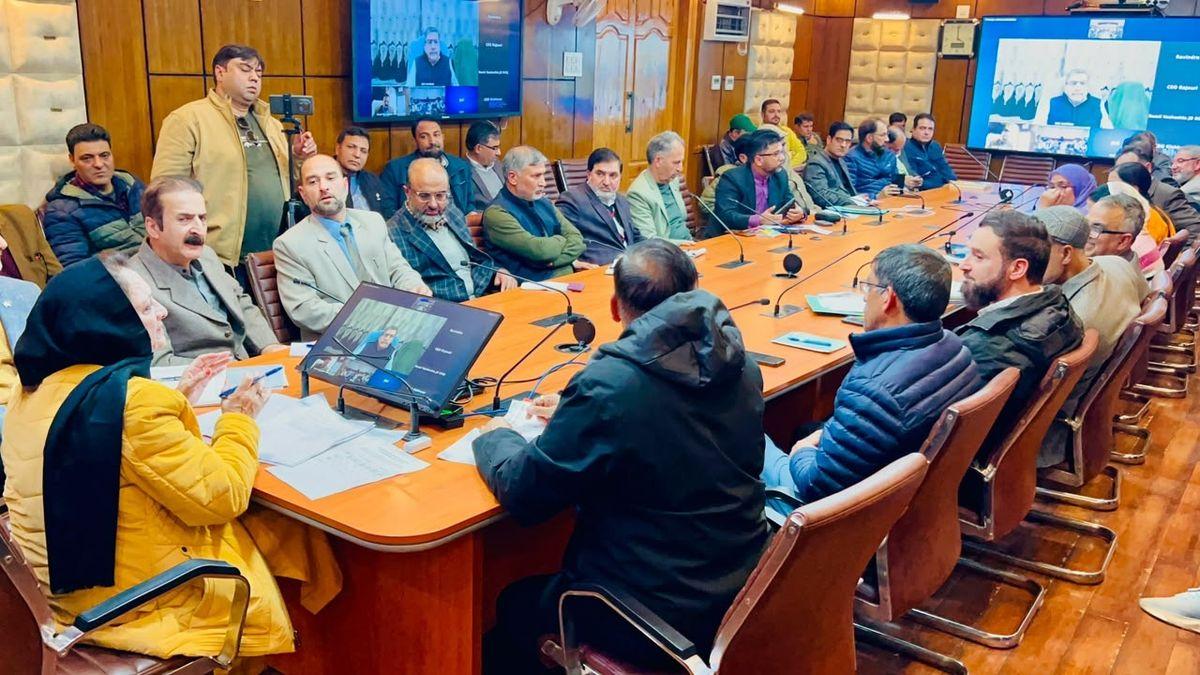
Jammu and Kashmir says it will implement the 25 per cent reservation for economically weaker and disadvantaged children in private schools. The announcement came on 17 November 2026 from Education Minister Shamim Firdous at a review meeting, according to Greater Kashmir. This explainer sets out what was said, what the law provides, and what has not yet been announced.
What was announced
- The government will implement Section 12(1)(c) of the Right of Children to Free and Compulsory Education (RTE) Act, which reserves 25 per cent of entry-level seats in private schools for eligible children.
- The rules for the provision are in the "final stage" of notification. No date has been given.
- The government will reimburse schools for admissible expenditure.
What the law already says
Section 12(1)(c) of the RTE Act, 2009 requires private unaided schools, and specified-category schools, to "admit in class I, to the extent of at least twenty-five per cent. of the strength of that class, children belonging to weaker section and disadvantaged group in the neighbourhood and provide free and compulsory elementary education till its completion." A proviso adds that where a school offers pre-school education, the same admission rule applies to those pre-school classes. That is why reports of the meeting speak of "entry-level" seats rather than naming a class.
The Act also fixes how schools are paid. Under Section 12(2), a school is reimbursed "to the extent of per-child-expenditure incurred by the State, or the actual amount charged from the child, whichever is less". A school that received land, buildings or equipment free or at a concessional rate on condition of educating some children free is not reimbursed for those seats.
Who counts as eligible is left partly to each government. The Act defines a "disadvantaged group" to include children with disabilities and children from the Scheduled Castes, Scheduled Tribes and socially and educationally backward classes, and a "weaker section" as children whose parents' annual income is below a limit the government notifies. The J&K rules will have to set that income limit.
The textbook and shopping rules announced alongside
The same meeting, with School Education Department officers, private school associations, parents' groups and civil society, covered the cost of schooling beyond fees. As reported:
- JKBOSE-affiliated private schools will follow the JKBOSE curriculum and prescribe JKBOSE textbooks aligned with the NCERT syllabus.
- Students should not be burdened with unnecessary supplementary books; schools may use libraries, book banks and e-books instead of "compelling parents to purchase multiple additional books."
- Parents should be free to buy uniforms, books, notebooks and writing materials from vendors of their choice, not only from vendors inside school premises.
- The minister took note of complaints about books being sold at exorbitant prices.
How long this has been pending
The quota is not new on paper. In April 2020 Kashmir Reader reported that private schools were "now legally bound to admit 25 percent students in class 1", quoting the then Principal Secretary of School Education, who said the quota was "being notified for implementation by all schools". In February 2024 Greater Kashmir reported that J&K had "yet to implement Section 12 of the RTE Act in private schools", and in May 2024 Kashmir Observer reported that schools did "not reserve any quota" for poorer students, quoting an unnamed official who said the government was "not ready to reimburse fees to the private schools."
The question also reached the court. On 13 September 2025 Bar & Bench reported that the High Court of J&K and Ladakh had closed a public interest litigation seeking implementation of the RTE Act, pending since 2020, after the government released draft RTE rules. This week's statement says the final rules are now close to notification.
How other places fill these seats
The Act leaves the admission process to the rules, and other governments have chosen a lottery so that schools do not pick children themselves. Delhi's Directorate of Education ran a computerised draw of lots for its EWS and disadvantaged-group seats in nursery, KG and Class 1 in April 2026, Millennium Post reported. Maharashtra allots its 25 per cent seats through a random draw on a state portal, with about 1.15 lakh seats across 8,701 schools this year, according to the Free Press Journal. Whether J&K adopts an online lottery, school-level admission or another method is one of the details its rules have not yet made public.
What is not yet known
The report does not say which income limit or documents will define an eligible child, how admissions to the reserved seats will be allotted, from which academic session the quota applies, or how much schools will be reimbursed. Private schools' and parents' own responses to the announcement are not in the published report, and JammuBeat has not seen them. Until the rules are notified, those details remain open.
Why it matters to young Jammu
For families with children entering Class 1 or nursery, the notified rules will decide whether a private-school seat is open to them without fees. For students and young parents who buy books, the textbook rules would change what a school may ask them to purchase. JammuBeat has earlier covered the fee and book-pricing debate; see J&K Plans an Audit of Private Schools Over Fees.
What to watch, and what you can do now
- The notification itself. Look for the income limit, the documents needed to prove eligibility, the admission method and the academic session the quota starts from.
- The reimbursement figure. The Act ties it to what the government spends per child; how J&K calculates that will shape how schools respond.
- If your family may qualify, keep income, caste or disability certificates current now, so that a short application window does not catch you out once the rules are notified.
We will update this story when the rules are notified.
Source: Greater Kashmir, "J&K to implement 25% reservation for EWS, disadvantaged children in private schools soon: Education Minister", 17 November 2026.
Other reports of the 17 November meeting: Rising Kashmir (whose photograph of the meeting is used above) and Kashmir Observer. The Act: Section 12, RTE Act 2009 (Indian Kanoon); the official text is on India Code. Background: Kashmir Reader, 23 April 2020; Greater Kashmir, 6 February 2024; Kashmir Observer, 18 May 2024; Bar & Bench, September 2025; Millennium Post (Delhi draw); Free Press Journal (Maharashtra lottery).