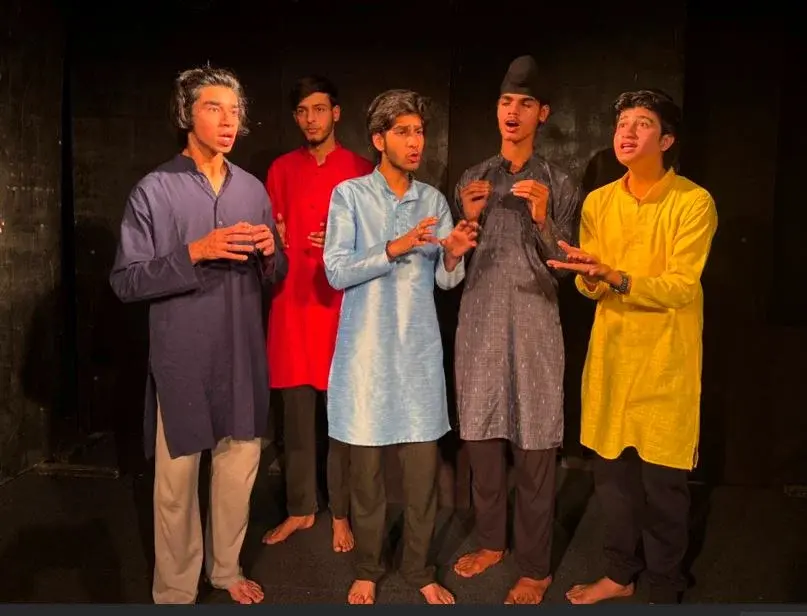
Somewhere in Jammu this Sunday evening, a small crowd will settle onto chairs — or, in this monsoon season, onto the open lawns of Rani Park — the light will drop, and a play will begin. There is no ticket to buy and no queue for a screen. There almost never has been. For 22 years, the theatre group Natrang has staged a live performance in the city nearly every single Sunday, and the streak is still running.
The series is called, simply, Sunday Theatre. In a city where a night out increasingly means a mall multiplex or a phone, it is a quietly radical thing: a weekly, recurring, free-to-all appointment with live drama that has outlasted trends, funding gaps and the odd washed-out evening.
The habit that became an institution
Behind it is Balwant Thakur, one of Indian theatre's most travelled figures, whose productions have been staged and applauded across Asia and Europe. But the real genius of Sunday Theatre isn't the international CV — it's the discipline of showing up. Every Sunday, constraints and all, Natrang's artists put a play in front of an audience. Over two decades, that stubborn regularity has turned a weekly slot into one of J&K's longest-running cultural fixtures, and arguably its most democratic one: anyone can walk in.
The venue moves with the season. Performances run at Natrang's own Studio Theatre and at Abhinav Theatre, and through the summer and monsoon they spill outdoors to Rani Park, where the plays are staged in the open air with the city as a backdrop.
What's actually on stage
This is not museum-piece theatre. The 2026 run alone has moved between registers: AAG, a hard-hitting Hindi play built around the drug menace; the comedy Chor; and, in the spring, an experimental evening of six short stage adaptations driven almost entirely by young performers, directed by Neeraj Kant. Satire, social drama, folk texture and outright comedy all get a Sunday.
That range is deliberate. The series regularly turns its stage toward the issues its audience actually lives with — addiction, unemployment, family pressure — and then, the following week, sends everyone home laughing. It is theatre that argues live drama still has something to say that a screen doesn't.
A stage where young actors are made
Sunday Theatre has long doubled as a workshop and a launchpad. Instead of making new actors wait for a once-a-year festival slot, it hands them real stage time in front of a real, unpredictable audience — the fastest way anyone learns to perform. The spring 2026 youth-talent evening, built around first-time and early-career performers, was Natrang doing exactly what it has done for a generation: using the Sunday slot to grow the next set of Jammu's stage artists.
For a student who has ever thought about acting, direction, stagecraft or writing, that is the door. The people on stage this month were, not long ago, in the audience.
More than a Sunday slot
Natrang is not only a weekly show; it is one of Jammu's most serious cultural institutions, with a studio, a body of original productions, and a reputation that has carried Dogri and Hindi theatre from this city to national and international stages. That matters for what the Sunday series can offer. The plays you see on a Rani Park lawn are made by a group that also mounts full-scale productions and takes its work far beyond Jammu — so the free evening in your neighbourhood is plugged into something much larger than it looks.
It also plays a quiet role in keeping Jammu's own cultural identity on stage. In a media diet dominated by content made elsewhere, a company telling local stories, in local languages, every week, is doing something that no streaming service will do for this city.
Why this is a young person's evening out
For students and young professionals in Jammu, the pitch is almost absurdly good. It is free. It is weekly, so you don't have to catch a rare event — you just have to turn up. And it is participatory in a way a cinema never is: Natrang actively pulls young talent onto its stage, which means the person watching a play this Sunday could be in one a few months from now.
There is also something worth protecting here. Jammu's live-arts calendar leans on a handful of institutions — the mushairas and ghazal evenings at Abhinav, the festivals, and this. Live theatre survives on people in seats, and a 22-year streak carries into a 23rd year only if the audience keeps arriving.
How to catch it
Specific play titles are announced only a few days ahead, so the move is to follow Natrang's own channels for the week's listing and venue — Studio Theatre, Abhinav, or Rani Park in the open-air months. Then do the simplest thing: pick a Sunday, show up, and watch live theatre in your own city for the price of nothing.
Sources: Daily Excelsior · Brighter Kashmir · Bold News