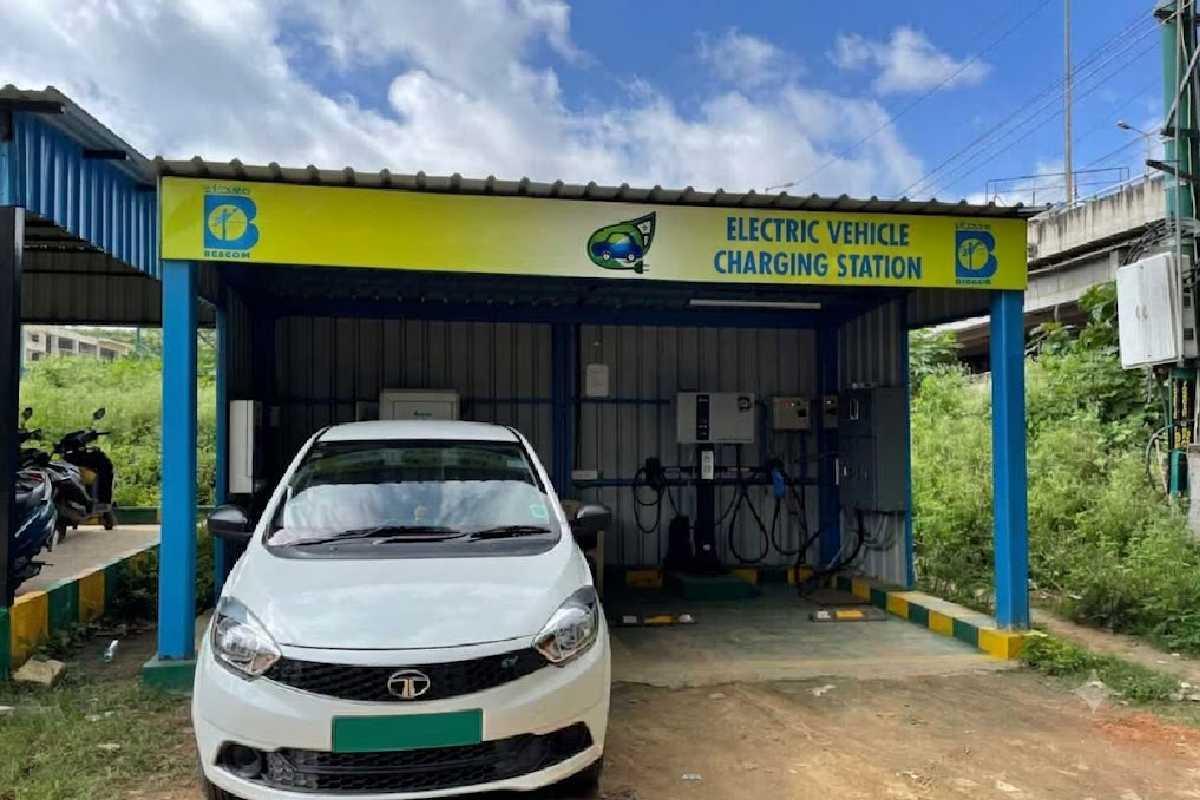
Seventeen. That is how many public EV charging stations have been cleared as technically feasible in Jammu district — the largest share of any district in Jammu and Kashmir, out of 50 sites identified across the Union Territory.
It is the most concrete number to come out of two separate reviews chaired by Chief Secretary Atal Dulloo on Friday. One looked at a draft policy that would run for six years. The other looked at where the chargers actually go. For anyone in Jammu weighing an electric scooter against a petrol one, the second is the more immediately useful of the two.
Where the 50 sites are
Across the Jammu division, the feasible sites break down as 17 in Jammu, five in Kathua, four each in Rajouri and Doda, three in Udhampur, two each in Ramban and Reasi, and one in Samba. The rest are spread across the Kashmir division; reports differ on the exact divisional split, so treat the district figures above as the firm ones.
The same review covered the procurement of 200 electric buses under the Centre's PM E-DRIVE scheme, to be run on a Gross Cost Contract model and procured through Convergence Energy Services Limited. Charging infrastructure has to be in place before those buses can be deployed, which is a large part of why the siting exercise matters.
What the draft policy would actually give you
The Draft Jammu and Kashmir Electric Vehicle Policy 2026 was prepared by the Transport Department with the Centre for Innovation and Transformation in Governance. Its consumer-facing offer is narrower than the headlines suggest, and worth reading precisely:
An interest subvention of up to 3% a year on the vehicle loan, or rolling top-up support — the draft allows one or the other, not both.
An annual scrappage exchange bonus, available for a maximum of three years, if you trade in an old vehicle.
For a student or a first-job buyer financing a two-wheeler, three percentage points off the interest rate is the sort of number that changes the monthly EMI rather than the sticker price. The draft's own adoption target for two-wheelers — 35% of new registrations within six years — is aimed squarely at that buyer.
The targets, and the charging maths behind them
Over six years the draft sets these shares of new registrations: 40% of personal four-wheelers, 35% of two-wheelers, 30% of buses and 25% of taxis and shared-mobility vehicles.
To support that, public charging is meant to go from roughly 180 stations today to 450 by year three and 900 by year six — a fivefold increase. Within that, 140 priority fast-charging hubs would each be held to a monthly uptime target of at least 98%. That uptime clause is the quietly important one: the common complaint about public chargers in India is not that they do not exist but that they do not work when you reach them.
The draft also sets a 40% renewable-energy integration target for charging operations over the policy period.
The winter clause
One provision is specific to this place. The draft carries a Winter Validation Protocol to assess battery thermal behaviour, low-temperature charging acceptance and the effect of cabin heating on range.
Anyone who has watched a phone battery collapse on a January morning in Jammu will recognise the problem. Cold weather reduces both how much charge a battery holds and how fast it will accept a charge — and in the higher belt around Jammu, that is a real constraint on whether an EV works as a daily vehicle, not a theoretical one. Writing a testing protocol into policy is an admission that a scheme designed for the plains does not transfer unchanged to J&K.
What has not happened yet
This is a draft. It is pending legal vetting by the Law Department before it can be finalised, and no approval has been announced. Nor has any public objection or comment window been announced — so if you were hoping to file a view on it, there is currently no stated mechanism to do so.
The departments in the room span Power Development, Finance, Food, Civil Supplies and Consumer Affairs, Housing and Urban Development, Law and Transport, along with the municipal corporations. That breadth is a fair signal of how much has to line up: an EV policy is only partly a transport document, and mostly a power-supply and land-use one.
What to watch
Three things will tell you whether this becomes real. Whether the Law Department clears the draft and a final policy is notified. Whether the 17 Jammu sites move from technically feasible to built. And whether the 98% uptime target survives into the final text — because a charger that is offline is, for a rider stranded at it, the same as a charger that was never installed.
Separately, the same review moved on inland water transport, including a nine-kilometre stretch of the Chenab between Reasi and Akhnoor Fort mapped as a corridor on National Waterway 26, with ten hybrid eco-vessels of 20 seats each due for delivery in March 2027.
Sources: Kashmir Life on the draft EV policy review; Kashmir Images on the same review; Greater Kashmir on the charging-site and PM E-DRIVE review.